
Picture this. You’re running a small e-commerce store in Manchester, or maybe you’re the marketing lead at a mid-sized startup in Austin. Every day, data piles up in front of yousales figures, website clicks, customer emails, social media comments. You know there’s gold buried in there somewhere. You just don’t have the time, the training, or honestly the patience to dig through spreadsheets until 2 a.m. trying to find it.
That was pretty much my situation a few years back, before I got seriously into learning how businesses were using data analytics AI to make decisions that used to take weeks in a matter of hours. I remember sitting with a client whose team was still manually compiling monthly sales reports in Excel, cross-referencing three different systems, and losing half a day every month just to answer the question: “Are we actually growing?”
That’s the world data analytics AI is quietly rewriting. Not with hype, not with buzzwords thrown around in boardrooms, but with real, tangible shifts in how ordinary businesses yours included can understand what’s happening and, more importantly, what to do next.
This guide is written for beginners. No jargon-heavy detours, no assuming you’ve already got a data science degree. Just a clear, honest walkthrough of what AI-driven data analytics actually is, how it connects to business intelligence, and how you can start using it, even if your current “analytics setup” is a folder full of spreadsheets named “Final_v3_actualfinal.xlsx.”
Table of Contents
- What Is AI-Driven Data Analytics, Really
- Why This Matters Now More Than Ever
- Data Analytics AI vs Traditional Analytics
- How Business Intelligence Fits Into the Picture
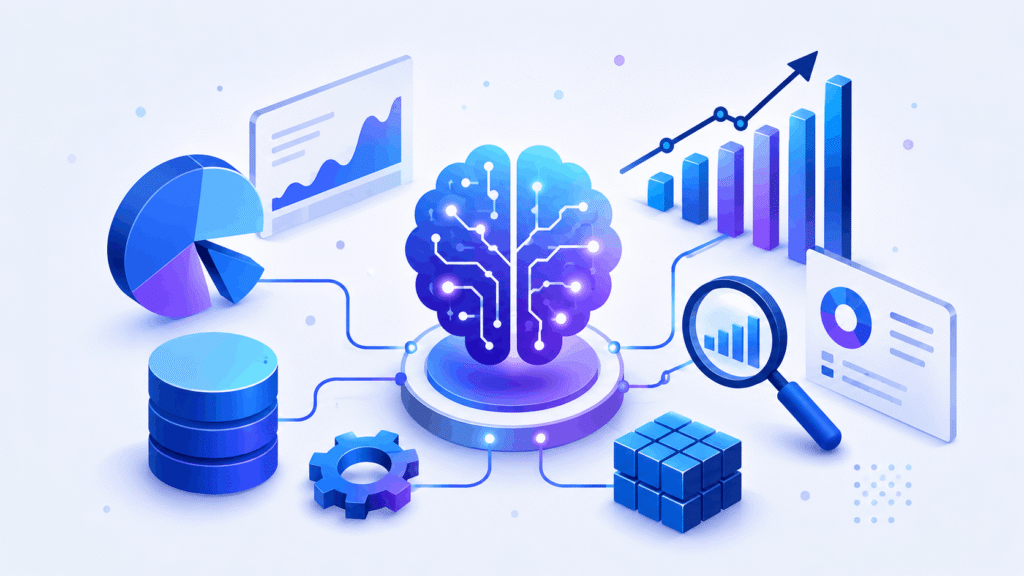
- Core Building Blocks of AI-Driven Analytics
- Real-World Applications Across Industries
- Getting Started: A Beginner’s Roadmap
- Common Mistakes Beginners Make
- Tools Worth Knowing About
- The Human Side of AI-Driven Data Analytics
- What the Future Looks Like
- Final Thoughts
- Frequently Asked Questions
What Is AI-Driven Data Analytics, Really
AI-Driven Data Analytics Let’s strip away the marketing language for a second. AI-driven data analytics is simply the process of using artificial intelligence machine learning models, natural language processing, predictive algorithms to collect, clean, interpret, and act on data faster and more accurately than a human team could manage alone.
Think about the difference between reading a weather report and having a meteorologist who never sleeps, constantly adjusting predictions as new information comes in, and tapping you on the shoulder the moment something important changes. That’s roughly the shift happening in analytics right now. Instead of pulling a report once a month and hoping it’s still relevant by the time anyone reads it, data analytics AI works continuously, flagging patterns, anomalies, and opportunities almost as they happen.
For beginners, the easiest way to think about it is this: traditional analytics tells you what happened. AI-driven analytics tells you what happened, why it likely happened, and what’s probably going to happen next.
Why This Matters Now More Than Ever
Businesses in the US and UK are drowning in more data than at any point in history, and the volume isn’t slowing down. A report from IDC estimated that global data creation would surpass 180 zettabytes by the middle of this decade. Most companies aren’t using anywhere close to the full value of that information, largely because human teams simply can’t process it at scale.
Here’s the uncomfortable truth: businesses that ignore data analytics AI aren’t just missing out on convenience. They’re operating with a fraction of the visibility their competitors have.AI-Driven Data Analytics A retailer using predictive analytics can restock inventory before a shortage hits. A bank can flag fraudulent transactions in milliseconds instead of days. A hospital can predict patient readmission risks before they become costly emergencies.
This isn’t science fiction anymore. It’s Tuesday morning for a growing number of companies.
Data Analytics AI vs Traditional Analytics
I get this question constantly from beginners: “Isn’t this just regular analytics with extra steps?” Fair question. Here’s the honest breakdown.
Traditional analytics relies heavily on human-defined rules. Someone decides what metrics matter, builds a dashboard, and manually digs for insights whenever a question comes up. It’s reactive. It’s also slow, and it tends to only catch what you already knew to look for.
Data analytics AI flips that model. Instead of waiting for a person to ask the right question, machine learning models actively search for patterns across massive datasets, including ones humans wouldn’t think to look for. AI-Driven Data Analytics It can detect a subtle dip in customer satisfaction three weeks before it shows up in your churn numbers. It can notice that customers who browse your site on mobile between 9 and 11 p.m. convert at a completely different rate than everyone else, and adjust marketing accordingly, without anyone manually building that report.
The difference isn’t just speed. It’s depth. AI doesn’t get tired of looking, and it doesn’t have confirmation bias steering it toward the answer it expects to find.
How Business Intelligence Fits Into the Picture
This is where a lot of beginners get confused, so let’s clear it up. Business intelligence and data analytics AI are related, but they’re not identical twins.
Business intelligence, or BI, generally refers to the tools and processes companies use to collect, organize, and visualize data—think dashboards, reports, and KPI trackers. It answers questions like “What were our sales last quarter?” or “Which region underperformed?”
AI-driven analytics builds on top of business intelligence rather than replacing it. Where classic BI shows you the dashboard, AI adds the layer of intelligence that interprets the dashboard for you. AI-Driven Data Analytics Modern business intelligence platforms are increasingly embedding AI directly into their systems, which means the line between the two is blurring fast.
A good way to picture it: BI gives you the map. Data analytics AI gives you a guide who’s already walked the terrain a thousand times and knows exactly where the potholes are.
Companies that combine both tend to see the strongest results. According to a widely cited McKinsey study, organizations that effectively use data-driven decision-making are 23 times more likely to acquire customers and 6 times more likely to retain them compared to competitors that don’t.
Core Building Blocks of AI-Driven Analytics
If you’re just starting out, it helps to understand the moving parts. You don’t need to become an engineer, but knowing the vocabulary will save you a lot of confusion in meetings and vendor pitches.
Data collection is the foundation. This includes everything from website analytics and CRM records to social media engagement and transaction histories. Garbage in, garbage out still applies here, AI or not.
Data cleaning and preparation is the unglamorous but essential step where duplicate entries, missing values, and inconsistencies get sorted out. AI tools have gotten remarkably good at automating this, which used to eat up as much as 80 percent of a data analyst’s time.
Machine learning models are the engines doing the heavy lifting, spotting patterns, making predictions, and improving as they process more data over time.
Natural language processing (NLP) allows systems to understand and generate human language, which is how tools like chatbots and AI-powered reporting assistants can summarize your quarterly performance in plain English instead of a wall of numbers.
Visualization layers turn all of this into something a human brain can actually digest, charts, heatmaps, trend lines, and plain-language summaries.
Put those pieces together, and you’ve got a system that doesn’t just store your data. It actively works for you.
Real-World Applications Across Industries
Theory is fine, but let’s talk about where this actually shows up in day-to-day business life.
Retail and e-commerce. Predictive analytics helps forecast demand, personalize product recommendations, and optimize pricing in real time. Amazon’s recommendation engine, often cited as one of the earliest large-scale examples, reportedly drives a significant share of its total sales.
Healthcare. Hospitals use AI-driven analytics to predict patient risk, optimize staffing schedules, and reduce readmission rates. AI-Driven Data Analytics The NHS in the UK has piloted AI systems to help triage patients and flag early warning signs in diagnostic imaging.
Finance. Banks lean heavily on AI for fraud detection, credit risk scoring, and algorithmic trading. A suspicious transaction can be flagged and blocked in less time than it takes you to read this sentence.
Marketing. Businesses use AI to segment audiences, predict customer lifetime value, and automate ad spend allocation based on what’s actually converting, not just what looks good on a slide.
Manufacturing. Predictive maintenance uses sensor data and machine learning to flag equipment failures before they happen, saving companies enormous amounts in downtime and repair costs.
None of these examples require a Fortune 500 budget anymore. Cloud-based tools have brought this capability down to businesses with a fraction of that scale.
Getting Started: A Beginner’s Roadmap
If all of this sounds exciting but slightly overwhelming, that’s completely normal. Here’s a grounded, step-by-step approach for someone starting from scratch.
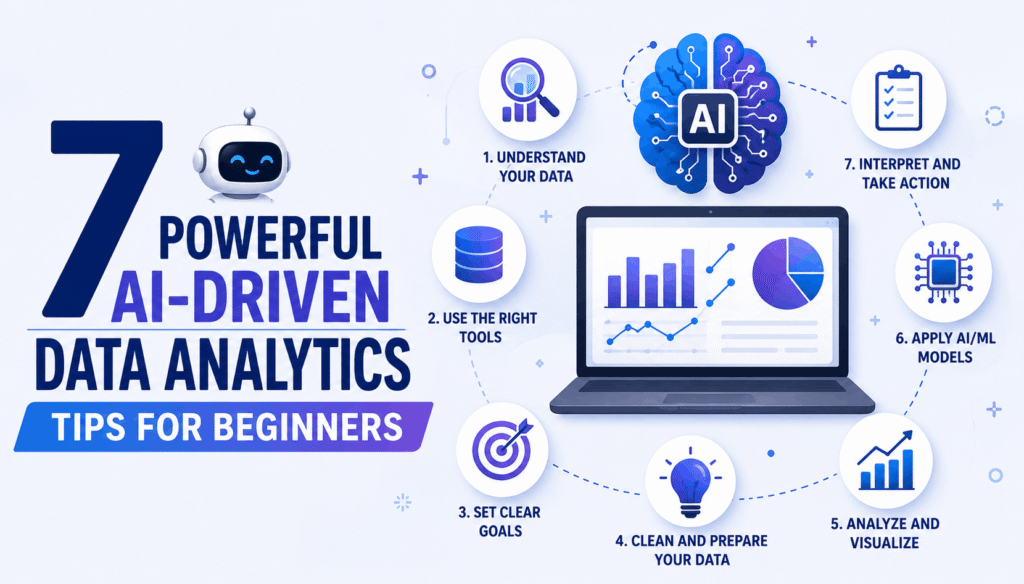
Step one: Get honest about your data. Before touching any AI tool, take stock of what data you actually have. Is it clean? Centralized? Scattered across five different apps that don’t talk to each other? You need to know this before anything else matters.
Step two: Define the actual business question. Don’t start with “let’s use AI.” Start with “we need to know why customers abandon their carts” or “we want to predict next quarter’s revenue.” AI should serve a specific goal, not be the goal itself.
Step three: Start with accessible tools. You don’t need to build a custom machine learning model on day one. Platforms like Microsoft Power BI, Google Looker Studio, and Tableau now offer built-in AI features that are genuinely beginner-friendly.
Step four: Involve your team early. Analytics adoption fails more often because of people problems than technical ones. If your team doesn’t trust or understand the insights, they won’t use them.
Step five: Iterate. Your first dashboard won’t be perfect. Treat it as a living system, not a one-time project.
Common Mistakes Beginners Make
I’ve watched plenty of businesses stumble in the same handful of ways, so let’s name them directly.
Chasing tools before strategy is probably the most common one. Buying an expensive AI analytics platform without a clear question you’re trying to answer is like buying a professional camera and expecting it to make you a photographer.
Ignoring data quality is another big one. AI models trained on messy, biased, or incomplete data will confidently produce misleading conclusions. It won’t announce that it’s wrong. It’ll just be wrong with total confidence.
Over-relying on automation without human judgment causes real damage too. AI can suggest a pattern, but it takes a human to understand context, ethics, and nuance. A model might notice that a certain customer segment converts less often and recommend cutting marketing spend there, without understanding that segment represents your brand’s long-term reputation in a key community.
Finally, expecting instant results trips up a lot of beginners. Meaningful insight from data analytics AI usually builds over weeks and months of consistent use, not overnight.
Tools Worth Knowing About
You don’t need to master every tool on the market, but a working familiarity helps.
Power BI and Tableau remain strong choices for beginners wanting visual, intuitive business intelligence dashboards with AI-assisted insights built in. Google Analytics 4 has leaned heavily into predictive metrics, offering churn probability and revenue predictions out of the box. For teams wanting more advanced, customizable machine learning capability, platforms like DataRobot or Amazon SageMaker offer no-code and low-code options that don’t require a computer science background to get started.
The right tool depends entirely on your goals, your budget, and how technical your team is. Start small, prove value, then scale up.
The Human Side of AI-Driven Data Analytics
Here’s something that doesn’t get said enough. The technology is only half the story. The other half is culture.
I’ve seen companies invest heavily in AI analytics platforms only to watch them collect dust because nobody trusted the output or knew how to translate it into action. And I’ve seen scrappy small teams get remarkable results from basic tools simply because they built a habit of actually looking at their data and asking good questions.
Data analytics AI works best when it augments human judgment rather than replacing it entirely. The businesses seeing the strongest returns tend to be the ones that treat AI as a very capable colleague, not an oracle. It gives you evidence. You still make the call.
What the Future Looks Like
Looking ahead, a few shifts seem almost certain. AI-driven analytics is becoming more conversational, meaning you’ll increasingly be able to simply ask your dashboard a question in plain English and get an immediate answer, rather than digging through filters and pivot tables yourself.
Real-time analytics will keep expanding, moving businesses away from monthly reports toward continuous, living dashboards that update the moment new data arrives. And smaller businesses will keep gaining access to capabilities that used to be exclusive to large enterprises, as cloud-based AI tools continue dropping in cost and complexity.
The gap between companies that use data well and those that don’t isn’t going to shrink. If anything, it’s widening. Getting comfortable with the basics now puts you ahead of that curve rather than scrambling to catch up later.
Final Thoughts
If there’s one thing worth taking away from all this, it’s that AI-driven data analytics isn’t some distant, futuristic concept reserved for tech giants with unlimited budgets. It’s a practical, increasingly accessible way to understand your business more clearly and make decisions with genuine confidence instead of gut instinct alone.
You don’t need to become a data scientist. You need to get curious about your own numbers, pick a tool that matches where you actually are right now, and commit to building the habit of asking your data good questions. Start small. Ask one clear question. Let the data, and the AI helping you read it, do the rest.
The businesses that figure this out early aren’t necessarily the biggest or the best funded. They’re simply the ones willing to start.
FAQ
Is AI-driven data analytics only for large companies? No. Cloud-based tools have made this technology genuinely accessible to small and mid-sized businesses. Many platforms offer free or low-cost tiers that include AI-powered features.
Do I need coding skills to get started? Not necessarily. Many modern business intelligence platforms offer no-code or low-code interfaces designed specifically for beginners.
How is business intelligence different from data analytics AI? Business intelligence focuses on organizing and visualizing data, while AI-driven analytics adds predictive and interpretive capabilities on top of that foundation, often working together in the same platform.
What’s the biggest mistake beginners make? Jumping straight into tools without first defining a clear business question. Strategy should always come before technology.
How long before I see real results? Most businesses start noticing meaningful patterns within a few weeks of consistent use, though deeper insights typically build over several months.
Can AI-driven analytics replace human analysts entirely? Not really, at least not yet. AI is best used to support human judgment, handling the heavy data processing while people provide context, ethics, and strategic decision-making.
What industries benefit most from this technology? Retail, healthcare, finance, and manufacturing have seen some of the most measurable gains, though virtually every industry can benefit from better data visibility.
Read About AI Customer Service Chatbots