
AI Bias and Fairness A few years ago, a friend of mine applied for a credit limit increase through her bank’s app. Her husband, with a nearly identical income and credit history, applied the same week and got approved for a limit twenty times higher than hers. Same bank. Same zip code. Same financial picture, more or less. When she called to ask why, nobody could give her a straight answer, because nobody at the bank could fully explain how the algorithm had made its decision.
That story isn’t unusual anymore. It’s becoming one of the defining tensions of our time. We’ve handed enormous decision-making power to systems that can process millions of data points in seconds, and in doing so, we’ve also handed them the ability to replicate, and sometimes amplify, the same prejudices that have always existed in human institutions. This is the uncomfortable reality behind AI bias, and it’s a conversation that businesses, developers, and everyday consumers in the US and UK can no longer afford to sit out.
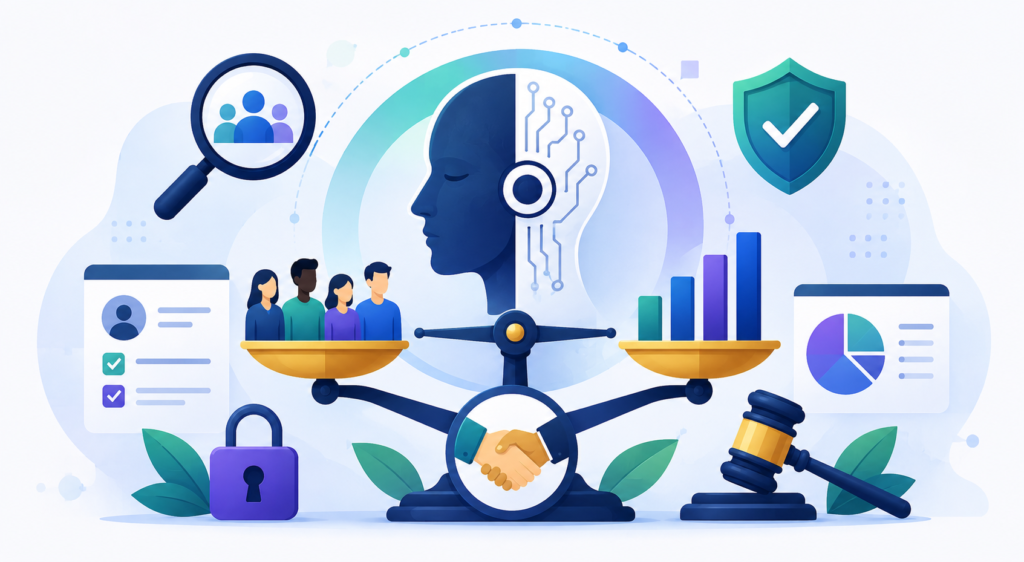
This article isn’t here to scare you away from artificial intelligence. It’s here to help you actually understand what AI Bias and Fairness looks like, why it happens, and what building genuinely ethical AI requires, whether you’re a business leader deploying these tools or simply someone trying to make sense of the systems increasingly shaping your daily life.
Table of Contents
- What AI Bias Actually Means
- Why This Conversation Matters Right Now
- How AI Bias Creeps Into Systems
- Real World Cases That Changed the Conversation
- The Difference Between Bias and Fairness
- Building Toward Ethical AI
- What Businesses Can Do Right Now
- The Role of Regulation in the US and UK
- Common Misconceptions About AI Bias
- Tools and Frameworks Worth Knowing
- The Human Responsibility Behind the Machine
- Where This Is Heading
- Final Thoughts
- Frequently Asked Questions
What AI Bias Actually Means AI Bias and Fairness
Let’s start with a plain definition, because this term gets thrown around loosely. AI bias refers to systematic and unfair discrimination that emerges in the outputs of an artificial intelligence system, usually because of patterns baked into the data it was trained on, the way it was designed, or the assumptions of the people who built it.
It’s important to understand something upfront: AI doesn’t “decide” to be prejudiced the way a person might. It has no intentions at all. What it does is learn patterns from historical data, and if that data reflects decades of unequal treatment, whether in lending, hiring, policing, or healthcare, the algorithm will often learn those same patterns and repeat them at scale, just faster and with a false sense of objectivity attached.
That last part is what makes AI bias particularly dangerous. A biased loan officer might be challenged, questioned, retrained. A biased algorithm gets treated as neutral simply because it’s a machine, which makes its errors harder to spot and even harder to contest.
Why This Conversation Matters Right Now
AI systems aren’t confined to tech companies anymore. They’re screening job applications, approving or denying mortgages, flagging medical conditions, setting insurance premiums, and even influencing sentencing recommendations in some US courts. When these systems carry hidden bias, the consequences aren’t abstract. They show up as a qualified candidate never getting an interview, a patient’s symptoms being under-prioritized, or a family being charged a higher interest rate than their neighbors for reasons that have nothing to do with their actual creditworthiness.
A study from the National Institute of Standards and Technology & AI Bias and Fairness examined over 100 facial recognition algorithms and found that many produced significantly higher error rates when identifying Black and Asian faces compared to white faces, in some cases by a factor of 10 to 100 times. That’s not a rounding error. That’s a system making high-stakes identification decisions with wildly uneven accuracy depending on someone’s race.
This is why ethical AI has moved from a niche academic concern into boardroom conversations, government hearings, and consumer trust surveys. People are starting to ask the right question: who is this system actually working for?
How AI Bias Creeps Into Systems
Understanding how AI Bias and Fairness forms is genuinely useful, because it stops feeling like some mysterious flaw and starts looking like a series of specific, identifiable failure points.
Historical data bias happens when training data reflects past discrimination. If a company historically hired mostly men for engineering roles, an AI trained on that hiring history will likely learn to favor male candidates, even if nobody explicitly programmed it to.
Sampling bias occurs when the data used to train a model doesn’t represent the full population it will eventually be used on. A healthcare algorithm trained primarily on data from one demographic group may perform poorly when applied to patients outside that group.
Label bias creeps in through the human judgments used to categorize training data. If the people labeling data carry their own unconscious assumptions, those assumptions get absorbed into the model.
Measurement bias shows up when the proxy used to represent something isn’t actually a fair stand-in for it. A well-documented example involved a US healthcare algorithm that used prior healthcare spending as a proxy for medical need, without accounting for the fact that Black patients historically had less access to care and therefore lower recorded spending, despite often needing equal or greater care.
Deployment bias happens when a system built for one context gets applied somewhere it was never designed for, without proper recalibration.
Each of these failure points can exist independently, but more often than not, several stack together, which is exactly why AI bias tends to be so persistent and so difficult to fully eliminate.
Real World Cases That Changed the Conversation
Sometimes abstract explanations don’t land the way real examples do, so let’s look at a few cases that reshaped how seriously this issue gets taken.
In 2018, Amazon scrapped an internal AI recruiting tool after discovering it was systematically downgrading resumes that included the word “women’s,” as in “women’s chess club captain,” because the model had been trained on ten years of resumes submitted mostly by men. The system had essentially taught itself that male candidates were preferable, not because anyone instructed it to, but because that’s what the historical data implied.
In the criminal justice system, a widely investigated risk-assessment tool called COMPAS, used in several US courts to help predict the likelihood of reoffending, was found by independent journalists at ProPublica to flag Black defendants as future criminals at nearly twice the rate of white defendants, even when they did not go on to reoffend. AI Bias and Fairness The tool’s developers disputed some of the analysis, and the debate over how to properly measure fairness in that case is still cited in academic literature today, but the case became a defining example of how opaque algorithmic decision-making can quietly reinforce systemic inequality.
In the UK, a 2020 controversy erupted when an algorithm used to standardize A-level exam results during the pandemic disproportionately downgraded high-achieving students from lower-income schools, based heavily on the historical performance of their school rather than their individual academic record. Public backlash was intense enough that the government reversed the decision within days.
These aren’t edge cases from a decade ago. They’re recent, well-documented reminders that AI bias isn’t a theoretical risk. It’s an operational one, with real consequences for real people.
The Difference Between Bias and Fairness
Here’s something that trips up a lot of people new to this topic: fairness isn’t one single, universally agreed-upon definition. That’s part of what makes solving AI bias so genuinely hard, even for well-intentioned teams.
There are several competing mathematical definitions of fairness, and here’s the uncomfortable part: it’s often mathematically impossible to satisfy all of them simultaneously. A model can be calibrated to treat groups equally in one statistical sense while failing to treat them equally in another. AI Bias and Fairness This isn’t a flaw in the math. It’s a reflection of the fact that fairness is fundamentally a human and philosophical question, not purely a technical one.
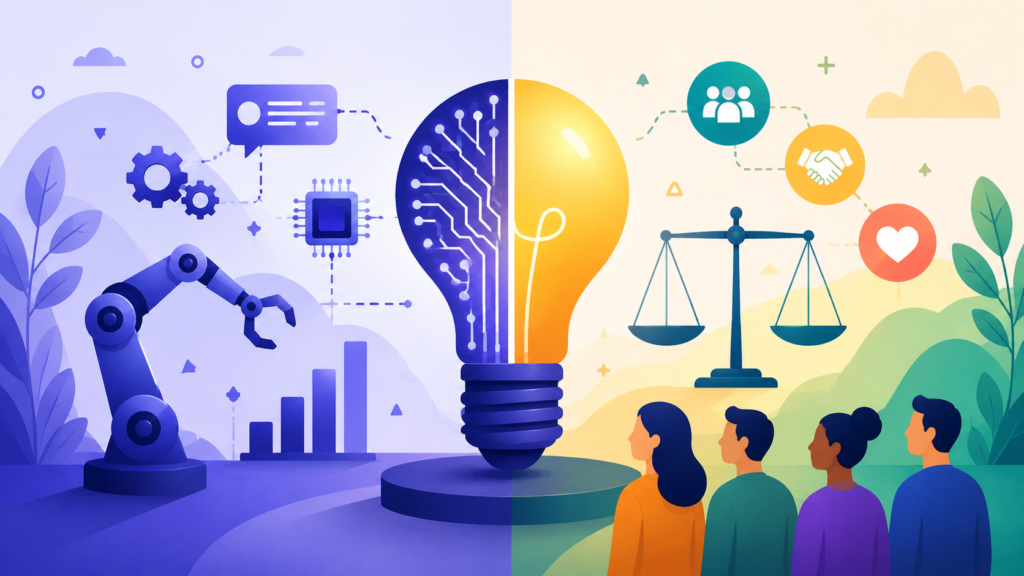
This is exactly why building ethical AI requires more than a checklist. It requires ongoing judgment calls about which type of fairness matters most in a given context, and those calls should never be left entirely to engineers working in isolation.
Building Toward Ethical AI
So what does ethical AI Bias and Fairness actually look like in practice, beyond the buzzword? A few principles tend to show up consistently across serious frameworks.
Transparency matters enormously. People affected by algorithmic decisions deserve to understand, in plain language, how those decisions were made and what factors influenced them. A black box explanation of “the algorithm decided” isn’t acceptable when someone’s mortgage, job, or medical treatment is on the line.
Accountability has to be built in from the start, not bolted on after a scandal. That means having clear ownership over model decisions, documented testing processes, and a real path for people to challenge or appeal outcomes they believe are unfair.
Diverse development teams consistently produce better outcomes. When the people building and testing a system come from a narrow set of backgrounds, blind spots multiply. Teams with varied life experiences are simply more likely to catch problems before they reach the public.
Continuous auditing matters because bias isn’t a one-time bug you fix and forget. Models drift as real-world data changes, and periodic fairness testing needs to be part of a system’s entire lifecycle, not a single pre-launch checkbox.
What Businesses Can Do Right Now
If you’re running a business and using AI in any decision-making capacity, whether that’s hiring, lending, marketing segmentation, or customer service, there are concrete steps worth taking immediately.
Start by auditing your training data for representation gaps. Ask honestly whether the historical data reflects the population you’re actually serving today, or whether it reflects who was served in the past.
Bring in outside perspective. Internal teams often can’t see their own blind spots. Independent fairness audits, even informal ones, tend to surface issues that get missed internally.
Document your decision logic. If your AI system denies someone a loan or rejects a job application, you should be able to explain why in terms a non-technical person can understand.
Build a human review process for high-stakes decisions.AI Bias and Fairness AI can assist decision-making, but final judgment on anything with serious life consequences, employment, healthcare, credit, housing, should retain meaningful human oversight.
Train your teams. Everyone from data scientists to customer service reps should understand the basics of how AI Bias and Fairness forms and what to do if a customer raises a legitimate concern about unfair treatment.
The Role of Regulation in the US and UK
Regulators on both sides of the Atlantic have started catching up, though the pace and approach differ.
In the UK, the Information Commissioner’s Office has issued detailed guidance on AI and data protection, and the broader regulatory approach leans on existing frameworks like the UK GDPR alongside sector-specific guidance rather than one sweeping AI law, at least for now.
In the US, there isn’t yet a single comprehensive federal AI law, but momentum is building. The White House released a Blueprint for an AI Bill of Rights outlining principles around algorithmic discrimination protections, and several states, including Colorado and Illinois, have passed their own AI-specific legislation targeting things like biometric data use and automated employment decision tools. New York City now requires companies using automated hiring tools to conduct independent bias audits and publish the results.
The direction is clear even if the specifics are still evolving. Regulators increasingly expect businesses to proactively demonstrate that their AI systems don’t produce discriminatory outcomes, rather than waiting for harm to occur and dealing with it after the fact.
Common Misconceptions About AI Bias
A few myths tend to circulate, and clearing them up helps set realistic expectations.
“More data automatically fixes bias.” Not necessarily. More biased data just produces a more confidently biased model. Quality and representativeness matter far more than raw volume.
“Removing sensitive attributes like race or gender solves the problem.” This is a common but flawed assumption. Algorithms can often infer these attributes indirectly through proxies like zip code, name, or shopping history, a phenomenon researchers call proxy discrimination.
“AI Bias and Fairness is a technical problem for engineers to solve alone.” In reality, addressing it requires input from ethicists, legal experts, affected communities, and business leaders, not just the people writing the code.
“Bias-free AI is achievable.” Given the competing definitions of fairness discussed earlier, a perfectly unbiased system is more of an ongoing commitment than a finished destination.
Tools and Frameworks Worth Knowing
For those wanting to go deeper, several open frameworks have emerged to help teams evaluate and reduce bias. IBM’s AI Fairness 360 toolkit offers open-source metrics and mitigation algorithms usable across various industries. Google’s What-If Tool allows teams to visually probe how a model’s predictions change across different demographic slices without writing extensive code. Microsoft’s Fairlearn toolkit focuses specifically on assessing and improving fairness in machine learning models.
None of these tools solve the problem automatically. They’re instruments that help surface issues a human team still has to interpret and act on, which circles back to a theme that shows up throughout this entire topic: technology alone was never going to fix this.
The Human Responsibility Behind the Machine
It’s tempting to talk about AI bias as though it’s purely a technical glitch waiting for a technical patch. But that framing lets everyone off the hook a little too easily. These systems are trained on human history, built by human teams, and deployed within human institutions that already carry their own inequalities.
Ethical AI Bias and Fairness isn’t a feature you switch on. It’s closer to an ongoing discipline, similar to workplace safety or financial compliance, something that requires continuous attention rather than a one-time certification. The organizations getting this right tend to treat fairness testing the same way they treat security testing: not optional, not an afterthought, but a standard part of doing responsible business.
Where This Is Heading
A few trends seem likely to shape the next several years. Expect regulatory pressure to keep intensifying, particularly around high-stakes uses like hiring, lending, and healthcare. Expect third-party algorithmic auditing to become a standard business practice, similar to how financial audits became routine decades ago. And expect public awareness to keep growing, meaning customers and employees will increasingly ask hard questions about how automated decisions affecting them were actually made.
Companies that get ahead of this now, building transparent, well-tested, genuinely fair systems, will likely find themselves with a real competitive advantage, not just fewer legal headaches. Trust,AI Bias and Fairness once it becomes a differentiator, tends to be difficult for competitors to quickly replicate.
Final Thoughts
AI Bias and Fairness isn’t a distant, abstract risk confined to research papers. It’s already shaping who gets hired, who gets approved for a loan, who gets flagged by a facial recognition system, and who gets the benefit of the doubt in a healthcare setting. Recognizing that is the first step. Building genuinely ethical AI Bias and Fairness , systems that are transparent, accountable, regularly audited, and grounded in real human oversight, is the ongoing work that follows.
If you take one thing away from this, let it be this: fairness in AI Bias and Fairness isn’t something you achieve once and move on from. It’s something you keep choosing to prioritize, decision by decision, audit by audit, system by system. Start by asking hard questions about the tools your own organization already uses. That single habit, more than any framework or toolkit, is what actually moves this forward.
FAQ
What causes AI bias in the first place? It typically stems from biased training data, flawed labeling processes, unrepresentative sampling, or applying a model outside the context it was originally designed for.
Can AI bias be completely eliminated? Realistically, no. Because fairness has multiple competing definitions, bias is better managed through continuous monitoring and mitigation rather than treated as a problem with a single permanent fix.
Is AI bias illegal? Not automatically, but outcomes caused by biased systems, like discriminatory hiring or lending decisions, can violate existing anti-discrimination laws in both the US and UK, regardless of whether a human or an algorithm made the decision.
How can a business detect bias in its own AI systems? Regular AI Bias and Fairness audits, diverse testing datasets, and third-party reviews are the most effective ways to catch issues before they cause real-world harm.
Does removing race or gender from a dataset prevent bias? Not reliably. Algorithms can infer these characteristics through related data points, a problem often referred to as proxy discrimination.
What industries are most affected by AI bias concerns? Hiring, lending, healthcare, insurance, and criminal justice tend to draw the most scrutiny, since decisions in these areas carry significant real-world consequences.
What’s the first step a company should take toward ethical AI? Start with an honest audit of your training data and decision-making processes, then bring in outside perspective to catch blind spots internal teams are likely to miss.
Read About AI Customer Service Chatbots