
Picture this: you’re scrolling through your phone, you snap a photo of a broken kitchen faucet, type “why is this leaking,” and then record a ten-second video of the drip pattern.
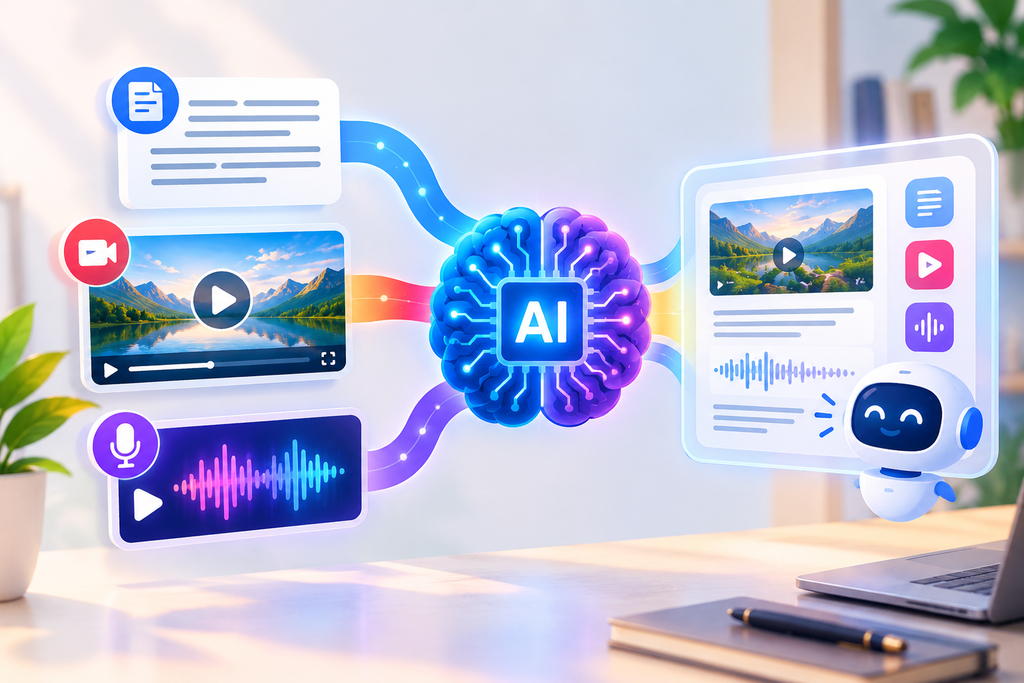
A few seconds later, you get back a coherent answer that references what it saw in the video, what it read in your question, and even picks up on the sound of the water hitting metal. That’s not science fiction anymore. That’s multimodal AI quietly working behind the scenes, and it’s changing how we interact with machines in ways most people haven’t fully clocked yet. For years, AI systems lived in silos. One model read text. Another looked at images.
A separate one transcribed audio. You’d have to stitch the outputs together yourself, like translating between three people who don’t speak each other’s language. That era is ending. Today’s multimodal AI models are built to understand text, video, and audio at the same time, inside the same “brain,” using the same reasoning process. This shift is arguably one of the most underrated leaps in AI development over the last few years, and it’s worth understanding not just how it works, but why it matters to anyone who uses technology day to day, whether you’re in Manchester, Minneapolis, or anywhere in between.
Table of Contents
- What Is Multimodal AI, Really?
- The Old Problem: AI That Could Only “Sense” One Thing at a Time
- How Multimodal AI Models Actually Combine Text, Video, and Audio
- Cross-Modal Machine Learning: The Engine Room Nobody Talks About
- Walking Through a Real Query, Step by Step
- Why This Actually Matters (Beyond the Hype)
- The Hard Problems Multimodal AI Still Hasn’t Solved
- Where Multimodal AI Is Headed Next
- Frequently Asked Questions
- Final Thoughts
What Is Multimodal AI, Really?
Let’s start simple. When people say multimodal AI, they mean an artificial intelligence system capable of processing more than one type of input, and often more than one type of output, at once. Think of “modes” as different senses. Text is one mode. Images are another. Video adds motion. Audio adds sound and tone. A multimodal AI system isn’t just running three separate programs side by side and mashing the results together at the end. It’s genuinely learning relationships between these different types of information, the same way a human brain connects the sight of a dog barking with the sound it makes and the word “bark” you might use to describe it. That connection matters more than it sounds. If you show a toddler a video of a dog barking while saying the word “dog,” they start linking the visual, the sound, and the label together automatically.
That’s essentially what researchers are trying to replicate at scale with multimodal AI models, except instead of one child learning over years, it’s a neural network processing millions of examples in a fraction of the time. The difference between old-school AI and modern multimodal AI comes down to this: older systems processed one input type through one specialized pipeline. A newer multimodal AI system uses shared internal representations, meaning the “understanding” of a cat sitting on a windowsill looks similar internally whether that information came from a photo, a video clip, a spoken description, or written text. That shared understanding is the whole point.
The Old Problem: AI That Could Only “Sense” One Thing at a Time
Before we get too deep into how this works, it helps to understand what came before, because the contrast makes the innovation click. A few years back, if you wanted an AI to describe an image, you used a computer vision model trained specifically on labeled photos. If you wanted an AI to transcribe speech, you used a completely different model trained on audio waveforms. If you wanted it to write or summarize text, that was yet another separate system, usually a language model with zero awareness of images or sound. These systems didn’t talk to each other.
They couldn’t. It’s a bit like hiring three brilliant specialists who’ve never met, don’t speak the same language, and only communicate through sticky notes passed under a door. You’d get individually impressive results, but nothing cohesive. Ask an image-only model what a barking dog sounds like, and it simply couldn’t answer, because sound wasn’t part of its world. This siloed approach created obvious friction for real applications. Customer support tools couldn’t watch a video a customer uploaded and read their complaint at the same time. Medical imaging software couldn’t cross-reference a scan with a doctor’s spoken notes. Video platforms struggled to understand context that spanned both what was shown on screen and what was said in the audio track. Every workaround required duct-taping separate systems together, and duct tape, as anyone who’s used it, eventually fails under pressure. The rise of true multimodal AI solved this by fundamentally rethinking the architecture from the ground up rather than gluing separate tools together after the fact.
How Multimodal AI Models Actually Combine Text, Video, and Audio
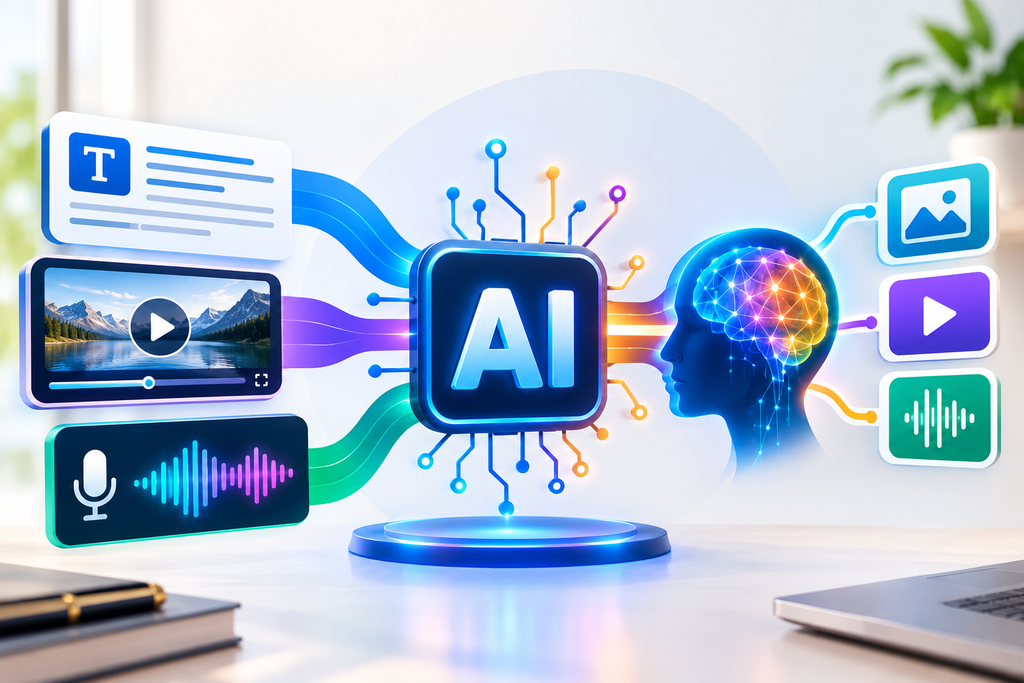
This is where things get genuinely interesting, and I’ll try to explain it without turning this into a computer science lecture. At the heart of most modern multimodal AI models is a concept called a shared embedding space. An embedding is essentially a way of turning any piece of information, whether it’s a word, a video frame, or a sound clip, into a long list of numbers that captures its meaning. The genius move in multimodal AI design is training the system so that related concepts end up close together in this numerical space, regardless of which “mode” they originated from. So the embedding for the written word “ocean waves,” the embedding for a video clip showing waves crashing, and the embedding for the audio of waves rolling onto sand all end up sitting near each other mathematically.
The model has essentially learned that these three completely different data types are describing the same underlying concept. Getting there requires a specific kind of training. Researchers feed the system enormous amounts of paired data, video with matching audio and captions, images with descriptive text, spoken sentences paired with their transcriptions, and the model gradually learns which combinations belong together and which don’t. Over millions of examples, patterns emerge that no human explicitly programmed. The architecture typically involves separate “encoder” components for each input type at first. A text encoder processes language. A vision encoder processes frames from video or static images. An audio encoder processes sound waves. Each does its specialized job of converting raw input into that shared numerical format. Then comes the part that makes multimodal AI actually multimodal rather than just three models bolted together: a fusion mechanism, often using something called cross-attention, allows information from each encoder to inform and adjust the others in real time. This is genuinely different from older approaches, and it’s why modern multimodal AI models feel so much more coherent when you interact with them.
Cross-Modal Machine Learning: The Engine Room Nobody Talks About
If shared embeddings are the destination, cross-modal machine learning is the journey that gets you there, and honestly, it deserves way more attention than it usually gets in casual conversations about AI. Cross-modal learning refers to the specific training techniques that teach a model to transfer understanding from one type of data to another. Here’s a concrete way to think about it. Suppose a model has seen thousands of videos of people cooking pasta, each with audio of sizzling oil and spoken narration. Through cross-modal machine learning, the system starts to associate the visual of bubbling water, the sound of a rolling boil, and the phrase “bring to a boil” as related concepts, even without anyone manually labeling each connection. This is fundamentally different from traditional supervised learning, where you’d need someone to sit down and label “this is boiling water” on every single frame. Instead, cross-modal training often uses a technique called contrastive learning, where the model is shown matching pairs (a video clip and its correct caption) alongside mismatched pairs (that same video clip with an unrelated caption), and it learns to pull the correct pairs closer together in that shared embedding space while pushing incorrect pairs further apart.
Do this across billions of examples, and the model develops a genuinely rich, generalized understanding of how concepts manifest differently across text, video, and audio. One thing that makes cross-modal machine learning particularly powerful is something researchers call “transfer of knowledge between modalities.” If a model has learned extensively about visual textures from images, and separately learned a lot about descriptive language from text, cross-modal training lets it transfer some of that visual knowledge into how it interprets written descriptions of textures, even in cases it hasn’t seen paired examples for. It’s a bit like how someone who’s studied both music theory and physics might suddenly understand sound waves more intuitively than someone who only studied one or the other. The knowledge from each domain reinforces and enriches the other. This is precisely why a well-trained multimodal AI system can often make surprisingly accurate guesses about things it wasn’t explicitly trained on. It’s borrowing patterns from adjacent modalities and applying them creatively.
Walking Through a Real Query, Step by Step
Let’s make this less abstract with an actual walkthrough, because theory only gets you so far. Imagine you upload a fifteen-second video of your dog limping, along with the text question “does this look like it’s hurting its back leg or its paw.” Here’s roughly what happens inside a modern multimodal AI system.
First, the video gets broken down into a sequence of frames, and the audio track (if there’s barking or whimpering) gets separated out and processed through the audio encoder. Simultaneously, your typed question runs through the text encoder. Each of these encoders converts their respective input into that shared numerical embedding space discussed earlier. Next comes the fusion stage. The system doesn’t just process these three streams independently and staple the results together at the end. Through cross-attention layers, the model actively cross-references what it’s “seeing” in the video frames (the angle of the leg, the gait pattern, weight distribution) against what it’s “hearing” in any audio cues, against what you’ve literally asked in text.
If the video shows the dog favoring its left rear leg and there’s a slight whimper on certain steps, the model integrates all three signals into one unified understanding before generating a response. Then it produces output, typically as text, describing what it observed: something like noting the dog appears to be favoring its back left leg based on the walking pattern, and recommending a vet visit if it persists. What’s remarkable here isn’t any single step. It’s that all three modalities inform each other throughout the process rather than being handled in isolated silos and combined only at the very end. This is the practical payoff of cross-modal machine learning, and it’s the reason multimodal AI feels less like “three tools stitched together” and more like a single coherent system reasoning across everything it perceives.
Why This Actually Matters (Beyond the Hype)
It’s easy to get lost in technical descriptions and lose sight of why any of this matters to a regular person reading a blog post over their morning coffee. So let’s ground this in real impact. Multimodal AI is quietly reshaping entire industries because it removes a barrier that’s existed since the earliest days of computing: machines needing you to translate the world into their preferred format before they could help you. Consider healthcare. A radiologist reviewing a scan can now use multimodal AI models that simultaneously analyze the imaging data, cross-reference it against the patient’s written medical history, and even factor in a recorded verbal consultation, flagging inconsistencies a human might miss when reviewing each piece separately. Consider accessibility. Someone with visual impairments can point their phone camera at a busy street, and a multimodal AI system can describe what’s happening visually while also processing ambient sound (approaching traffic, a crosswalk signal beeping) to give a genuinely useful, situationally aware description rather than a flat, context-free caption.
Consider content moderation on video platforms. Instead of separately checking whether the visuals violate guidelines and whether the audio track contains problematic language, a unified multimodal AI system evaluates both together, catching context that would be missed if you only looked at frames or only listened to audio in isolation. A video showing a peaceful cooking demonstration paired with mocking, offensive audio commentary is only obviously problematic when you consider both modes together. Consider customer service. Someone can send in a video of a malfunctioning product along with a written description of the issue, and support teams using multimodal AI models can get an accurate diagnosis far faster than sorting through a support ticket and a separately uploaded video as disconnected pieces of evidence. Consider education. Students learning a new language benefit enormously from systems that can watch a video, listen to pronunciation, and read accompanying text simultaneously, correcting nuances in a way that isolated text-only tutoring never could. None of these examples are hypothetical anymore. They’re actively being built and deployed, and the pace is accelerating because the underlying cross-modal machine learning techniques keep improving year over year.
The Hard Problems Multimodal AI Still Hasn’t Solved
I’d be doing you a disservice if I painted this as a solved problem with no rough edges, because it absolutely isn’t. Building genuinely reliable multimodal AI remains one of the harder challenges in machine learning, and it’s worth being honest about where the friction still lives. Data alignment is a persistent headache. Training these systems requires massive amounts of paired data, videos with accurate captions, audio with correct transcriptions, images with meaningful descriptions, and a lot of publicly available data is messy, mislabeled, or simply doesn’t exist in the volume needed for certain languages, dialects, or cultural contexts. This creates real gaps. A multimodal AI system trained overwhelmingly on English-language, Western-context video and text data will understandably struggle more with content from underrepresented regions or languages, simply because it hasn’t seen enough examples to build the same depth of cross-modal understanding.
Computational cost is another genuine constraint. Processing video and audio alongside text requires dramatically more computing power than text alone. A single video might contain thousands of frames, each needing analysis, plus a continuous audio stream, plus the text context. This is expensive, both financially and environmentally, and it’s part of why truly capable multimodal AI models have historically been the domain of large, well-resourced labs rather than something any small team could easily build from scratch. Then there’s the trickier issue of modality imbalance during reasoning. Sometimes a model will lean too heavily on one input type and effectively ignore useful information from another. If the text prompt is detailed and specific, a poorly calibrated multimodal AI system might underweight what’s actually visible in an accompanying video, leading to answers that sound confident but miss what’s plainly there on screen.
Getting the balance right, teaching the model when to trust vision over audio, or text over both, is an ongoing area of active research rather than a settled science. Latency matters too. Real-time applications, like a video call assistant that needs to process speech and visual cues simultaneously without noticeable delay, push these systems to their performance limits. And finally, there’s the evaluation problem. It’s genuinely difficult to measure how well a multimodal AI system is actually integrating information across modes versus just getting lucky with one dominant signal. Researchers are still developing better benchmarks to capture this nuance accurately.
Where Multimodal AI Is Headed Next
Looking forward, a few clear trends are shaping where multimodal AI goes from here, and they’re worth keeping an eye on if you care about where this technology touches your daily life. The first is real-time, low-latency processing becoming standard rather than exceptional. Right now, some multimodal interactions still feel slightly delayed compared to a natural human conversation. As hardware improves and models get more efficient, expect multimodal AI models that can watch, listen, and respond with the immediacy of a real conversation, no awkward pauses.
The second trend is expansion beyond the current “big three” of text, video, and audio. Researchers are already working on incorporating sensor data, spatial and depth information, even things like temperature or motion data from wearable devices, into the same shared embedding framework. This means future multimodal AI systems might reason across an even wider range of inputs than we currently think of as standard. Third, expect much stronger reasoning that spans longer time horizons. Right now, a lot of cross-modal machine learning research focuses on relatively short clips or single exchanges. The next frontier involves systems that can maintain coherent understanding across hours of video, entire meetings, or long-running conversations that blend text, voice, and shared screens over extended periods. Fourth, personalization is going to deepen significantly.
As multimodal AI models get better at cross-referencing your specific patterns, how you speak, what you tend to photograph, your writing style, they’ll increasingly tailor responses in ways that feel less generic and more genuinely attuned to you as an individual. Finally, expect much broader accessibility. As these systems become more efficient and less computationally expensive, capabilities that once required massive data centers will become available on regular consumer devices, meaning multimodal AI stops being something you access through a specific app and starts becoming a baseline expectation woven into everyday software.
Frequently Asked Questions
What exactly makes an AI system “multimodal” instead of just having multiple separate tools?
The key difference is integration. A genuinely multimodal AI system processes different input types through a shared understanding framework, meaning the different data types actively inform each other during reasoning. Multiple separate tools running independently and combining outputs afterward isn’t true multimodal architecture, it’s just parallel processing with a manual stitching step.
Is multimodal AI the same thing as generative AI?
Not exactly, though they often overlap. Generative AI refers to systems that create new content, text, images, audio, whereas multimodal AI refers specifically to systems that can understand and process multiple types of input together. A system can be multimodal without being generative, and vice versa, though many modern systems combine both capabilities.
Why is cross-modal machine learning considered harder than training a single-mode model?
Because it requires the system to learn relationships between fundamentally different types of data structures, pixels, sound waves, and text tokens, rather than mastering patterns within just one. This demands more diverse training data, more computational resources, and more sophisticated architecture to align these different “languages” into one coherent understanding.
Can multimodal AI models understand sarcasm or tone better than text-only models?
Generally yes, particularly when audio is involved. Tone of voice, pacing, and emphasis carry information that plain text simply can’t capture, so a multimodal AI system with access to audio often catches sarcasm or emotional nuance that a text-only system would completely miss.
Do I need special hardware to use applications built on multimodal AI?
Usually not for everyday consumer applications, since the heavy processing happens on remote servers rather than your device. However, more advanced or real-time multimodal AI applications may require decent internet bandwidth and modern devices to handle smooth video and audio streaming.
Is multimodal AI more prone to errors than single-mode systems?
It depends on the situation. When modalities reinforce each other with consistent information, multimodal AI models tend to be more accurate than single-mode systems because they have more context to work with. Errors are more likely when the modalities conflict or when training data for certain combinations is sparse.