
Somewhere around 2 AM, a data engineer at a mid-sized startup in Austin stared at a search bar that just wasn’t working. Users typed “affordable running shoes for flat feet” and got back a page of hiking boots. The keywords technically matched somewhere in the product descriptions, but the meaning didn’t match anything at all. That engineer eventually swapped their traditional search index for a vector database, and within a week, the same query returned exactly what people meant, not just what they typed. That’s the moment a lot of engineering teams have their “oh, that’s why everyone’s talking about this” realization.
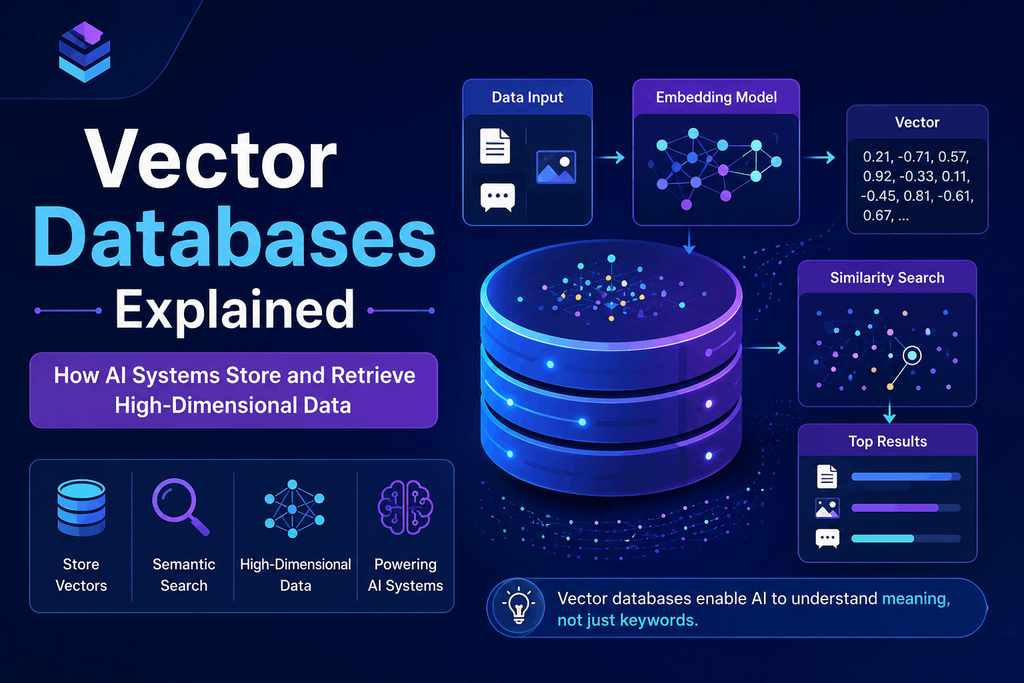
If you’ve spent any time around AI systems lately chatbots that remember context, recommendation engines that feel eerily accurate, semantic search that understands intent instead of just matching text you’ve been interacting with a vector database whether you realized it or not. It’s the quiet infrastructure layer making modern AI feel intelligent rather than mechanical.
And yet, ask ten people in tech what a vector database actually is, and you’ll get ten slightly different, slightly fuzzy answers. Some will say it’s “just a database for AI.” Others will mumble something about embeddings and hope you don’t ask a follow-up question. The truth is more interesting and, honestly, more approachable than the jargon suggests.
This article breaks down what a Vector Databases actually does, how it’s structured under the hood, why traditional databases fall short for this kind of work, and how embeddings retrieval actually happens in practice. No unnecessary complexity, no pretending this is more mysterious than it is. Just a clear, grounded walkthrough for anyone building with AI, evaluating tools, or simply trying to understand the technology quietly running underneath half the apps on their phone.
Table of Contents
- What Is a Vector Databases In Plain English?
- Why Traditional Databases Can’t Do This Job
- Understanding Embeddings: The Raw Material of a Vector Database
- Vector Database Architecture Explained Layer by Layer
- How Embeddings Retrieval Actually Works
- Approximate Nearest Neighbor Search: The Engine Under the Hood
- Indexing Strategies Used in a Modern Vector Database
- Real-World Applications of Vector Databases
- Case Study: Semantic Search for an E-Commerce Platform
- Vector Databases vs Traditional Search: A Direct Comparison
- Scaling Challenges in Vector Database Systems
- Choosing the Right Vector Database for Your Project
- Common Mistakes Teams Make When Adopting a Vector Database
- Security and Privacy Considerations
- The Future of Vector Databases in AI Infrastructure
- Frequently Asked Questions
- Final Thoughts
1. What Is a Vector Databases In Plain English?
Strip away the technical language, and a vector databases is simply a system built to store and search through numerical representations of meaning, rather than raw text, images, or audio themselves.
Here’s the core idea: when an AI model processes a piece of content a sentence, a photo, a product description it converts that content into a long list of numbers called a vector, or an embedding. That list of numbers captures something abstract but powerful: the meaning, context, and relationships within the content. A vector databases exists specifically to store millions or billions of these numerical representations and find the ones most similar to a given query, almost instantly.
Traditional databases are built to find exact or partial matches a customer ID, a specific word, a date range. A Vector Databases is built to find things that are conceptually close, even when nothing matches literally. That distinction is the entire reason this technology exists.
Why Traditional Vector Databases Can’t Do This Job
Relational databases are extraordinary tools, but they were designed decades before anyone needed to search by meaning rather than exact value. A SQL query built around WHERE productname running shoes' will never understand that “trainers for jogging” means roughly the same thing.
Traditional full-text search engines improved on this somewhat, using techniques like keyword weighting and fuzzy matching. But they’re still fundamentally pattern-matching on text characters, not understanding concepts. Ask a keyword-based system for “a laptop good for long flights” and it has no real way of connecting that to “lightweight ultra book with 14-hour battery life” unless someone manually tagged the data that way.
This is precisely the gap a vector database fills. Because it operates on numerical meaning rather than literal text, it can recognize that two completely different sentences are conceptually related a capability no amount of clever SQL indexing can replicate on its own.
Understanding Embeddings: The Raw Material of a Vector Database
Before diving deeper into architecture, it’s worth slowing down on embeddings, since they’re the actual content stored inside a vector database.
An embedding is produced by a machine learning model often a neural network trained specifically for this purpose. The model takes an input (text, image, audio, even code) and outputs a fixed-length array of numbers, typically anywhere from 128 to 1,536 dimensions depending on the model. Each dimension doesn’t correspond to something human-readable like “color” or “price.” Instead, the model learns abstract patterns during training, and similar concepts end up positioned close together in that high-dimensional numerical space.
This is the part that trips people up initially: a Vector Databases isn’t storing “meaning” directly. It’s storing coordinates in an enormous mathematical space, where distance between coordinates correlates with conceptual similarity. Two product descriptions about waterproof hiking boots will produce embeddings that sit close together in that space, even if they never share a single identical word.
Vector Databases Architecture Explained Layer by Layer
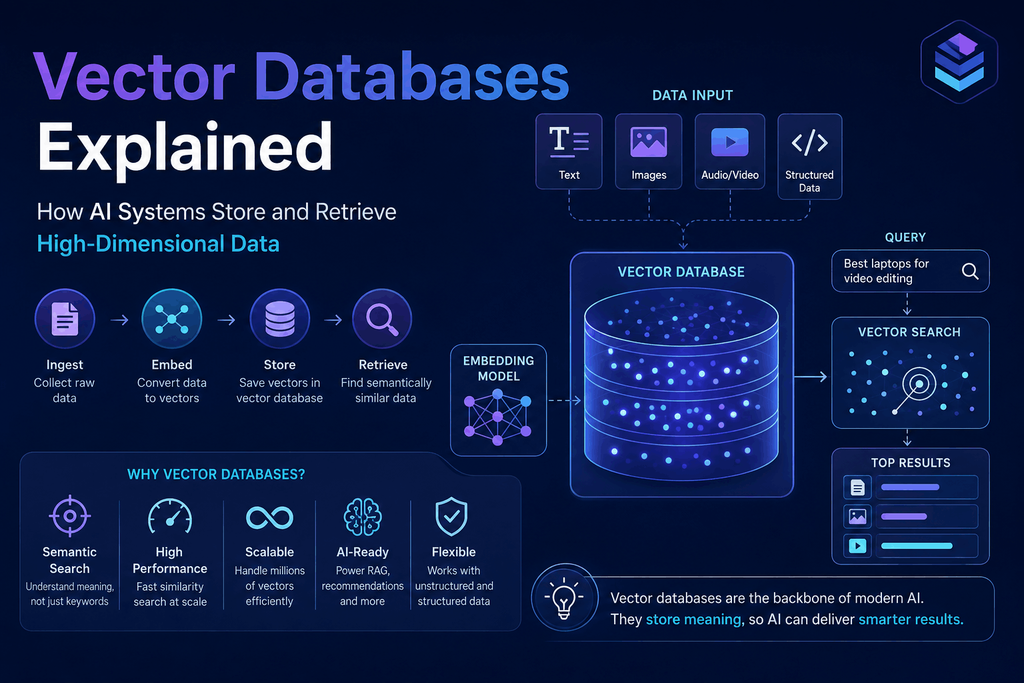
Understanding vector database architecture helps clarify why this technology behaves so differently from anything that came before it. Most systems are built from four core layers.
The ingestion layer handles incoming data, converting raw content into embeddings using a chosen machine learning model, then preparing those vectors for storage.
The storage layer organizes the embeddings efficiently, often alongside metadata (timestamps, categories, source IDs) that allows for filtered searches later on. This layer is where a vector database has to make real engineering trade-offs between storage cost, memory usage, and retrieval speed.
The indexing layer is arguably the most important part of vector database architecture. Instead of scanning every single vector for every query which would be painfully slow at scale indexing structures organize the data so the system can narrow down candidates intelligently before doing precise comparisons.
The query layer takes an incoming search request, converts it into a vector using the same embedding model, then searches the indexed space for the closest matches, returning results ranked by similarity.
Understanding these four layers is genuinely useful, because when a vector database performs poorly in production, the bottleneck almost always traces back to one specific layer rather than the system as a whole.
How Embeddings Retrieval Actually Works
Embeddings retrieval is the process of taking a query, converting it into the same vector space as the stored data, and finding the closest matches. It sounds simple in one sentence, but the mechanics behind it are genuinely elegant.
When a user searches for something, that query text passes through the exact same embedding model used to index the original content. This consistency matters enormously if your stored data was embedded with one model and your query gets embedded with a different one, the coordinate systems won’t align, and embeddings retrieval quality collapses almost entirely. This is one of the most common and most avoidable mistakes teams make.
Once the query becomes a vector, the vector database calculates similarity between that query vector and the stored Vector Databases typically using distance metrics like cosine similarity, Euclidean distance, or dot product. The results with the smallest distance meaning the closest conceptual match get returned, usually ranked by a similarity score.
Well-implemented embeddings retrieval feels almost telepathic to end users. Ask a support chatbot a vaguely worded question, and it pulls up the right documentation article even though your wording shares almost no vocabulary with the source text. That experience is embeddings retrieval working exactly as designed.
Approximate Nearest Neighbor Search: The Engine Under the Hood
Here’s a detail that surprises a lot of people: most production Vector Databases systems don’t search for the mathematically perfect closest match. They search for an approximate answer, and that’s actually the right engineering decision.
Finding the exact nearest neighbor among billions of high-dimensional vectors is computationally brutal it would require comparing the query against every single stored vector, which becomes painfully slow at scale. Instead, a Vector Databases typically uses Approximate Nearest Neighbor (ANN) algorithms, which sacrifice a small amount of precision in exchange for massive speed gains, often returning results in milliseconds rather than seconds.
Popular ANN techniques include Hierarchical Navigable Small World graphs (HNSW), which build a layered graph structure allowing the system to “hop” toward likely matches instead of checking everything, and Inverted File Indexing (IVF), which clusters similar vectors together so searches only need to examine relevant clusters rather than the entire dataset.
This trade-off between perfect accuracy and practical speed is central to how any modern Vector Databases operates at real-world scale, and it’s a decision most end users never notice because the tiny accuracy loss is almost never perceptible in everyday use.
Indexing Strategies Used in a Modern Vector Databases
Different indexing strategies suit different workloads, and choosing correctly has a real impact on both cost and performance.
Flat indexing compares queries against every stored vector directly. It’s the most accurate approach and the simplest to implement, but it scales poorly, making it suitable mainly for smaller datasets or situations where perfect precision genuinely matters more than speed.
HNSW indexing is currently the most widely adopted approach across production vector database deployments, offering a strong balance between speed, accuracy, and memory usage.
IVF-based indexing works well for extremely large datasets, since clustering reduces the search space dramatically before fine comparisons happen.
Product quantization compresses vectors to reduce memory footprint, which matters enormously when a vector database needs to hold hundreds of millions of embeddings without requiring an unreasonable amount of RAM.
Many production systems combine several of these strategies together, which is why evaluating a vector database purely on marketing claims about speed can be misleading the right choice depends entirely on your dataset size, latency requirements, and budget.
Real-World Applications of Vector Databases
The use cases have expanded far beyond the research labs where this technology started.
Semantic search lets users find content by meaning rather than exact keywords, which is transforming everything from e-commerce search bars to internal company knowledge bases.
Recommendation systems use a Vector Databases to find items conceptually similar to what a user already likes, powering the “you might also enjoy” sections across streaming platforms and retail sites.
Retrieval-Augmented Generation (RAG) systems, which have become central to how modern AI chatbots access up-to-date or company-specific information, rely almost entirely on a vector database to pull relevant context before generating a response.
Fraud and anomaly detection systems use vector similarity to flag transactions or behaviors that deviate meaningfully from established patterns.
Image and audio search applications convert visual or audio content into embeddings, allowing users to search using a photo or sound clip instead of typed text.
Across nearly every one of these applications, the underlying mechanism is the same: convert content into meaningful numerical form, then use a vector database to retrieve what’s conceptually closest.
Case Study: Semantic Search for an E-Commerce Platform
Consider a mid-sized outdoor gear retailer based in Leeds, struggling with search abandonment. Their existing keyword-based search returned technically correct but practically useless results customers searching “jacket for cold rainy hikes” were shown everything containing the word “jacket,” sorted by nothing meaningful.
The engineering team implemented a vector database to power semantic search across their product catalog. Every product description got converted into an embedding capturing its actual attributes and use case, not just its literal wording. When a customer searched using natural language, that query was embedded using the same model and compared against the stored catalog vectors.
Within six weeks of launch, search-to-purchase conversion improved by a meaningful margin, and customer support tickets related to “I couldn’t find what I was looking for” dropped noticeably. The team didn’t need to manually tag thousands of products with every possible synonym or use case the vector database handled that conceptual matching automatically, because embeddings retrieval doesn’t require exact wording to succeed.
This is a fairly ordinary story at this point, but it illustrates something important: the value of a Vector Databases isn’t theoretical. It shows up directly in metrics that businesses actually care about.
Vector Databases vs Traditional Search: A Direct Comparison
Traditional keyword search excels at precision when users know exactly what term they’re looking for a specific product SKU, a legal case number, an exact phrase. It’s fast, well-understood, and cheap to run at small scale.
A Vector Databases excels when meaning matters more than exact wording, when users express intent in natural, varied language, or when the system needs to understand relationships between concepts rather than just matching characters. It typically requires more computational resources and more careful architecture decisions than a traditional keyword index.
Most mature systems today don’t choose one over the other exclusively. They combine both using traditional filtering for precise constraints (price range, category, date) alongside a Vector Databases for the conceptual matching layer. This hybrid approach tends to outperform either method used alone, and it’s quickly becoming the default architecture for serious search and retrieval systems.
Scaling Challenges in Vector Databases Systems
Running a vector database at genuine scale introduces real engineering challenges that don’t show up in small demos.
Memory costs grow substantially as embedding count increases, since high-dimensional vectors consume meaningful storage, and many indexing methods keep large portions of data in memory for speed.
Latency under load can degrade if the indexing strategy wasn’t chosen with production traffic patterns in mind, which is why load testing a vector database before launch matters far more than teams typically expect.
Embedding model consistency becomes a genuine operational challenge if you update your embedding model, every previously stored vector technically becomes incompatible with new queries unless you re-embed the entire dataset, which can be an expensive, time-consuming process for a large vector database.
Metadata filtering complexity increases as use cases grow, since combining vector similarity search with traditional filters (only show results from the last 30 days, only show in-stock items) requires careful architectural planning to avoid major performance penalties.
None of these challenges are dealbreakers, but they’re exactly the kind of details that separate a vector database that works beautifully in a proof-of-concept from one that holds up reliably in production.
Choosing the Right Vector Database for Your Project
With dozens of options now available, choosing the right vector database comes down to a handful of practical questions rather than marketing comparisons.
How large is your dataset, and how fast is it growing? Small projects can tolerate simpler indexing; large-scale systems need serious ANN infrastructure from day one. What are your latency requirements? Real-time customer-facing search demands different performance than an internal nightly batch analysis job. Do you need hybrid search combining metadata filters with vector similarity? Many production use cases do, and not every vector database handles this equally well. What’s your team’s operational capacity? Fully managed vector database services reduce infrastructure burden considerably compared to self-hosted options, at the cost of ongoing subscription pricing.
There’s no universally “best” vector database only the one that fits your specific data volume, latency needs, and team capacity.
Common Mistakes Teams Make When Adopting a Vector Databases
Mismatched embedding models. Using different models for indexing and querying quietly destroys embeddings retrieval accuracy, often without any obvious error message pointing to the cause.
Ignoring metadata filtering needs early on. Bolting on filtered search after the fact usually requires significant re-architecture.
Underestimating re-indexing costs. Teams frequently discover, too late, how expensive and time-consuming it is to re-embed an entire dataset after upgrading their embedding model.
Treating similarity scores as absolute truth. A high similarity score means conceptual closeness, not guaranteed relevance human review and evaluation still matter, especially in sensitive use cases.
Skipping load testing. A vector database that performs beautifully with a thousand test vectors can behave very differently at ten million, and teams that don’t test at realistic scale often get an unpleasant surprise post-launch.
Security and Privacy Considerations
Because a vector database often stores representations derived from sensitive source material — customer messages, medical records, proprietary documents — security deserves real attention, not an afterthought.
Embeddings can, in certain circumstances, be partially reverse-engineered to reveal information about the original content, so access controls and encryption at rest matter just as much for a vector database as they do for traditional data stores. Teams handling regulated data in the US and UK should treat vector storage with the same compliance rigor as any other system holding personal or sensitive information, including clear data retention policies and audit logging around who queries what.
The Future of Vector Databases in AI Infrastructure
As AI systems become more embedded in everyday software, the role of the vector database is only going to expand. Expect tighter integration between vector search and traditional databases, reducing the current friction of running separate systems side by side. Expect better standardization around embedding models, making it easier to switch providers without a full re-indexing project. And expect continued improvement in indexing efficiency, pushing both speed and accuracy further without the trade-offs that currently define approximate search.
What won’t change is the underlying principle: as long as AI systems need to understand and retrieve information by meaning rather than exact match, some form of vector database will sit at the center of that architecture.
FAQ
What exactly is stored inside a vector database? Numerical arrays called embeddings, which represent the meaning of content such as text, images, or audio, often alongside metadata used for filtering.
Is a vector database the same thing as a regular database with a vector data type? Not quite. While some traditional databases now offer vector search extensions, a purpose-built vector database is architected from the ground up around similarity search and indexing at scale.
Do I need a vector database if I’m building a small application? Not necessarily. For small datasets, simpler solutions or vector extensions on existing databases may be sufficient. The benefits of a dedicated vector database become clearer as data volume and query complexity grow.
How does embeddings retrieval handle multiple languages? Multilingual embedding models can map semantically similar content across languages into nearby coordinates, allowing embeddings retrieval to work across language boundaries without manual translation.
Can a vector database guarantee perfectly accurate search results? Most production systems use approximate search for speed, meaning results are highly accurate but not mathematically guaranteed to be the absolute closest match every single time.
What’s the biggest factor in vector database performance? Indexing strategy, chosen based on dataset size and latency requirements, has the single largest impact on real-world performance.
Read About 10 AI Marketing Tools