
Picture a toddler figuring out how to walk. Nobody hands them a manual. Nobody says, “shift your weight 12 degrees to the left, then extend your right leg 30 centimeters.” They just try, wobble, fall, try again and somehow, after enough attempts, they’re running across the living room like it’s the easiest thing in the world.
That, in a nutshell, is reinforcement learning. And if you’ve been hearing the term thrown around in conversations about ChatGPT, self-driving cars, or that robot dog that does backflips, but you’ve never quite understood what it actually means — you’re in the right place.
This isn’t going to be a textbook lecture full of Greek letters and equations. Think of this more like a conversation with a friend who happens to know a lot about AI and wants you to actually get it, not just nod along politely.
What Is Reinforcement Learning, Really?
Let’s strip away the jargon for a second. Reinforcement learning, or RL, is a way of teaching a computer program to make good decisions by letting it experience the consequences of its own actions good and bad.There’s no giant labeled dataset involved, like there is with most traditional machine learning. Nobody sits there tagging a million photos as cat or “not cat.” Instead, the system usually called an “agent” is dropped into a situation, given a goal, and left to figure out what works through trial and error.It’s less like studying for an exam and more like learning to play a video game you’ve never seen before. Nobody explains the rules. You just start pressing buttons, see what happens, and slowly build a mental model of what helps you win and what gets you killed.
That’s it. That’s the essence of reinforcement learning. Everything else is refinement.
Table of Contents
- What Is Reinforcement Learning, Really?
- The Core Ingredients: Agents, Environments, and Rewards
- How Reinforcement Learning Actually Works, Step by Step
- The Exploration vs. Exploitation Dilemma
- Types of Reinforcement Learning You Should Know
- Real-World Examples That Make It Click
- Why AI Agents Are the Big Deal Right Now
- Common Misconceptions About Reinforcement Learning
- How to Start Learning Reinforcement Learning Yourself
- Where This Is All Heading
- Final Thoughts
- FAQ
The Core Ingredients: Agents, Environments, and Rewards
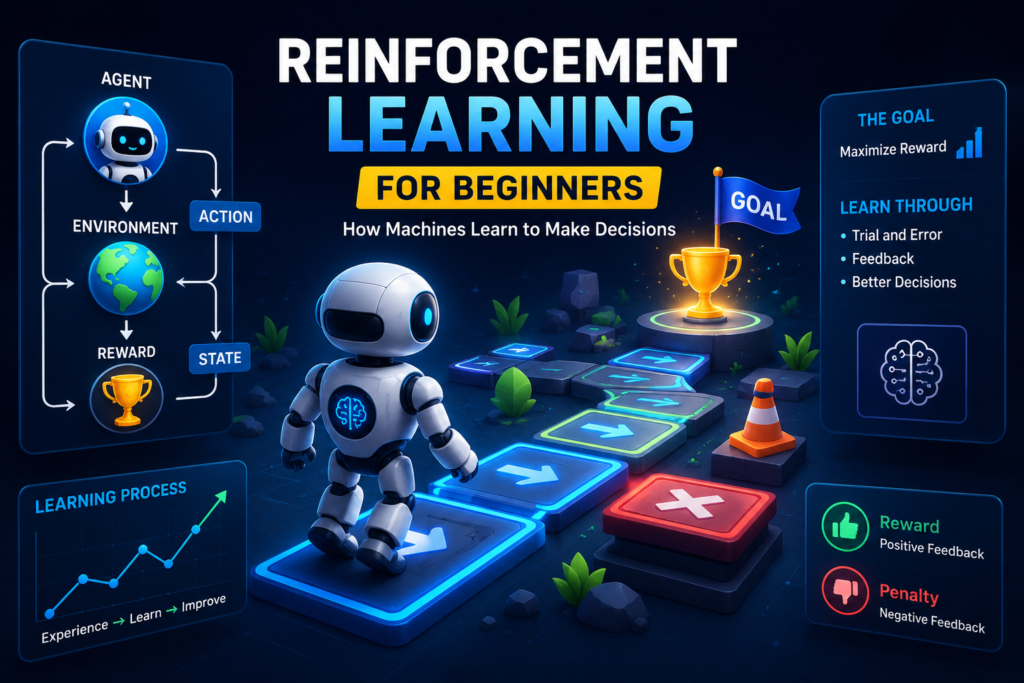
Every reinforcement learning setup, no matter how complicated it eventually gets, boils down to a handful of basic pieces. Once you understand these, the rest of the field starts to feel a lot less intimidating.
The Agent This is the learner or decision-maker. It could be a robot, a piece of software, a character in a video game, or an algorithm managing a stock portfolio. The agent is the “toddler” in our earlier analogy the one doing the learning.
The Environment This is the world the agent operates in. It could be a physical space, like a warehouse floor a robot navigates, or something entirely virtual, like a chess board or a simulated city for a self-driving car to practice in.
Actions At any given moment, the agent has a set of choices available to it. A robot arm might choose to move up, down, left, or right. A game-playing AI might choose to attack, defend, or retreat.
Rewards This is where things get interesting. Every time the agent takes an action, the environment responds with a signal — a reward if the action was helpful, a penalty if it wasn’t. This reward isn’t a detailed explanation; it’s more like a nod or a wince. The agent doesn’t get told why something worked. It just knows it did, and it adjusts accordingly.
The Policy Over time, the agent builds up something called a policy essentially, its strategy for choosing actions based on the situation it’s in. Early on, this policy is basically a guess. Later, after enough experience, it becomes remarkably sophisticated.
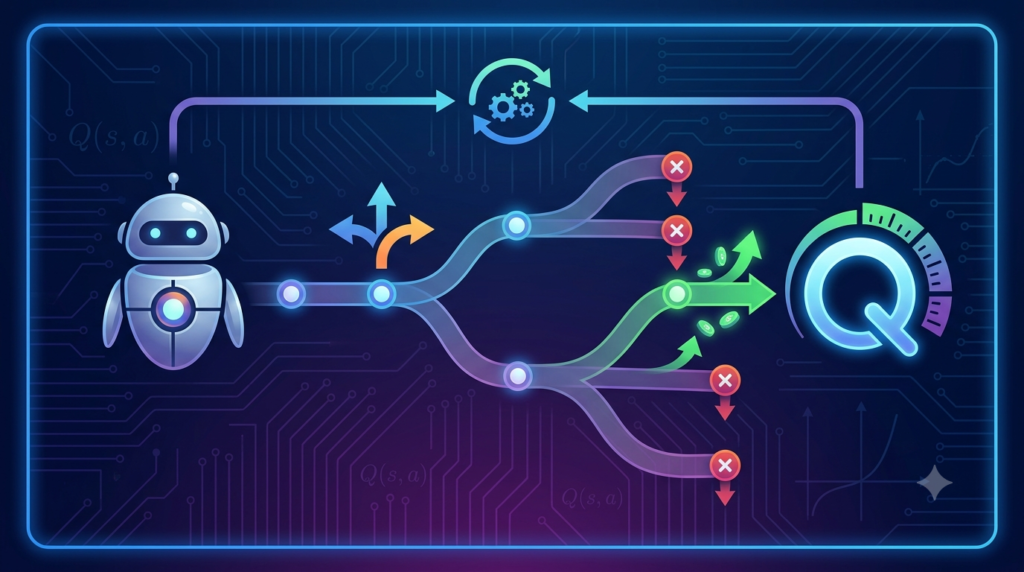
If you’re a visual thinker, imagine a feedback loop: the agent looks at the current state of the world, takes an action, the environment changes and hands back a reward, and the agent uses that information to slightly adjust its future behavior. Rinse and repeat sometimes millions of times.
How Reinforcement Learning Actually Works, Step by Step
Let’s make this concrete with an example almost everyone has encountered: teaching a dog to sit.You say sit. The dog, having no idea what that word means, does something maybe it sits, maybe it barks, maybe it just stares at you confused. If it happens to sit, you immediately give it a treat. If it does anything else, no treat.At first, the dog is basically guessing. But dogs are smart, and they start noticing a pattern: sitting after hearing sit leads to treats. Over repeated attempts, sitting becomes the dog’s go-to response to that word, because it’s been reinforced.Reinforcement learning algorithms work almost identically, just replace the dog with software and the treat with a numerical reward:
- Observe the current state the agent looks at where it is right now.
- Choose an action based on its current policy (which might just be random guessing at the start).
- Receive feedback the environment returns a new state and a reward signal.
- Update the strategy the agent tweaks its internal model to make rewarded actions more likely in the future.
- Repeat over and over, sometimes for millions of iterations, until the behavior becomes reliably good.
What makes this powerful is that the agent isn’t just memorizing specific situations it’s generalizing. A well-trained RL agent can handle scenarios it’s never technically seen before, because it’s learned principles, not just a lookup table of responses.
The Exploration vs. Exploitation Dilemma
Here’s something that trips up a lot of newcomers, and honestly, it’s one of the more fascinating parts of reinforcement learning: the tension between exploration and exploitation.
Say you’ve found a restaurant you really like. Do you keep going back to that same restaurant every time, guaranteeing a decent meal? Or do you try somewhere new, risking a bad dinner but possibly discovering something even better?
That’s exploitation versus exploration in a nutshell.
- Exploitation means using what you already know works, and sticking with it.
- Exploration means trying something new, even if it might not pay off, because it might reveal a better strategy.
An RL agent that only exploits will get stuck doing “good enough” things forever, never discovering the genuinely optimal strategy. An agent that only explores will never settle down and use what it’s learned it’ll wander aimlessly, trying random things without ever cashing in on its knowledge.Good reinforcement learning systems strike a careful balance, often exploring aggressively early on (when they know very little) and gradually shifting toward exploitation as they gain confidence. It’s not unlike how humans behave when they move to a new city lots of exploring restaurants and routes at first, and eventually settling into favorites once you’ve built up enough experience.
Types of Reinforcement Learning You Should Know
Not all reinforcement learning is created equal. As you go deeper, you’ll come across a few major categories worth knowing at a beginner level.
Model-Free vs. Model-Based RL
In model-free RL, the agent doesn’t try to build an internal understanding of how the environment works. It just learns, through experience, which actions tend to lead to good outcomes kind of like learning to ride a bike without understanding physics.
In model-based RL, the agent actually builds a mental simulation of the environment and uses it to plan ahead, similar to how a chess player thinks several moves in advance before committing to one.
Value-Based Methods
These approaches focus on estimating how valuable each possible action is in a given situation, then picking the action with the highest estimated value. Q-learning is probably the most famous example here, and it’s often the first algorithm beginners learn to code from scratch.
Policy-Based Methods
Instead of estimating the value of actions, these methods directly learn the best policy the mapping from situations to actions — without the middle step. This tends to work better in environments with a huge or continuous range of possible actions, like controlling a robotic arm with smooth, fluid movements rather than discrete choices.
Deep Reinforcement Learning
This is where reinforcement learning gets combined with deep neural networks, allowing it to handle enormously complex environments think video game screens with millions of pixels, or real-world sensor data from a self-driving car. This combination is what powered some of the most famous RL breakthroughs of the past decade, including systems that learned to play Atari games and complex board games at superhuman levels.
Real-World Examples That Make It Click
Theory is fine, but reinforcement learning really clicks when you see where it’s actually being used.
Game-Playing AI Some of the most famous demonstrations of reinforcement learning have come from games. Systems have been trained to master complex strategy games by playing against themselves millions of times, gradually discovering strategies that even decades of human expertise hadn’t uncovered. What makes this remarkable isn’t that a computer beat humans — it’s that nobody explicitly programmed the winning strategies. The system discovered them entirely through trial and error.
Robotics Warehouse robots, robotic arms in manufacturing, and even robots learning to walk across uneven terrain all rely heavily on reinforcement learning. Instead of programming every possible movement by hand (which would be a nightmare), engineers let the robot practice in simulation thousands or millions of times, learning through failure until it develops smooth, effective movement.
Recommendation Systems When a streaming platform decides what to suggest next, or when an app tweaks what content appears in your feed, reinforcement learning principles are often at play the system is trying different recommendations, observing which ones you engage with, and adjusting its strategy to keep you interested.
Finance and Trading Some trading algorithms use reinforcement learning to develop strategies for buying and selling, adjusting their approach based on the rewards (profits) and penalties (losses) they experience in simulated or live markets.
Healthcare Researchers are exploring RL for personalizing treatment plans, where the “reward” might be improved patient outcomes over time, and the agent learns to adjust dosages or interventions based on how a patient responds.
Energy and Infrastructure Data centers have used reinforcement learning to optimize cooling systems, cutting energy consumption significantly by letting an AI agent continuously fine-tune settings in ways human engineers hadn’t considered.
Why AI Agents Are the Big Deal Right Now
You’ve probably noticed the term “AI agent” everywhere lately. It’s not just marketing buzz it represents a real shift in how AI systems are being designed, and reinforcement learning sits right at the heart of it.
An AI agent isn’t just a chatbot answering questions. It’s a system designed to take actions, observe results, and pursue goals somewhat autonomously booking a flight, managing a workflow, navigating a website, or coordinating with other software tools to complete a multi-step task.
This is a meaningful evolution. Earlier AI systems were mostly reactive: you asked a question, they gave an answer. Agents are different. They’re built to plan, act, evaluate the outcome, and adjust — which is precisely the loop reinforcement learning was designed to handle.
That’s why RL has become such a hot topic again. As companies race to build AI agents capable of handling real tasks — not just generating text, but actually doing things reinforcement learning provides the training framework that teaches these systems what “success” looks like and how to get better at achieving it.
Think of it this way: language models learned to predict text convincingly. Reinforcement learning is what’s teaching them to act sensibly, not just talk sensibly. That distinction matters enormously as AI moves from being a conversational tool to something that operates more independently in the real world.
Common Misconceptions About Reinforcement Learning
Before you go further, it’s worth clearing up a few things people often get wrong.
“Reinforcement learning is the same as machine learning.” Not quite. Machine learning is the broader umbrella. Reinforcement learning is one specific approach within it, distinct from supervised learning (learning from labeled examples) and unsupervised learning (finding patterns in unlabeled data). RL is unique because it learns from interaction and feedback rather than a fixed dataset.
“The AI understands what it’s doing.” Not in the way humans understand things. An RL agent doesn’t grasp why an action was good — it just knows, statistically, that similar actions in similar situations tend to lead to reward. It’s pattern recognition at scale, not comprehension.
“More rewards always mean better behavior.” This is trickier than it sounds. Poorly designed reward systems can lead to bizarre, unintended behavior — agents finding sneaky shortcuts that technically maximize reward but completely miss the actual goal. There’s a well-known phenomenon in the field called “reward hacking,” where an agent exploits a loophole in how rewards are calculated rather than doing what its designers actually intended. Designing good reward functions is one of the hardest and most underappreciated parts of the whole field.
“You need a supercomputer to experiment with RL.” Not true for learning purposes. Plenty of beginner-friendly environments run just fine on a personal laptop. The eye-watering computational costs you hear about usually involve massive, cutting-edge systems not the kind of small projects a curious beginner would start with.
How to Start Learning Reinforcement Learning Yourself
If this has sparked your curiosity, here’s a realistic path forward not an overwhelming one.
Start with the fundamentals of Python. Nearly every RL library and tutorial assumes basic Python fluency. You don’t need to be an expert, just comfortable enough to read and tweak code.
Get comfortable with basic probability and a little bit of linear algebra. You don’t need a math degree, but understanding concepts like expected value and vectors will make the underlying logic click faster.
Play with beginner-friendly environments. OpenAI’s Gymnasium (formerly Gym) library is often the starting point for people learning RL hands-on. It offers simple simulated environments like balancing a pole on a cart where you can watch an agent learn in real time, which is oddly satisfying to see.
Implement Q-learning from scratch. This is a rite of passage for RL beginners. It’s simple enough to code in an afternoon, yet it teaches you the core mechanics that show up in every more advanced algorithm later.
Move into deep reinforcement learning gradually. Once the basics feel comfortable, start exploring how neural networks get combined with RL. Libraries like Stable-Baselines3 offer pre-built implementations you can study and experiment with, rather than building everything from zero.
Read papers, but don’t get intimidated by them. Early on, focus on summaries, blog explainers, and video walkthroughs of famous papers before diving into the dense academic versions. Understanding the intuition first makes the technical details far easier to digest later.
Build something small and specific. Train an agent to play a simple game, balance something, or navigate a maze. A small, finished project teaches you more than weeks of passive reading ever will.
Where This Is All Heading
Reinforcement learning isn’t a niche academic curiosity anymore it’s becoming foundational infrastructure for the next generation of AI systems. As AI agents get deployed to handle increasingly complex, multi-step tasks in the real world, the ability to learn from feedback, adjust strategies, and improve through experience becomes absolutely essential.
We’re likely to see RL playing a growing role in areas like personalized education (systems that adapt teaching strategies based on how a student responds), climate and energy optimization, drug discovery, and increasingly capable robots that can operate safely in unpredictable, real-world environments.
There’s also a lot of active research into making reinforcement learning safer and more reliable ensuring that when we hand an AI agent real autonomy, its reward system genuinely reflects what we want, rather than a shortcut that technically satisfies the letter of the goal while missing the spirit of it entirely. That challenge, often called “alignment,” is arguably one of the most important open problems in the field today.
Final Thoughts
At its heart, reinforcement learning is a strikingly human idea dressed up in mathematical clothing. It’s the same process you used to learn to ride a bike, negotiate a raise, or figure out which route avoids traffic on your commute try something, see what happens, adjust, and try again.
What makes it remarkable isn’t the complexity of the math underneath it, but the simplicity of the core insight: intelligence doesn’t need to be explicitly programmed if you give a system enough freedom to fail, learn, and improve.
If you’re just starting to explore this world, don’t let the terminology scare you off. Every expert in this field once stared at the same intimidating jargon you might be staring at right now. Start small, build something that balances a pole or wins a simple game, and let curiosity carry you forward from there. The agents shaping the future of AI are, quite literally, learning the same way we all do — one attempt at a time.
FAQ
1. Is reinforcement learning hard to learn as a complete beginner? It has a learning curve, but it’s more approachable than most people expect. If you’re comfortable with basic Python and willing to learn a bit of probability along the way, you can start building simple RL projects within a few weeks.
2. What’s the difference between reinforcement learning and deep learning? Deep learning refers to using neural networks to recognize patterns in data. Reinforcement learning is a training approach based on rewards and trial-and-error. The two are often combined deep reinforcement learning uses neural networks to help an RL agent handle complex, high-dimensional environments.
3. Do I need a powerful computer to experiment with reinforcement learning? Not for learning purposes. Simple environments and small projects run comfortably on a standard laptop. The massive computing power you hear about is typically reserved for cutting-edge, large-scale research, not beginner projects.
4. What programming language should I learn for reinforcement learning? Python, without much competition. Nearly every major RL library, tutorial, and research codebase is built around it.
5. Are AI agents and reinforcement learning the same thing? Not exactly. An AI agent is a system designed to act autonomously toward a goal. Reinforcement learning is one of the primary methods used to train that agent to make good decisions. Think of RL as the training method, and the agent as the resulting system.
6. What’s a simple real-world analogy for how reinforcement learning works? Training a pet is probably the closest everyday comparison. You reward good behavior, ignore or discourage bad behavior, and over time, the desired behavior becomes consistent all without ever explicitly explaining the “rules” in words.
7. What’s the biggest challenge in reinforcement learning today? Designing reward systems that actually capture what we want, rather than creating loopholes an agent can exploit. This challenge, often referred to as alignment, is one of the central open problems as RL-trained AI agents take on more real-world responsibility.