
Machine Learning I still remember the exact moment machine learning stopped feeling like magic to me. I was three weeks into my first “real” ML project, feeding data into a model, watching accuracy numbers climb, and nodding along like I understood what was happening under the hood. Then a colleague asked me a simple question: “What is the model actually doing to the numbers?”
I froze. I could tell you what a neural network did, in the loose, hand-wavy sense you get from YouTube tutorials and Medium articles. But I couldn’t tell you how. I didn’t know what was happening between the input and the output, mathematically speaking. And that gap between using a tool and understanding it is where a lot of us get stuck.
If you’ve ever felt that same disconnect, you’re not alone. Most people learn machine learning backwards. We start with , get a working result, and only later realize we’ve built a house without ever looking at the foundation. The foundation, it turns out, is math and specifically, it’s linear algebra doing most of the heavy lifting.
This article is the explanation I wish someone had given me three weeks into that first project. No unnecessary jargon, no pretending you need a PhD to get it. Just a clear, honest look at the math that actually makes machine learning work.
Why Bother Understanding the Math At All?
Let’s address the obvious pushback first: with so many libraries, frameworks, and pre-trained models available today, do you really need to understand the math to build good machine learning systems?
Technically, no. You can drag a dataset into a tool, click a few buttons, and get predictions. People do this every day.
But here’s the catch. The moment something goes wrong and in ML, something always eventually goes wrong the math is what tells you why. Your model’s predictions are wildly off. Training loss refuses to go down. The model works beautifully on your test set and falls apart in production. These aren’t mysteries you can debug by reading documentation. They’re math problems wearing a code disguise.
Understanding the math also changes how you think about the problem itself. You stop treating a model like a black box you feed data into and start seeing it as a structured, logical system with knobs you can actually reason about. That shift from user to practitioner is almost entirely a function of how comfortable you are with the underlying mathematics.
And the good news? You don’t need advanced math. You need a working understanding of a handful of concepts, mostly from one branch: linear algebra.
The Three Pillars: Linear Algebra,
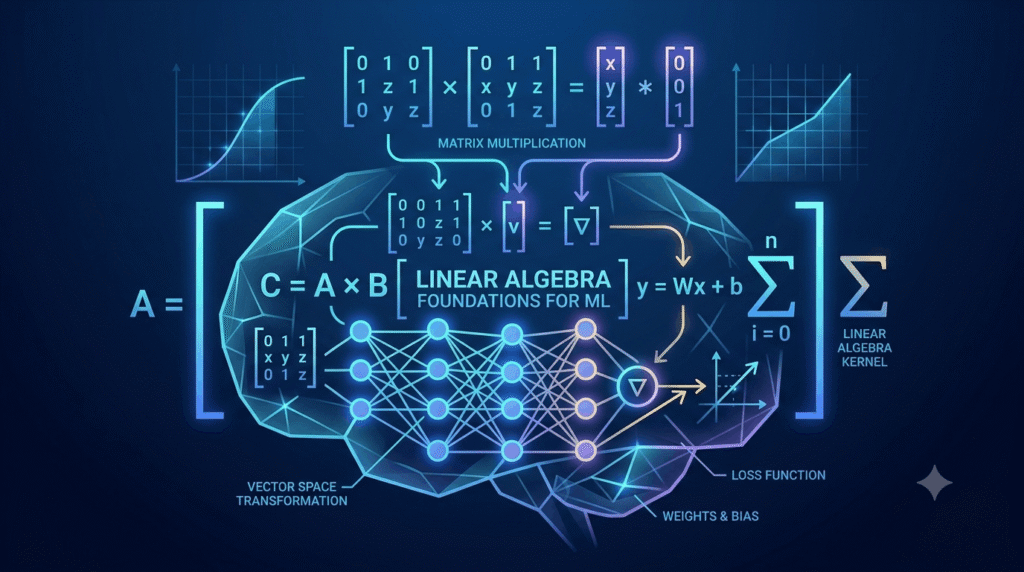
Before we zoom into linear algebra specifically, it’s worth knowing the full picture. Machine learning math generally rests on three pillars.Linear algebra handles how data is represented and transformed. Every dataset, every image, every batch of text you feed into a model gets converted into vectors and matrices, and the model’s job is essentially to manipulate those structures in useful ways.
Calculus, specifically derivatives and gradients, handles how models learn. When a model is “training,” what it’s really doing is adjusting its internal numbers to reduce error, and calculus is the mechanism that tells it which direction to adjust in.
Probability and statistics handle uncertainty. Machine learning models rarely deal in absolutes they deal in likelihoods, distributions, and confidence. Probability is what lets a spam filter say “this email is 94% likely to be spam” instead of just guessing yes or no.
All three matter. But if you had to rank them by sheer footprint across the field, linear algebra would win, and it’s not close. It’s the language that data speaks once it enters a machine learning system. So let’s spend the rest of this article there.
What Linear Algebra
Here’s a definition that won’t put you to sleep: linear algebra is the study of vectors, matrices, and the operations you can perform on them. That’s it. It’s not about solving abstract puzzles for their own sake it’s about representing collections of numbers and figuring out efficient, structured ways to transform them.
In machine learning, almost everything you touch is secretly a vector or a matrix.
A single data point say, a house with 5 features like square footage, number of bedrooms, age, and location score is a vector. It’s just a list of numbers, but that list has geometric meaning. You can think of it as a point in a 5-dimensional space.
A whole dataset thousands of houses, each with those 5 features is a matrix. Rows represent individual examples, columns represent features. Suddenly, your spreadsheet of housing data isn’t just a spreadsheet. It’s a mathematical object with properties you can manipulate.
An image is a matrix too or more precisely, a stack of matrices, one for each color channel (red, green, blue). A 224×224 pixel color photo is really three 224×224 matrices layered together. When a computer vision model “looks” at a photo, it’s actually performing matrix operations on that stack of numbers.
Once you see data this way, the rest of machine learning starts to click into place. Training a model isn’t some mystical process — it’s a sequence of matrix operations designed to transform inputs into useful outputs.
Vectors: The Building Blocks
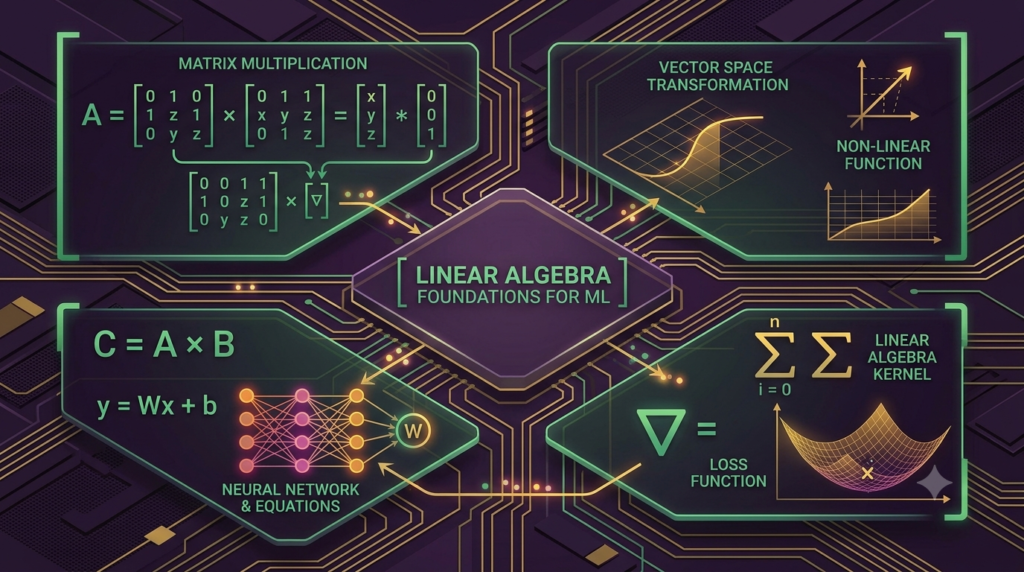
A vector is just an ordered list of numbers. In machine learning, a vector usually represents a single observation, described by its features.
Take a simple example: predicting whether someone will click on an ad. You might represent a user as a vector like That’s a vector living in four-dimensional space.
Now here’s where it gets interesting. Vectors aren’t just static lists they have direction and magnitude. Two users with similar vectors are, in a mathematical sense, “close” to each other. This idea of distance and similarity between vectors is the backbone of techniques like recommendation systems, clustering, and nearest-neighbor search. When Netflix suggests a show because “users like you also watched this,” it’s often relying on vector similarity calculations under the hood.
Matrices: Where the Real Work Happens
If vectors are individual data points, matrices are collections of them and more importantly, matrices are also how models transform data.
Every layer in a neural network, for instance, is essentially a matrix multiplication followed by a small nonlinear tweak. Your input vector gets multiplied by a weight matrix, producing a new vector. That new vector gets multiplied by another weight matrix in the next layer, and so on. By the time your data reaches the output layer, it has been transformed dozens or even hundreds of times, each transformation reshaping it slightly to bring it closer to a useful prediction.
This is genuinely the core insight worth sitting with: a neural network is, at its mathematical heart, a long chain of matrix multiplications with some clever nonlinear adjustments sprinkled in between. Everything else the architecture choices, the training tricks, the regularization methods exists to make that chain of multiplications learn something meaningful instead of collapsing into noise.
The Concepts That Show Up Again and Again
You don’t need to master every corner of linear algebra to work effectively in machine learning. But a handful of concepts show up so consistently that they’re worth knowing cold.
Matrix Multiplication
This is the workhorse operation. When you multiply a data matrix by a weight matrix, you’re combining features in weighted ways to produce new representations of the data. Every prediction a neural network makes ultimately traces back to a sequence of these multiplications.
What’s worth understanding isn’t the mechanical process of multiplying matrices by hand computers do that instantly but the intuition behind it. Multiplication combines information. It lets a model take raw features like pixel values or word counts and combine them into increasingly abstract, useful representations. Early layers in an image classifier might combine pixels into edges. Later layers combine edges into shapes. Even later layers combine shapes into recognizable objects like “cat” or “car.” That entire progression happens through repeated matrix multiplication.
Dot Products
The dot product measures how much two vectors “agree” with each other how aligned they are in direction. This single, simple operation quietly powers an enormous chunk of machine learning.
In recommendation engines, dot products measure similarity between a user’s preferences and an item’s characteristics. In attention mechanisms the technology behind large language models like GPT dot products are literally how the model decides which words in a sentence should “pay attention” to which other words. When a language model figures out that “it” in a sentence refers back to “the dog” mentioned three words earlier, dot products are doing that work.
Eigenvalues and Eigenvectors
This one sounds intimidating, but the concept is more approachable than the name suggests. Eigenvectors are special directions that a matrix transformation doesn’t rotate it only stretches or shrinks them. Eigenvalues tell you by how much.
Why does this matter for machine learning? Techniques like Principal Component Analysis (PCA), used heavily for dimensionality reduction, rely entirely on eigenvalues and eigenvectors. If you’ve ever worked with a dataset that has hundreds of features and needed to compress it down to a manageable number while preserving the most important patterns, PCA is likely how that happened and eigenvectors are what identify those “most important patterns” mathematically.
Matrix Transformations and Dimensionality
Every layer of a neural network typically changes the dimensionality of your data compressing a 1000-dimensional input down to 500 dimensions, then 100, then eventually down to whatever the output requires (say, 2 dimensions for a binary classification problem). Understanding that this is happening, and roughly why, helps demystify architecture decisions that otherwise look arbitrary. Why does this layer have 256 neurons and the next one 128? Because someone is deliberately shaping the dimensional “funnel” the data passes through, trying to force the model to compress information into increasingly meaningful abstractions.
A Real Example: Linear Regression, Demystified
Let’s ground all of this in something concrete, because abstract concepts only click when you see them applied.
Linear regression probably the first machine learning algorithm most people learn is entirely a linear algebra problem in disguise. You’re trying to find a set of weights that, when multiplied by your input features and summed together, produce a prediction close to the actual value.
In plain math terms, this looks like:
prediction = (weights) × (features) + bias
That’s a vector-matrix multiplication with an added adjustment. Training the model means finding the specific weight values that minimize the difference between predictions and actual outcomes across your entire dataset. And solving for those optimal weights, in the classic formulation of linear regression, literally involves matrix inversion a core linear algebra operation.
This is why linear regression is such a good starting point for understanding ML math. It’s not a simplified toy version of what “real” machine learning does it’s the same underlying operations you’ll find in a massive neural network, just with far fewer layers and much less complexity. Once linear regression clicks, deep learning stops looking like an entirely different beast and starts looking like an extension of the same core idea, scaled up.
Where Calculus and Probability Fit Into the Picture
I promised to focus on linear algebra, but it deserves a quick, honest mention of how it interacts with the other two pillars, because in practice they never operate in isolation.
Once a model makes a prediction using matrix operations, calculus steps in to figure out how wrong that prediction was and which direction to adjust the weights to reduce that error. This process, called backpropagation, is really just the chain rule from calculus applied systematically across every matrix multiplication in the network. Linear algebra builds the structure; calculus tunes it.
Probability, meanwhile, shows up in how models express uncertainty and how training data is treated statistically. Loss functions the formulas that measure how “wrong” a model is are often rooted in probabilistic reasoning. A model isn’t just saying “this is a cat.” It’s saying “based on the patterns I’ve learned, there’s an 87% probability this is a cat,” even if that probability gets rounded off before you see it.
So while linear algebra is the backbone, it works in constant conversation with calculus and probability. Understanding one deeply makes the other two significantly easier to grasp, because they’re all describing different aspects of the same underlying system.
How Much Math Do You Actually Need to Learn?
This is the question that stops most people before they even start, so let’s be direct about it.
You don’t need to become a mathematician. You need working fluency, not academic mastery. That means being able to:
- Look at a dataset and understand it as a matrix, with rows as examples and columns as features.
- Understand what matrix multiplication is doing conceptually, even if you let NumPy or PyTorch handle the actual computation.
- Grasp what a dot product measures and why similarity matters in ML.
- Have a rough intuition for eigenvectors and why dimensionality reduction techniques rely on them.
- Understand that training is an optimization process, guided by calculus, operating on the matrices linear algebra provides.
If you can hold those five ideas comfortably, you’re already ahead of a large percentage of people working in the field, because most practitioners learn to use the tools long before they understand what the tools are doing.
The path to get there doesn’t require enrolling in a full university course, either. A focused few weeks with a good linear algebra resource something visual and applied rather than purely theoretical combined with hands-on coding practice, is usually enough to build genuine intuition. The visual, geometric way of thinking about vectors and matrices (rather than pure symbol manipulation) tends to stick far better and translates directly into understanding what’s happening inside a model.
Bringing It All Together
Machine learning can feel like a black box right up until the moment you understand that it isn’t one at all. It’s a carefully structured sequence of mathematical operations, and linear algebra is the language nearly all of it is written in. Vectors represent your data. Matrices transform it. Multiplication combines information into increasingly useful patterns. Dot products measure similarity. Eigenvectors reveal hidden structure. And every neural network, no matter how sophisticated it sounds in a headline, is fundamentally a long chain of these operations working together.
None of this requires you to become a mathematician. It requires curiosity, a willingness to sit with a few uncomfortable concepts until they click, and enough practical grounding to connect the math to the code you’re already writing. That connection between the equation and the outcome is what separates people who use machine learning from people who genuinely understand it.
So here’s the honest takeaway, and the one I’d have wanted handed to me three weeks into that first project: the next time your model does something unexpected, resist the urge to just try a different algorithm and hope for the best. Ask what’s happening to your data, mathematically, at each step. More often than not, the answer and the fix is sitting quietly inside a matrix.