
Customer Support Chatbots We’ve all had the experience. You’re stuck on a billing issue at 11 p.m., you open the little chat bubble in the corner of a website hoping for a human, and instead you get a cheerful bot asking if you’d like to “learn more about our products.” You type your actual question. It replies with something completely unrelated. You type “AGENT” in all caps, hoping that’s still the magic word. Sometimes it works. Sometimes you’re stuck in a loop until you give up entirely.
That experience has given chatbots a bit of a bad reputation, and honestly, a lot of that reputation is earned. But here’s the thing that gets lost in the collective eye-rolling: the technology behind customer service chatbots has changed dramatically in the last couple of years, and the businesses using it well are seeing genuinely impressive results faster resolutions, lower costs, and customers who don’t even realize they weren’t talking to a person until well into the conversation.
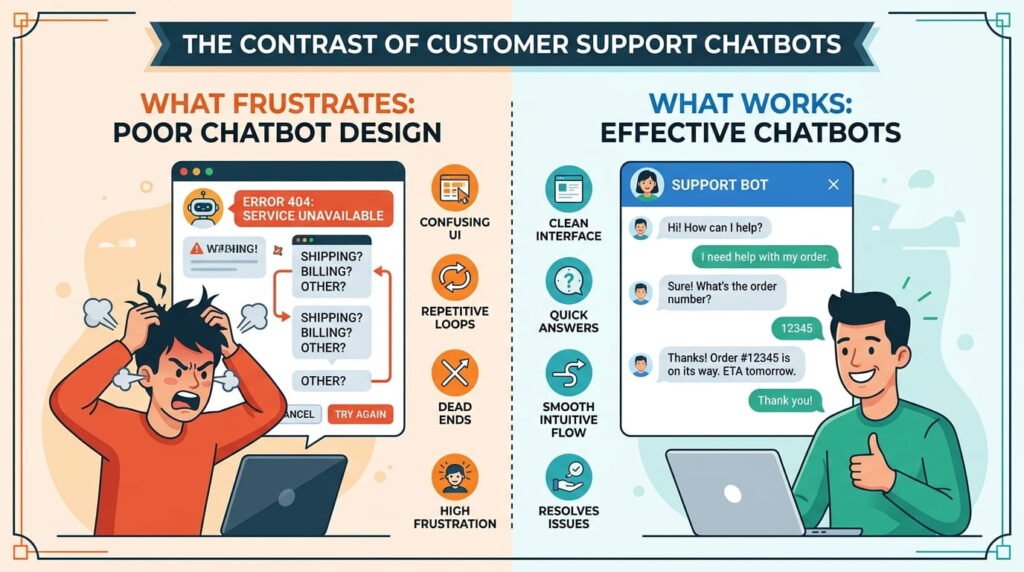
The gap between “chatbot that makes you want to throw your laptop” and “chatbot that quietly solves your problem in ninety seconds” almost entirely comes down to how it’s built and deployed, not whether AI belongs in customer service at all. This piece is about understanding that gap, so if you’re considering chatbots for your own business, or just curious about how they actually work, you come away with something more useful than “chatbots are either great or terrible.”
Table of Contents
- Why Businesses Turned to Chatbots in the First Place
- How AI Customer Service Actually Works Today
- Rule-Based Bots vs. AI-Powered Bots
- What Business Chatbots Genuinely Do Well
- Where Chatbots Still Fall Short
- The Human-AI Handoff: Getting It Right
- Real-World Examples Across Different Industries
- Mini Case Studies: Getting Automation Right and Wrong
- How to Actually Implement a Chatbot Without Alienating Customers
- Measuring Whether Your Chatbot Is Actually Working
- Where This Is All Heading
- Final Thoughts
- FAQ
Why Businesses Turned to Chatbots in the First Place
Customer Support Chatbots has always been a strange balancing act for businesses. Customers expect fast answers, ideally around the clock. But staffing a support team that’s genuinely available 24/7, across every time zone your customers live in, is expensive, and for a lot of businesses, simply unrealistic.
Chatbots emerged as an obvious answer to that gap. A well-built bot doesn’t take breaks, doesn’t get overwhelmed during a traffic spike after a product launch, and doesn’t need to be paid overtime for handling a question at 3 a.m. For businesses fielding a high volume of repetitive, predictable questions where’s my order, how do I reset my password, what’s your return policy automating those answers frees up human agents to spend their time on the complicated, emotionally sensitive, or genuinely unique problems that actually need a person’s judgment.
There’s also a cost dimension that’s hard to ignore. Support teams are one of the more expensive parts of running a customer-facing business, and even modest efficiency gains translate into real savings at scale. But cost-cutting alone isn’t why the good implementations work the good ones work because they genuinely make the customer’s experience faster and easier, not just cheaper for the business.
How AI Customer Support Chatbots Actually Works Today
It’s worth demystifying what’s actually happening when you type a message into a modern support chatbot, because the technology has moved well past the rigid, script-following bots that gave the category its bad reputation.
Older-generation chatbots operated almost entirely on decision trees if the customer’s message contained certain keywords, respond with a pre-written answer Customer Support Chatbots if not, fall back to a generic response or route to a human. This is why those bots felt so brittle. Phrase your question slightly differently than the bot expected, and the whole system fell apart.
Modern AI-powered customer service tools work differently. Built on large language models, they’re capable of understanding the actual meaning and intent behind a customer’s message, even when it’s phrased in an unexpected way, contains typos, or mixes multiple questions into one message.
Instead of matching keywords, they interpret context, which is why a well-built modern bot can handle “hey my package never showed up and I’m kind of annoyed, can someone help” almost as naturally as a trained human agent would.The best implementations also connect the chatbot to a business’s actual internal systems order databases, account information, Customer Support Chatbots knowledge bases, previous support tickets so the bot isn’t just chatting pleasantly but genuinely retrieving real, accurate, personalized information rather than guessing at generic answers.
Rule-Based Bots vs. AI-Powered Bots
Understanding this distinction matters enormously if you’re evaluating chatbot options for your own business, because these two categories behave very differently in practice Customer Support Chatbots.
Rule-based bots follow a fixed, pre-programmed decision tree. You click a button or type a phrase, and the bot responds based on a strict set of predefined pathways. These are cheaper and simpler to build, and they work reasonably well for extremely narrow, predictable use cases a bot that only handles order tracking, for instance, where the range of possible questions is genuinely limited.
AI-powered bots, built on large language models, can handle a much wider and more unpredictable range of questions, understand context across a multi-turn conversation, and adapt their responses dynamically rather than following a fixed script. They require more sophisticated setup and ongoing oversight,Customer Support Chatbots but they scale far better across the messy, varied reality of actual customer questions.
A lot of businesses today use a hybrid: AI handles the understanding and conversation, while certain high-stakes or highly regulated actions processing a refund over a certain dollar amount, for example still route to a specific, more controlled process or a human for approval. This hybrid approach tends to capture the flexibility of AI Customer Support Chatbots while maintaining guardrails where the stakes are higher.
What Business Chatbots Genuinely Do Well
Handling high-volume, repetitive questions instantly. Order status, return policies, basic troubleshooting steps, account information lookups these make up a huge percentage of most companies’ support volume, and a well-built bot can resolve them in seconds, any time of day, without a customer ever waiting in a queue.
Providing true 24/7 availability. For businesses with customers across multiple time zones, or simply people who prefer to sort out issues outside of business hours, round-the-clock availability is a genuine convenience that human-only support teams struggle to match without significant cost.
Reducing wait times during volume spikes. When a sale, product launch, or service outage causes a sudden surge in support requests, a chatbot doesn’t get overwhelmed the way a human team can, absorbing much of that spike without every customer having to wait in a long queue.
Consistent, accurate answers to policy questions. Human agents, especially newer or less experienced ones, can give inconsistent answers to policy questions. A well-configured bot, connected to accurate, up-to-date information, delivers the same correct answer every time.
Freeing up human agents for complex, high-value interactions. This might be the most underrated benefit. When routine questions get absorbed by automation, human agents get to spend more of their time and energy on the conversations that genuinely need empathy, Customer Support Chatbots judgment, and problem-solving which tends to make those interactions better too, since agents aren’t burned out from answering the same simple question for the fiftieth time that day.
Where Chatbots Still Fall Short
Genuinely novel or emotionally complex situations. A customer dealing with a serious, unusual problem, or one who’s frustrated and needs to feel heard before anything else, often needs a human’s judgment and empathy far more than a fast, technically correct answer.
Ambiguous requests that need real clarification. Even sophisticated AI bots can misunderstand a genuinely ambiguous request, and without a human’s intuition for reading between the lines, they can end up confidently answering the wrong question.
Situations requiring real discretion or exceptions. Policies exist for a reason, but good customer service sometimes involves a human deciding to make a reasonable exception based on context a rigid system wouldn’t weigh the same way.
Trust and reassurance during high-stakes moments. For things like a serious billing dispute, an account security concern, or anything involving real financial stress, many customers simply want to know a person is handling their situation, regardless of how capable the bot actually is.
Bots that don’t know their own limits. The worst chatbot experiences happen when a bot keeps confidently attempting to resolve something it’s clearly not equipped to handle, rather than recognizing the situation and handing off to a human quickly. A bot that knows when to say “let me connect you with someone who can help further” is often more trustworthy than one that never admits uncertainty.
The Human-AI Handoff: Getting It Right(Customer Support Chatbots)
If there’s one detail that separates a genuinely good chatbot implementation from a frustrating one, it’s this handoff moment the point where the bot recognizes it should bring in a human, and how smoothly that transition actually happens.
A poor handoff makes the customer repeat their entire problem from scratch once a human agent joins, which feels like the previous several minutes of conversation were wasted. A good handoff passes the full context automatically what the customer asked, what the bot already tried, any relevant account details so the human agent picks up seamlessly, and the customer never has to explain themselves twice.
The trigger for handoff matters just as much as the mechanics. Some businesses set the bot to escalate automatically after a certain number of failed attempts to understand the Customer Support Chatbots, others let the customer request a human at any point without friction, and the more thoughtful implementations combine both always giving the customer an easy exit to a human, while also proactively escalating when the bot detects genuine frustration or a topic outside its competence.
Getting this right requires treating the handoff as a designed part of the experience, not an afterthought bolted on because a bot occasionally fails.
Real-World Examples Across Different Industries
E-commerce. Online retailers use AI chatbots heavily for order tracking, return initiation, and product questions, often integrating the bot directly with inventory and shipping systems so it can give a customer a genuinely accurate, real-time answer rather than a generic response.
Financial services. Banks and financial institutions use chatbots for balance inquiries, transaction history questions, and basic account management, though these implementations tend to be built with particularly careful guardrails given the sensitivity of financial data and the need for airtight security.
Travel and hospitality. Airlines and hotel chains lean on Customer Support Chatbots heavily during high-stress moments like flight delays or cancellations, when support volume spikes dramatically and customers need fast, accurate rebooking or refund information.
SaaS and technology companies. Software companies frequently use Customer Support Chatbots as a first line of technical support, walking customers through common troubleshooting steps before escalating genuinely complex bugs or account issues to a human support engineer.
Healthcare-adjacent services. Appointment scheduling, insurance verification questions, and general administrative inquiries are increasingly handled by chatbots, though anything involving actual medical advice remains firmly, and appropriately, in human hands.
Mini Case Studies: Getting Automation Right and Wrong
A mid-sized online retailer that got it right. After noticing that roughly half their support tickets were simple order status questions, they deployed an AI chatbot connected directly to their shipping and order management system. Customers got instant, accurate tracking updates without waiting in a queue, and the support team saw their average response time on more complex tickets improve significantly, since agents weren’t spending a huge chunk of their day answering the same basic question repeatedly. The key detail Customer Support Chatbots they made the “talk to a person” option visible and easy to find at every stage of the conversation, so customers never felt trapped.
A software company that got it wrong, then fixed it. An early chatbot deployment used a rigid, keyword-based system that frequently misunderstood technical questions and gave customers irrelevant troubleshooting steps, leading to a wave of frustrated feedback and a noticeable uptick in customers explicitly requesting to bypass the bot entirely. After switching to a more sophisticated AI-powered system with clearer escalation triggers, and specifically training it on their actual historical support conversations rather than generic templates, satisfaction scores recovered substantially within a few months.
A small business that intentionally kept things simple. A boutique service business with a modest support volume chose a basic rule-based bot rather than a full AI system, reasoning that their support questions were narrow and predictable enough that the added complexity and cost of an AI-powered solution wasn’t worth it. This is a useful reminder that “more advanced” isn’t automatically “more appropriate” — the right level of automation depends on the actual shape and volume of your support needs.
How to Actually Implement a Customer Support Chatbots
Start narrow, then expand. Rather than trying to automate every possible support scenario immediately, begin with your highest-volume, most predictable questions, get those genuinely right, and expand the bot’s scope Customer Support Chatbots gradually as you build confidence in its accuracy.
Make the human option obvious and easy. Never bury the ability to reach a real person behind multiple menus or vague phrasing. Customers who want a human should be able to get one without a fight.
Train the bot on your actual support history, not generic templates. The businesses seeing the best results tend to feed their AI system real, historical examples of how their own support team has successfully handled past conversations, rather than relying purely on generic, out-of-the-box configurations.
Set honest expectations upfront. Let customers know clearly and immediately that they’re talking to an automated assistant, rather than trying to disguise it. Attempting to pass a bot off as human, beyond feeling dishonest, tends to backfire hard the moment the illusion breaks.
Review real conversations regularly. Don’t set a chatbot live and walk away. Regularly reviewing actual transcripts reveals where the bot is misunderstanding customers, where it’s giving inaccurate information, and where the handoff to humans could be smoother.
Keep a human safety net for sensitive categories. Certain topics genuine complaints, anything involving strong emotion, security concerns, high-value transactions deserve a lower threshold for automatic human escalation, even if the bot could technically attempt to handle them.
Measuring Whether Your Chatbot Is Actually Working
It’s easy to measure the wrong things here, so it’s worth being deliberate about which numbers actually reflect a good customer experience versus which ones just look good on a dashboard.
Resolution rate, not just deflection rate. A bot that successfully deflects a conversation away from a human agent isn’t automatically a win if the customer’s actual problem never got solved. Track whether issues get genuinely resolved, Customer Support Chatbots not just whether they avoided a human agent.
Customer satisfaction specifically on bot-handled conversations. Segment your satisfaction data so you can see how bot interactions perform compared to human-handled ones, rather than lumping everything together and losing the signal.
Escalation quality, not just escalation frequency. A high escalation rate isn’t necessarily bad if it means the bot is correctly recognizing its limits. What matters more is whether escalated conversations transition smoothly, with full context intact.
Time to resolution across the full journey. Measure how long it actually takes a customer to get their issue solved, including any handoff to a human, rather than only measuring how fast the bot’s individual replies are.
Repeat contact rate. If customers frequently have to come back and ask about the same issue again after a bot interaction, that’s a strong signal the original resolution wasn’t actually complete, regardless of how the initial conversation was scored.
Where This Is All Heading
The trajectory here points toward chatbots that feel less like a separate, siloed tool and more like a natural extension of a company’s broader support and operations systems. A few developments are worth watching.
Deeper integration across a customer’s full history. Expect bots to increasingly draw on a customer’s complete interaction history — past purchases, previous support tickets, account preferences — to provide genuinely personalized responses rather than generic ones.
More proactive support, not just reactive. Rather than waiting for a customer to reach out with a problem, some businesses are experimenting with AI systems that detect likely issues in advance — a delayed shipment, an unusual account activity — and reach out proactively before the customer even has to ask.
Better emotional intelligence in bot responses. As underlying language models improve, expect bots to get noticeably better at recognizing frustration or urgency in a customer’s tone and adjusting their approach, or escalating, accordingly.
Continued emphasis on transparency. As AI-powered support becomes more common, expect growing pressure, both from customers and potentially regulation, for businesses to be clear about when a customer is interacting with an AI system versus a human.
Final Thoughts
The businesses winning at chatbot-driven customer support aren’t the ones who automated the most. They’re the ones who automated the right things, and left the right things to people. That distinction sounds simple, but it’s exactly where most implementations go wrong — either by automating too aggressively and frustrating customers who needed a human touch, or by underusing the technology and leaving support teams buried in repetitive questions that never needed a person in the first place.
If you’re considering chatbots for your own business, don’t start by asking how much of your support volume you can automate. Start by asking what your customers actually need in their worst moments — the delayed order, the billing confusion, the frustrated late-night message and build outward from there. Automate the predictable, protect the human touch where it genuinely matters, and make the path between the two as seamless as possible. That’s the difference between a chatbot people tolerate and one they barely notice, because it just quietly solved their problem.
FAQ
1. Will chatbots eventually replace human customer support entirely? Unlikely in the foreseeable future. While chatbots handle repetitive, predictable questions extremely well, situations requiring empathy, judgment, or handling genuine exceptions still benefit significantly from human involvement.
2. How do I know if my business is ready to implement a chatbot? A good early signal is having a meaningful volume of repetitive, predictable support questions order status, policy questions, basic troubleshooting since these are exactly the kinds of interactions chatbots handle best.
3. What’s the biggest mistake businesses make when deploying customer service chatbots? Making it difficult for customers to reach a human when they need one. Trapping frustrated customers in an automated loop is one of the fastest ways to damage trust and satisfaction.
4. Do customers mind interacting with a chatbot instead of a human? Generally, customers care far more about getting their problem solved quickly and accurately than about who or what solved it, provided the bot is transparent about being automated and offers an easy path to a human when needed.
5. Is it expensive to implement an AI-powered customer service chatbot? Costs vary widely depending on scale and sophistication, but many platforms now offer accessible pricing tiers suitable for small and mid-sized businesses, not just large enterprises with dedicated technical teams.
6. Can a chatbot handle sensitive information like account details or payments securely? Reputable platforms build in strong security measures for handling sensitive data, but businesses should carefully review a vendor’s specific security and compliance practices, especially in regulated industries like finance and healthcare.
7. How often should a business review or update its chatbot’s performance? Regularly ideally reviewing real conversation transcripts on an ongoing basis rather than treating the initial setup as a finished, permanent solution, since customer needs and language patterns shift over time.
Read about AI Chatbots For Customer Services