
AI Tools for Small Business Marketing There’s a particular kind of exhaustion that comes with running the marketing for a small business almost entirely by yourself. You’re writing the social captions before breakfast, trying to figure out why last month’s email open rate dropped, designing a graphic you have no formal training to design, and somehow also running the actual business the marketing is supposed to support. Most AI Tools for Small Business Marketing owners aren’t lacking good ideas. They’re lacking hours in the day.
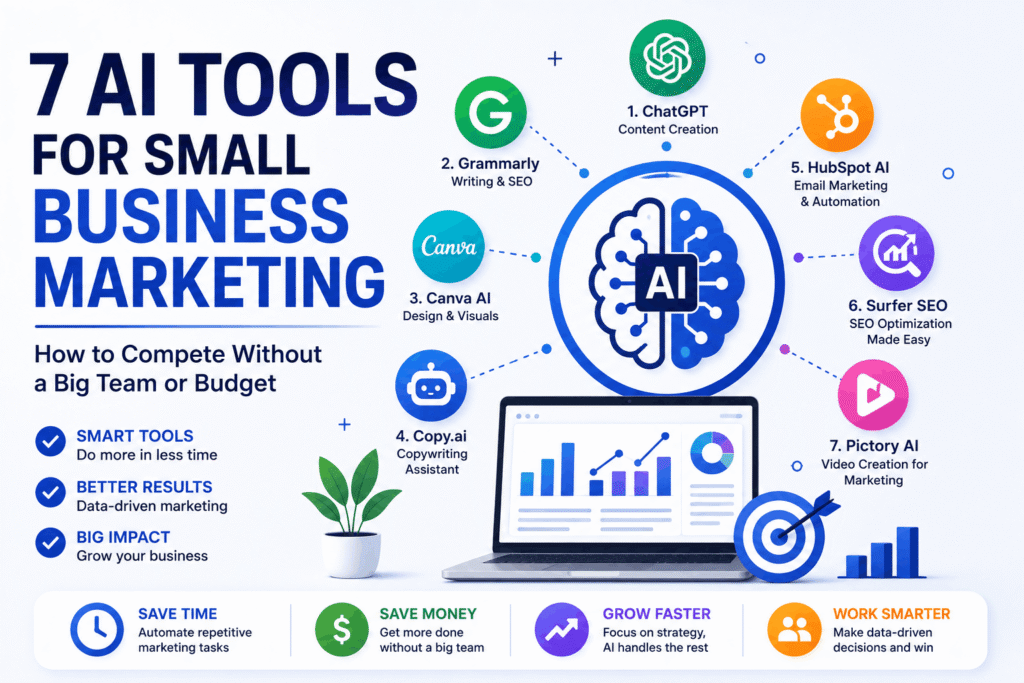
That’s exactly the gap AI Tools for Small Business Marketing have started to close, and not in a vague, theoretical way. A solo founder today can realistically produce the kind of consistent, polished marketing output that used to require an entire small agency, simply by using the right combination of tools intelligently. Business Marketing That’s not an exaggeration meant to sell you on hype. It’s just where the technology has genuinely landed.
This isn’t going to be a list of fifty tools you’ll forget by tomorrow. It’s a practical look at what these tools actually do, where they earn their keep, where they still need real human oversight, and how to build a workflow that doesn’t just save time but actually makes your marketing better.
Table of Contents
- Why Small Businesses Are Turning to AI Marketing Tools
- The Core Categories Worth Understanding
- Content Creation Tools and What They Actually Solve
- Marketing Automation: The Quiet Workhorse
- Social Media Management and Scheduling
- Email Marketing Gets Genuinely Smarter
- AI for Customer Insights and Targeting
- What These Tools Still Can’t Do For You
- Building a Realistic AI Marketing Workflow
- Mini Case Studies From Real Small Businesses
- Common Mistakes to Avoid
- Where This Is All Heading
- Final Thoughts
- FAQ
Why AI Tools for Small Business Marketing Are Turning to AI Marketing Tools
Marketing has always favored businesses with bigger budgets, simply because more budget usually meant more people, more tools, and more time dedicated specifically to getting the message right. A large company can afford a content team, a paid ads specialist, a designer, and an analytics person all working in coordination. AI Tools for Small Business Marketing owner is often trying to be all four of those people at once, in the margins of an already full day.
AI tools have started to level that playing field in a genuinely meaningful way. A single person with the right set of tools can now draft a week of social content in an hour instead of a full day, build an email sequence that used to require hiring a copywriter, and get a reasonably clear read on which marketing efforts are actually driving results, without needing a dedicated analyst to interpret the data.
This matters most for the businesses that have historically been squeezed out of consistent, professional marketing entirely the boutique shop owner, the independent consultant, the local service business competing against national chains with real marketing departments. AI hasn’t erased the advantage bigger budgets bring, but it has meaningfully narrowed it, and that shift is worth taking seriously if you’re running a small operation and wondering where to actually put your limited time.
The Core Categories Worth Understanding
Before diving into specific use cases, it helps to understand the broad categories these tools fall into, because a tool built for one purpose usually isn’t the right choice for a different one.
Content generation tools help produce written material such as blog posts, social captions, ad copy, and email content, often starting from a simple prompt or a few bullet points describing what you need.
Design and visual tools help produce graphics, social media images, and basic video content without requiring formal design training, often through templates guided by AI suggestions.
Automation platforms handle the repetitive, rules-based work of AI Tools for Small Business Marketing such as scheduling posts, sending follow up emails based on customer behavior, and moving contacts through a defined sequence based on their actions.
Analytics and insight tools help interpret marketing data, identify patterns in customer behavior, and surface recommendations that would otherwise require manually digging through spreadsheets and dashboards.
Customer relationship and personalization tools help tailor marketing messages to specific segments of your audience, rather than sending the exact same message to everyone regardless of their history with your business.
Most small businesses end up using a combination from several of these categories rather than relying on a single all in one platform, since no single tool tends to excel at everything.
Content Creation Tools and What They Actually Solve(AI Tools for Small Business Marketing
The blank page problem is real, and it’s arguably the single biggest barrier keeping small business owners from marketing consistently. AI content tools solve this by giving you something to react to and refine, rather than requiring you to generate every idea from nothing.
For blog content, these tools can help outline a post, generate a first draft, and even suggest angles you might not have considered based on what’s currently performing well in your industry. For social captions, they can produce multiple variations of the same core message, which is genuinely useful when you’re trying to post consistently across platforms with different tones and formats.
The important caveat, and one worth repeating regardless of which tool you choose, is that unedited AI content tends to read as generic. & AI Tools for Small Business Marketing The businesses getting real value from these tools treat the AI output as a first draft, then inject the specific details, personality, and voice that make the content actually sound like their AI Tools for Small Business Marketing rather than a template anyone could have generated. A well used AI content tool should save you time on structure and starting points, not replace the judgment about what your specific audience actually wants to hear from you.
Marketing Automation: The Quiet Workhorse
If content tools get most of the attention, automation is arguably the more transformative category for a small business, precisely because it works quietly in the background without requiring your daily involvement.
Marketing automation refers to software that triggers specific marketing actions based on a customer’s behavior, without you manually initiating each one. A new customer subscribes to your email list, and an automated welcome sequence begins without you lifting a finger. Someone abandons a cart on your online store, and a reminder email goes out a few hours later automatically. A customer hasn’t purchased in six months, and a re-engagement offer triggers on its own.
This matters enormously for a small team because it means your marketing keeps working even when you’re not actively at your desk. A well built automation sequence essentially becomes a permanent employee handling a specific, AI Tools for Small Business Marketing repetitive task, freeing your actual time for the strategic decisions and creative work that genuinely benefit from your personal attention.
The setup requires some upfront thought, mapping out what triggers should lead to what actions, but once built, automation tends to be one of the highest return investments a small business can make in its marketing infrastructure, precisely because the effort is front loaded rather than ongoing.
Social Media Management and Scheduling
Staying visible across multiple social platforms used to mean either dedicating significant daily time to posting manually, or letting your presence go quiet during busy stretches, which tends to hurt engagement and visibility over time.
AI powered social media tools help in a few distinct ways. They can suggest optimal posting times based on when your specific audience tends to be most active, generate caption variations tailored to each platform’s particular tone and character limits, and batch schedule an entire week or month of content in a single sitting rather than requiring daily manual posting.
Some tools also offer basic performance analysis, flagging which types of posts tend to perform best for your specific audience, which helps you refine your content strategy over time based on actual data rather than guesswork. AI Tools for Small Business Marketing This is particularly valuable for a small business owner without the time to manually track and analyze performance metrics across multiple platforms every week.
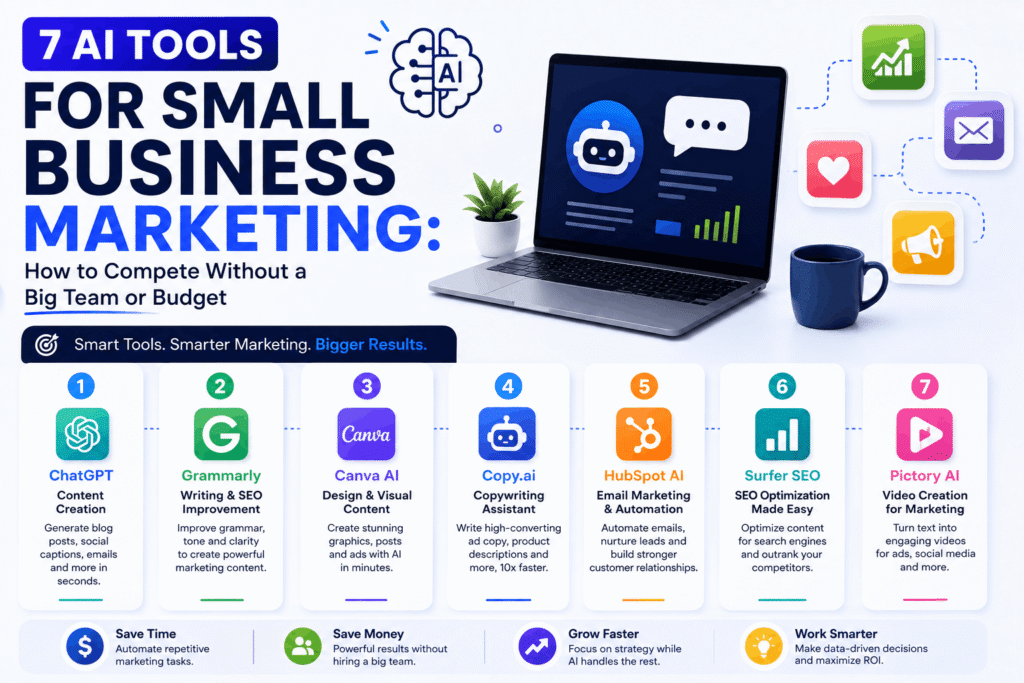
The practical benefit here isn’t just time saved, though that matters plenty. It’s consistency. A business that posts reliably, even without daily manual effort, tends to build stronger audience trust and algorithm favor than one that posts in unpredictable bursts followed by long silences.
Email Marketing Gets Genuinely Smarter
Email remains one of the highest return marketing channels available to small businesses, and AI has meaningfully improved what’s possible here without requiring specialized copywriting or data analysis skills.
Modern AI powered email tools can help write subject lines optimized for open rates, suggest send times based on when your specific list tends to engage most, and personalize content dynamically based on a subscriber’s past behavior, AI Tools for Small Business Marketing rather than sending an identical message to your entire list regardless of their individual history with your business.
Segmentation, which used to require manually sorting contacts into different lists based on characteristics or behavior, can now happen automatically based on patterns the software identifies in your customer data. AI Tools for Small Business Marketing who frequently buys a particular product category can automatically receive content relevant to that category, while a lapsed customer receives a different, re-engagement focused message, all without you manually managing separate lists by hand.
The businesses seeing the strongest results from AI Tools for Small Business Marketing tend to be the ones who use the automation to handle personalization at scale, while still writing the core brand voice and key messages themselves, rather than fully outsourcing the strategic thinking to the software.
AI for Customer Insights and Targeting
Understanding your customers has always been foundational to good marketing, but small businesses have historically lacked the resources to properly analyze customer data the way larger companies with dedicated analytics teams could AI Tools for Small Business Marketing
AI powered insight tools change that considerably. They can identify patterns across your customer base that would be genuinely difficult to spot manually, such as which customer segments are most likely to make a repeat purchase, which marketing channels are actually driving your highest value customers rather than just the most traffic, and which messaging themes tend to resonate most with specific audience segments.
This kind of insight used to require either significant technical skill or an expensive outside consultant. Now, a small business owner can get a reasonably clear, actionable read on their own customer data through tools designed specifically to translate raw numbers into plain language recommendations.
The caveat worth keeping in mind is that these insights are only as good as the underlying data feeding them. A business with inconsistent tracking or limited historical data will get considerably less useful output than one with clean, well organized customer information, which is worth investing time in even before bringing AI tools into the picture.
What These Tools Still Cannot Do For You
It would be dishonest to present AI Tools for Small Business Marketing as a complete replacement for genuine strategic thinking, and any honest look at this space needs to say so clearly.
AI cannot define what makes your business genuinely different from your competitors. That’s a strategic judgment only you and your team can make, informed by real knowledge of your market and customers that the software simply does not have access to.
AI cannot build authentic relationships with your community on your behalf. It can help you communicate more efficiently, but the trust that comes from a business owner genuinely engaging with their customers, responding to feedback thoughtfully, and showing up consistently over time is not something software can manufacture for you.
AI cannot reliably judge what’s tasteful, appropriate, or on brand for a nuanced, sensitive situation. A tone deaf post during a difficult news cycle, or messaging that misreads your audience’s current mood, is exactly the kind of mistake AI tools are prone to making without careful human review AI Tools for Small Business Marketing.
AI cannot replace the strategic decision of where to actually focus your limited marketing budget and time. It can inform that decision with better data, but the final call about priorities still belongs to you.
Treating these tools as an amplifier for your judgment, rather than a replacement for it, is the mindset that consistently separates businesses getting real value from AI marketing tools from those who end up with generic, forgettable output despite the technology being perfectly capable.
Building a Realistic AI Marketing Workflow
Start by identifying your single biggest time drain in current marketing efforts, whether that is content creation, scheduling, email writing, or data analysis, and address that specific bottleneck first rather than trying to overhaul everything simultaneously.
Choose one tool per category rather than accumulating a large stack of overlapping software, since managing too many disconnected tools often creates more overhead than it saves, particularly for a small team without dedicated technical support.
Set aside dedicated time weekly, even just an hour, to review and refine AI generated content and automated sequences, rather than setting things up once and assuming they remain optimal indefinitely without ongoing attention.
Keep your brand voice guidelines written down somewhere accessible, whether a simple document or a set of example phrases and tone notes, and feed that context into your AI tools consistently, since specific guidance produces noticeably better, more on brand output than vague or absent direction.
Measure results honestly rather than assuming automation is working simply because it is running. Regularly check whether your automated sequences and AI assisted content are actually driving the outcomes you care about, not just whether they are technically functioning.
Mini Case Studies From Real Small Businesses
A independent bakery owner struggling to post consistently on social media started using an AI scheduling tool to batch generate and schedule a full month of content in a single afternoon each month, dramatically improving her posting consistency without adding daily time commitment. She still personally reviews and edits every caption before it goes live, ensuring the tone matches her actual personality rather than sounding generic.
A small consulting firm with two partners implemented email automation to handle their lead nurture sequence, which previously relied on manually remembering to follow up with prospects at the right intervals. After automating the sequence, their follow up consistency improved dramatically, and they noticed a meaningful increase in prospects converting to actual clients, simply because fewer leads slipped through the cracks during busy weeks.
A boutique fitness studio used an AI insight tool to analyze their membership data and discovered that a significant portion of their highest value, longest retained members had originally come through a specific referral channel they had been under investing in. That single insight led them to shift marketing budget toward strengthening their referral program, a decision informed by data they would not have easily surfaced manually.
Common Mistakes to Avoid
Publishing AI generated content without meaningful editing tends to produce generic material that fails to differentiate a business from its competitors, undermining the very consistency the tools were meant to support.
Automating too aggressively too quickly, without testing sequences on a smaller scale first, can lead to embarrassing mistakes reaching your entire customer base before problems get caught and corrected.
Ignoring the data these tools surface, treating analytics features as a nice extra rather than genuinely acting on the recommendations, wastes much of the actual value these tools provide.
Choosing tools based purely on price or popularity rather than fit for your specific business needs often leads to underused subscriptions and frustration, particularly when a simpler business ends up paying for enterprise level complexity it never actually needs.
Forgetting that customers can often tell when marketing feels impersonal or overly automated, which risks eroding the trust and authenticity that small businesses often rely on as a genuine competitive advantage against larger, more impersonal competitors.
Where This Is All Heading
Expect these tools to keep integrating more deeply with each other, reducing the current fragmentation where a small business owner has to manually move information between separate content, automation, and analytics platforms.
Expect personalization to keep getting more precise, with AI increasingly able to tailor messaging to individual customer preferences and behavior patterns at a level of detail that would be entirely impractical to manage manually.
Expect stronger built in guidance around brand voice consistency, helping smaller businesses maintain a cohesive, recognizable identity across a growing number of automated touch points without requiring constant manual oversight.
Expect continued emphasis on transparency and authenticity, as customers become increasingly attuned to generic AI generated marketing and increasingly reward businesses whose communication still feels genuinely human and specific to them.
Final Thoughts
The small businesses winning with AI marketing tools right now are not the ones automating everything possible. They are the ones being deliberate about which parts of their marketing genuinely benefit from automation, and which parts still need their own voice, judgment, and personal touch to actually connect with customers.
Used well, these tools give you back something genuinely valuable that has nothing to do with the technology itself: time and energy to spend on the parts of your business that only you can actually do. That might mean more time actually talking to customers, refining your product, or simply having a life outside the business you built.
If you take one step away from this article, make it small and specific. Pick the single biggest time drain in your current marketing routine, find one tool that genuinely addresses it, and give yourself a month to actually use it well before adding anything else to your workflow. Consistent, thoughtful use of one tool will move your business further than a scattered collection of five tools you never fully learn to use.
FAQ
1. Do I need technical skills to use AI marketing tools as a small business owner? Generally no. Most modern AI marketing tools are built specifically for non technical users, with intuitive interfaces designed for business owners rather than developers or marketing specialists.
2. How much should a small business expect to spend on AI marketing tools? Costs vary considerably, but many tools offer accessible entry level pricing suitable for small budgets, and some offer free tiers sufficient for testing whether a tool genuinely fits your needs before committing financially.
3. Will AI marketing tools make my content sound generic and impersonal? Only if used without editing and personalization. Treating AI output as a first draft rather than a finished product, and consistently injecting your own voice and specific details, keeps content feeling authentic rather than generic.
4. Which should I prioritize first, content creation tools or marketing automation? It depends on your biggest current bottleneck. If inconsistent posting is your main struggle, start with content and scheduling tools. If you are losing potential customers due to inconsistent follow up, automation is likely the higher priority investment.
5. Can AI marketing tools replace hiring a marketing person entirely? For many small businesses, yes, particularly in the early stages, though most businesses eventually benefit from combining these tools with genuine human strategic oversight as the business grows and marketing needs become more complex.
6. How do I know if an AI marketing tool is actually working for my business? Track specific outcomes tied to your business goals, such as engagement rates, conversion rates, or time saved, rather than simply assuming a tool is effective because it is technically functioning and producing output.
7. Is it risky to rely heavily on AI for customer facing marketing communication? There is some risk if used carelessly, particularly around tone and authenticity, but with thoughtful human review and clear brand guidelines, most small businesses find the benefits considerably outweigh the risks involved.
Read about AI Marketing Tools For Small Business