
Content with AI Somewhere around 2 a.m., you’ve probably stared at a blinking cursor, trying to write the “About Us” page for a website that’s launching tomorrow. Every sentence sounds either like a corporate brochure or a bad LinkedIn post. You delete it. Start again. Delete it again.
If that scene feels familiar, you’re not alone, and you’re also not behind the times for reaching for AI to help. Writing website content the kind that actually converts visitors into customers, ranks in search, and doesn’t sound like it was copy-pasted from a template has always been harder than people expect. It’s not just stringing sentences together. It’s persuasion, clarity, SEO strategy, and brand voice all fighting for space in the same 300 words.
AI writing tools didn’t eliminate that difficulty, but they changed the starting point dramatically. Instead of facing a blank page, you’re now facing a rough draft you can shape, argue with, and improve. That’s a genuinely different creative experience, and it’s worth understanding properly before you decide how or whether to build it into your workflow.
Table of Contents
- Why Website Content Is Different from Other Writing
- How AI Blog Generators Actually Work
- Jasper.ai: What It Does and Who It’s Built For
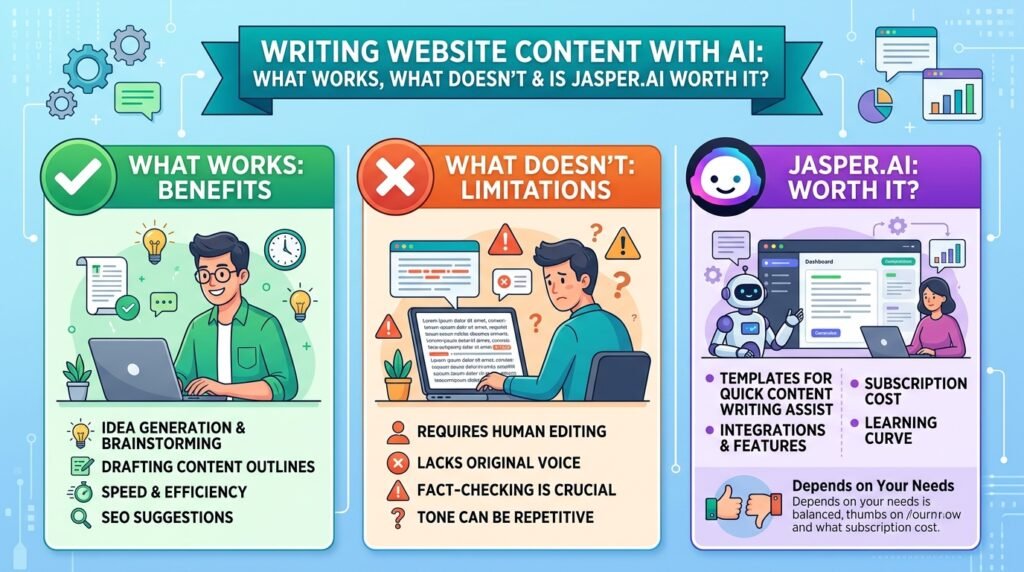
- The Honest Pros of Using AI for Website Content
- The Real Limitations Nobody Puts in the Marketing Copy
- Where AI Content Shines Versus Where It Struggles
- A Realistic Workflow for Writing Website Content with AI
- SEO Considerations You Can’t Afford to Ignore
- Mini Case Studies: How Different Businesses Use AI Content
- Common Mistakes to Avoid
- Final Thoughts
- FAQ
Why Website Content Is Different from Other Writing
Before getting into the tools themselves, it’s worth understanding why website copy is its own particular beast, distinct from writing an email, a novel, or a social post.
Content with AI has to do several jobs at once. It needs to be scannable, because most visitors skim rather than read line by line. It needs to be persuasive, because every page is quietly asking the reader to do something sign up, buy, subscribe, call. And increasingly, it needs to satisfy search engines too, which have their own opinions about structure, keyword relevance, and depth.
That’s a lot of competing demands for a few hundred words. A homepage headline that’s beautifully written but doesn’t communicate what the business actually does will underperform, no matter how clever it sounds. A blog post packed with keywords but written in a stiff, robotic voice will rank poorly and bore the humans who do land on it.
This is exactly why AI became such an attractive shortcut here. Website content is formulaic enough, in a structural sense, that AI models handle the scaffolding well while still leaving room for a human to inject the voice, nuance, and strategic judgment that make it actually good.
How AI Blog Generators Actually Work
It helps to demystify this a little, because a lot of the skepticism around AI writing tools comes from people imagining something more magical (or more sinister) than what’s actually happening under the hood.
AI blog generators are built on large language models trained on enormous amounts of text. When you give one a prompt say, Content with AI “write an introduction for a blog post about home coffee brewing” it’s not pulling from a stored database of pre-written coffee articles. It’s predicting, word by word, what a coherent, contextually appropriate continuation of that request would look like, based on patterns it absorbed during training.
This is why AI-generated content can feel eerily fluent but occasionally hollow. The model is excellent at mimicking structure and tone, but it doesn’t “know” your business, your customers, or your specific competitive advantage unless you tell it. Left completely unguided, it defaults to generic, safe, broadly applicable phrasing which is exactly the kind of content that fails to differentiate a brand.
Most modern tools try to solve this by letting you feed in more context: your brand voice, target keywords, existing content samples, even your ideal customer profile. The better the input, the better the output. Garbage in, garbage out still applies here, just with more sophisticated garbage.
Jasper.ai: What It Does and Who It’s Built For
Jasper.ai has positioned itself specifically for marketing teams and content-heavy businesses, rather than general-purpose writing. That distinction matters, because it shapes what the tool is actually good at.Where a general AI chatbot and Content with AI might handle a one-off request reasonably well, Jasper is built around repeatable content production the kind of workflow a marketing team runs weekly, not just once. It offers brand voice training, letting you feed it examples of your existing content so its output better matches your established tone rather than sounding like generic AI copy. Content with AI It also includes templates specifically designed for common website and marketing needs: product descriptions, ad copy, landing pages, email sequences, and blog outlines.
For teams producing high volumes of content say, an e-commerce store needing hundreds of product descriptions, or an agency managing content calendars for multiple clients this kind of structured, brand-aware system tends to save considerably more time than a general-purpose AI tool used ad hoc.It’s not without tradeoffs. Jasper is a paid, subscription-based tool aimed squarely at businesses rather than casual users, so it’s a harder sell if you just need the occasional blog post.
And like every AI writing tool, its output still benefits enormously from human editing brand voice training narrows the gap, but it doesn’t eliminate the need for a real person to review, fact-check, and refine what comes out.The practical takeaway: Jasper tends to make the most sense for teams already producing content at scale who want consistency and speed, rather than individuals writing the occasional page.
The Honest Pros of Using AI for Website Content
Speed, obviously but not just speed. The more interesting benefit is momentum. Staring at a blank page is often the biggest barrier to writing anything at all. An AI-generated first draft, even an imperfect one, gives you something to react to, which is psychologically much easier than creating from nothing.
Consistency across large volumes of content. If you’re writing fifty product descriptions, human writers naturally get fatigued and inconsistent by the fortieth one. AI tools don’t tire, and with the right brand guidelines fed in, they can maintain a more even tone across a large batch.
Lower barrier for non-writers. Small business owners who aren’t naturally comfortable writing can now produce reasonably solid website copy without hiring outside help for every single page, which matters enormously for anyone bootstrapping a business.
Faster iteration and testing. Marketing teams can generate multiple headline or landing page variations quickly, Content with AI then test them against real audience data, rather than waiting on a writer to produce each variation manually.
The Real Limitations Nobody Puts in the Marketing Copy
It doesn’t actually know your customers. AI can write persuasively in a general sense, but it doesn’t know the specific objection your last ten customers raised on sales calls, or the inside joke your community has about your product. That texture has to come from you.
It can confidently state things that aren’t true. This happens more than people expect, especially with statistics, specific claims, or nuanced technical details. Every factual claim in AI-generated content needs verification before it goes live treating AI output as a finished, trustworthy source is a genuine risk, not a minor inconvenience.
Generic phrasing creeps in without careful editing. Left unchecked, AI writing tends to gravitate toward safe, broadly applicable language — a lot of “unlock your potential” and “take your business to the next level” type phrasing that says very little. It reads smoothly but doesn’t actually differentiate your brand from a hundred competitors using the same tools.
Search engines are increasingly good at detecting low-effort AI content. Publishing large volumes of unedited AI text, especially content that lacks original insight or firsthand experience, has become a real risk for search rankings, not just a stylistic concern.
Content with AI Shines Versus Where It Struggles
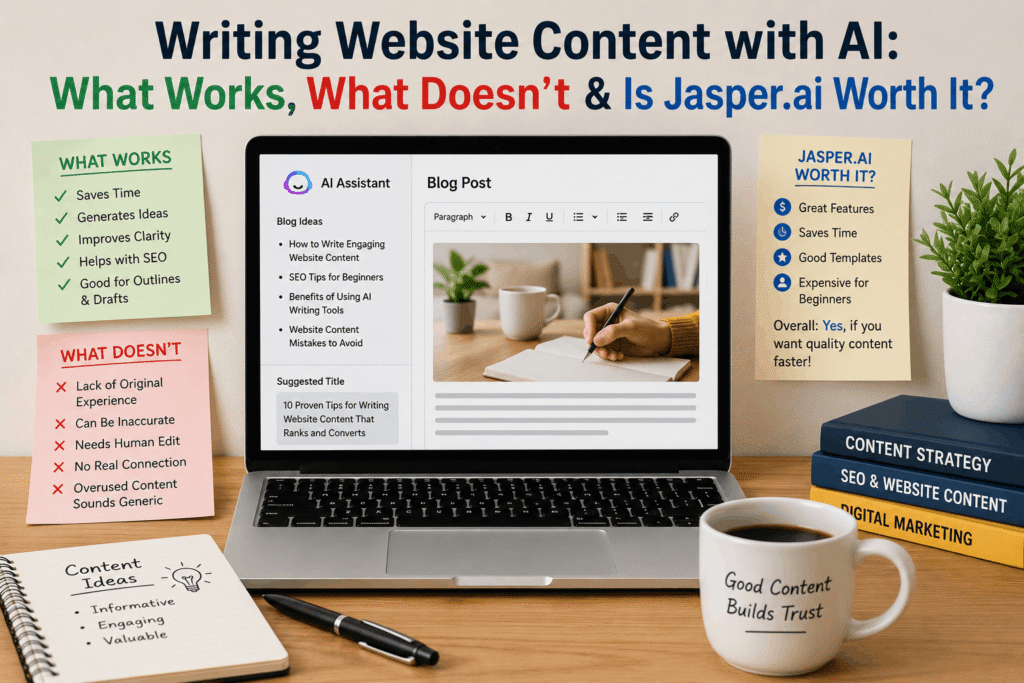
Content with AI It’s genuinely useful to separate these two categories honestly, rather than treating AI writing as universally good or universally bad.
Where it shines:
- Structural first drafts outlines, headings, basic page frameworks
- Repetitive, high-volume content like product descriptions or FAQ answers
- Brainstorming headline or subject line variations
- Summarizing or reformatting existing content into a new format
- Filling in standard boilerplate sections, like shipping policies or basic terms
Where it struggles:
- Anything requiring genuine firsthand experience or expertise (a personal case study, a specific technical process unique to your business)
- Emotionally nuanced storytelling that needs to feel authentic rather than performative
- Highly specialized or regulated content where factual precision is critical (medical, legal, financial)
- Content meant to establish deep authority and trust, where generic phrasing undermines credibility rather than building it
A Realistic Workflow for Writing Website Content with AI
Here’s a workflow that tends to hold up well in practice, whether you’re a solo founder or part of a larger content team.
Step one: Start with strategy, not the AI tool. Before generating anything, get clear on who the page is for, what action you want them to take, and what makes your offer genuinely different. Content with AI can’t do this strategic thinking for you in any meaningful way it needs direction, not a blank slate.
Step two: Generate a structural draft. Use the AI tool to produce an outline or rough first draft based on your strategy notes. Treat this the way you’d treat a first draft from a junior writer useful scaffolding, not a finished product.
Step three: Inject specificity. Go through the draft and replace generic statements with specific details only you know actual customer feedback, particular product features, your real founding story, specific numbers and outcomes.
Step four: Edit aggressively for voice. Read it out loud. If it doesn’t sound like a real person from your brand talking, rewrite the sentence. This step alone is often what separates content that converts from content that just sits there.
Step five: Fact-check everything. Any statistic, claim, or specific detail needs independent verification before publishing. Never assume AI-generated facts are accurate without checking.
Step six: Optimize for search, but for humans first. Review keyword placement and structure for Content with AI SEO, but never at the expense of readability. Content optimized purely for algorithms and not for real readers tends to underperform anyway, since search engines increasingly reward genuinely useful, well-structured writing.
SEO Considerations You Can’t Afford to Ignore(Content with AI)
A lot of businesses assume that using an AI blog generator automatically produces SEO-friendly content, since many tools advertise keyword optimization features. That’s only partially true, and treating it as fully true is a mistake.Search engines have become considerably better at recognizing content that demonstrates genuine expertise and firsthand experience versus content that reads as generic and interchangeable. This means the winning strategy isn’t “generate content quickly and often” it’s “use AI to accelerate production, but ensure the final content still demonstrates real knowledge, unique perspective, and accuracy.”
Keyword stuffing, a common mistake with early AI content strategies, tends to backfire. Modern search algorithms favor natural language that answers a searcher’s actual question thoroughly, rather than content mechanically repeating a target phrase. Content with AI & AI tools can help identify relevant keywords and related questions to address, but the actual writing still needs to prioritize genuine usefulness over keyword density.
It’s also worth remembering that thin, low-value content even if grammatically flawless tends to underperform over time. A page needs a reason to exist beyond filling a content calendar slot. If an AI-generated page doesn’t add anything a reader couldn’t get from a dozen other sites, no amount of technical optimization will save it long term.
Mini Case Studies: How Different Businesses Use AI Content
A solo consultant building her first website. She used an AI writing tool to generate first drafts for her services page and About page, then spent an afternoon rewriting them in her own voice, adding specific client outcomes and her actual background story. The AI saved her from staring at a blank page for days, but the final copy that converted visitors was almost entirely rewritten by her.
A small e-commerce store with 200 products. Writing unique, compelling descriptions for two hundred products by hand simply wasn’t realistic on a small team’s timeline. They used Jasper’s product description templates to generate a first pass for every item, then had a single team member spend a few hours per week refining the highest-traffic product pages by hand, while lower-traffic pages remained closer to the original AI draft.
A SaaS company scaling its blog. Rather than replacing their in-house writer, the marketing team used AI tools to handle outlining and research summarization, freeing their writer to focus entirely on original analysis, customer interviews, and the sections requiring genuine expertise essentially using AI as a research assistant rather than the final voice.
Common Mistakes to Avoid
Publishing AI drafts without human review. This is the single most common and most damaging mistake. Unedited AI content tends to read as flat and generic, and factual errors slip through easily.
Using AI to replace strategy rather than execution. AI can help you write faster once you know what you want to say, but it’s a poor substitute for the thinking that determines what your website actually needs to communicate in the first place.
Ignoring brand voice consistency. Without deliberate effort to train or guide the tool with your specific voice, AI-generated pages across a website can end up sounding subtly different from each other, undermining the cohesive feel a strong brand needs.
Treating every page the same way. A high-stakes page like your pricing or homepage deserves significantly more human refinement than a low-traffic FAQ entry. Content with AI Not every piece of content needs the same level of editing investment, but the important pages absolutely do.
Forgetting that readers can often tell. People have become increasingly attuned to generic AI phrasing. Content that leans too heavily on safe, vague language risks eroding trust rather than building it, especially on pages meant to establish credibility.
Final Thoughts
AI hasn’t replaced good website copywriting it’s replaced the blank page. That’s a meaningful difference, and understanding it changes how you should actually use these tools.
The businesses getting real value from AI blog generators and platforms like Jasper.ai aren’t the ones publishing unedited output at scale. They’re the ones using AI to handle the repetitive, structural heavy lifting, while reserving their own time and judgment for the parts that actually require a human perspective the story only you can tell, the specific detail that builds trust, the voice that makes your brand sound like an actual business run by actual people.
If you’re about to write your next page, don’t ask whether you should use AI. Ask what part of the job you genuinely want help with, and what part only you can do well. Start there, and the tool becomes what it should be a fast, capable assistant, not a replacement for your own voice.
FAQ
1. Can AI-written website content rank well on Google? Yes, but only when it’s edited thoroughly and demonstrates genuine expertise and usefulness. Thin, unedited AI content, even if grammatically correct, tends to underperform against content that clearly reflects real knowledge and firsthand insight.
2. Is Jasper.ai worth it for a small business with just a handful of website pages? Probably not on its own merits if your content needs are minimal — it’s built for volume and team workflows. A general-purpose AI writing tool is usually sufficient for a small, occasional content need.
3. How much editing does AI-generated website content actually need? Plan on treating any AI draft as a strong starting point rather than a finished product. High-visibility pages like your homepage or pricing page deserve substantial human rewriting, while lower-stakes pages may need lighter edits.
4. Will using AI to write my website content get me penalized by search engines? Not simply for using AI, but publishing large volumes of generic, unedited, low-value content can hurt your rankings over time. The quality and usefulness of the content matters far more than how it was produced.
5. What’s the biggest mistake businesses make when using AI blog generators? Publishing the AI’s first draft with minimal review. Skipping the editing and fact-checking stage is where most of the real risk and quality loss happens.
6. Can AI tools match my brand’s specific voice and tone? To a meaningful degree, especially with tools like Jasper that support brand voice training from existing content samples. But full authenticity still requires human review and refinement, particularly for your most important pages.
7. Should I mention that content on my website was written with AI assistance? There’s no universal legal requirement to disclose this in most contexts, but the more important question is whether the content is accurate, useful, and genuinely representative of your business — transparency about your process matters less than the quality and honesty of what’s actually on the page.
Read about 10 Powerful Benefits