
I still remember the first time an AI chatbot confidently gave me a completely made-up statistic. It didn’t stutter, didn’t hedge, didn’t say “I’m not sure.” It just stated a fake number like it was reading it off a government report. I actually used that number in a client deck before a colleague caught it. That’s the moment I stopped trusting large language models blindly and it’s also the moment I started paying close attention to something called.
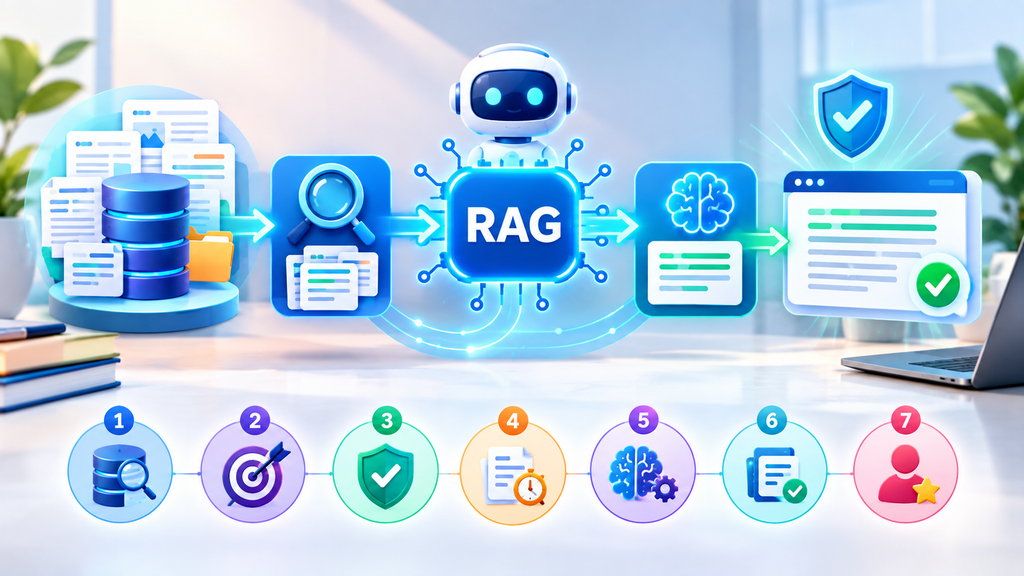
If you’ve spent any time around AI tools in the last couple of years, you’ve probably heard the term thrown around in meetings, LinkedIn posts, or product documentation: RAG. Short for Retrieval-Augmented Generation, it’s quietly become one of the most important ideas in applied AI. Not because it’s flashy, but because it solves a very real, very expensive problem AI models making things up with total confidence.
This article is a deep, practical walk-through of what actually is, how a RAG system is built under the hood, and why architecture has become the go-to fix for AI hallucinations in production environments across the US and UK. No fluff, no hype just a clear explanation from someone who’s watched this technology move from research papers to real business tools.
By the end, you’ll understand exactly how RAG works, why it matters, and how to think about it whether you’re a developer, a product manager, or just someone trying to figure out why your company’s chatbot keeps saying weird things.
Table of Contents
- What Is Retrieval-Augmented Generation (RAG)?
- Why Do Large Language Models Hallucinate?
- The Core Components of Architecture
- How RAG Actually Works, Step by Step
- RAG vs. Fine-Tuning vs. Prompt Engineering
- Real-World Examples of in Action
- The Limitations and Challenges of RAG
- Best Practices for Building a Reliable System
- The Future of Retrieval-Augmented Generation
- Frequently Asked Questions
- Final Thoughts
What Is Retrieval-Augmented Generation (RAG)?
Let’s start with the basics, because the term itself sounds more intimidating than it needs to be.
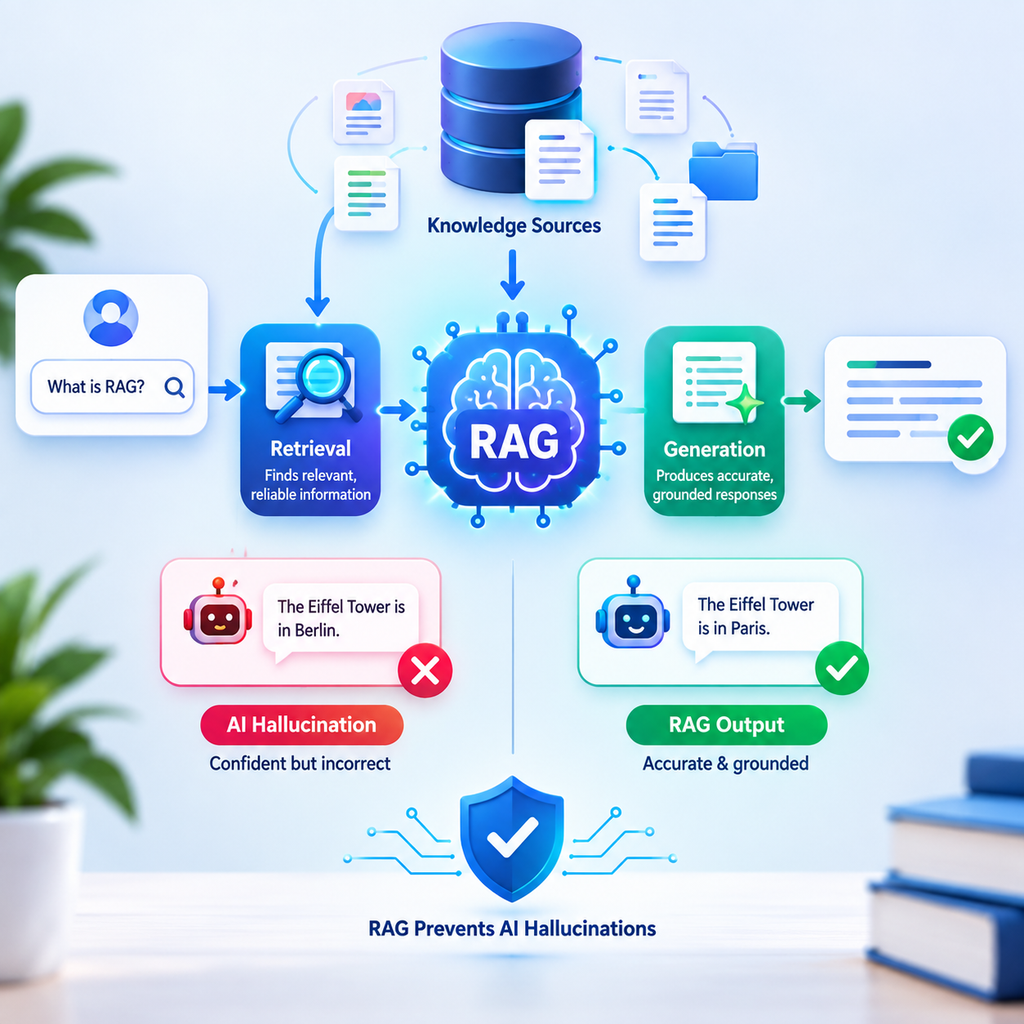
Retrieval-Augmented Generation, or , is an AI architecture that combines two things: a search system (the “retrieval” part) and a language model (the “generation” part). Instead of asking an AI model to answer purely from what it memorized during training, a system first goes and finds relevant, up-to-date information from an external source — a document library, a database, a website, internal company files and then feeds that information to the model before it generates a response.
Think of it like the difference between a student who has to answer a test question purely from memory versus a student who’s allowed to open their textbook first. The second student is going to be more accurate, more specific, and far less likely to guess. That’s essentially what RAG does for AI. It gives the model a textbook to reference in real time instead of forcing it to rely solely on what it “remembers.”
The term was popularized by a 2020 research paper from Meta AI (then Facebook AI Research), and since then, RAG has become one of the standard architectures for building reliable AI applications, especially anything involving customer support, legal research, medical information, internal knowledge bases, and enterprise search.
Here’s the key thing to understand: isn’t a replacement for a large language model. It’s an enhancement. You still need the underlying model to understand language, reason through a query, and generate a coherent answer. RAG just makes sure that answer is grounded in real, retrievable facts instead of whatever the model half-remembers from training.
Why Do Large Language Models Hallucinate?
Before we go further into how RAG solves hallucinations, it helps to understand why they happen in the first place.
Large language models like GPT, Claude, or Gemini are trained on massive amounts of text data. During training, they learn statistical patterns which words tend to follow other words, which facts tend to appear together, which sentence structures are common. They don’t actually “know” facts the way a database knows facts. They predict what’s likely to come next based on patterns.
This means a few things:
- Training data has a cutoff. Once training ends, the model has no idea what’s happened since. Ask it about something that occurred last week, and it may confidently make something up.
- Models generalize, they don’t memorize precisely. A model might blend two similar facts together, producing something that sounds right but isn’t accurate.
- There’s no built-in fact-checker. The model generates the most statistically probable next word, not necessarily the most true one. If a lie sounds statistically similar to the truth, the model may say it with the same confidence.
- Ambiguous or narrow questions increase risk. If you ask about a niche topic the model saw very little of during training, it may “fill in the gaps” with plausible-sounding fiction.
This is what the industry calls hallucination when an AI model generates information that sounds authoritative but is factually wrong, fabricated, or unverifiable. And it’s not a rare glitch. Studies from companies building enterprise AI tools have found hallucination rates ranging anywhere from a few percent to over 20% depending on the task, the domain, and how specific the question is.
For casual use, a hallucination might just be embarrassing. For a law firm, a healthcare provider, or a financial services company, a hallucination can be a liability nightmare. This is exactly the gap that RAG architecture was designed to close.
The Core Components of RAG Architecture
Now let’s get into the mechanics. A typical RAG system is built from several distinct components working together. Understanding these pieces makes the whole concept click.
1. The Knowledge Base (or Document Store)
This is the external source of truth the material the RAG system will pull information from. It could be:
- A company’s internal wiki or SharePoint
- Product manuals and technical documentation
- Legal contracts or compliance policies
- Customer support tickets and FAQs
- Scientific papers or medical literature
- Public web pages
This content gets broken into smaller chunks (usually a few hundred words each) and converted into what’s called embeddings numerical representations of meaning that allow a computer to compare how similar two pieces of text are, even if they use different wording.
2. The Vector Database
Once the knowledge base has been converted into embeddings, it’s stored in a vector database tools like Pinecone, Weaviate, Chroma, or FAISS are common choices here. This database is optimized for one specific job: finding the chunks of text that are most semantically similar to a given query, extremely fast, even across millions of documents.
3. The Retriever
The retriever is the component that takes a user’s question, converts it into an embedding using the same method used for the knowledge base, and then searches the vector database for the most relevant matches. This is the “R” in RAG, and it’s arguably the most important part of the entire pipeline, because if the retriever pulls back irrelevant or low-quality information, the final answer will suffer no matter how good the language model is.
4. The Generator (the Language Model)
Once the retriever has pulled back the most relevant chunks, those chunks are combined with the original user question and passed into the language model as context. The model then generates a response using both its general language understanding and the specific, retrieved facts. This is the “G” in RAG.
5. The Orchestration Layer
Behind the scenes, there’s usually a layer of logic tying everything together deciding how many chunks to retrieve, how to rank them, whether to re-rank results using a secondary model, how to format the final prompt, and how to handle cases where nothing relevant is found. This orchestration layer is often built using frameworks like LangChain, Llama Index, or custom pipelines.
Put simply: a RAG system is a search engine and a language model working as a team, with a coordination layer making sure they communicate effectively.
How RAG Actually Works, Step by Step
Let’s walk through an actual example so the RAG architecture feels less abstract.
Imagine you work at an insurance company, and a customer asks your AI assistant: “Does my policy cover water damage from a burst pipe?”
Here’s what happens inside a RAG pipeline:
Step 1: The query is received. The system takes the customer’s question as-is.
Step 2: The query is embedded. The question gets converted into a numerical vector representing its meaning.
Step 3: The retriever searches the knowledge base. It compares the query’s vector against thousands of embedded chunks from the company’s policy documents, underwriting guidelines, and FAQ database.
Step 4: The most relevant chunks are pulled. Maybe it finds three specific sections one about water damage exclusions, one about plumbing-related coverage, and one about claim filing procedures.
Step 5: Those chunks are injected into the prompt. The language model now receives something like: “Using the following policy excerpts, answer the customer’s question: [retrieved text]. Question: Does my policy cover water damage from a burst pipe?”
Step 6: The model generates a grounded answer. Instead of guessing based on general insurance knowledge from its training data (which might be outdated or generic), the model answers using the actual, current policy language retrieved in real time.
Step 7: Optionally, the system cites its sources. Many RAG implementations show which document or section the answer came from, giving the user a way to verify the response themselves.
This is the magic of RAG architecture. The AI isn’t reasoning in a vacuum anymore it’s reasoning with receipts.
RAG vs. Fine-Tuning vs. Prompt Engineering
A question I get asked constantly: why not just fine-tune the model on your own data instead of building a whole RAG pipeline?
It’s a fair question, and the honest answer is that RAG and fine-tuning solve different problems.
Fine-tuning changes the model’s internal weights by training it further on a specific dataset. This is useful for teaching a model a particular tone, style, or specialized skill. But fine-tuning is expensive, time-consuming, and critically it doesn’t solve hallucination well. A fine-tuned model can still make things up, and updating it with new information means retraining all over again.
Prompt engineering involves carefully crafting instructions to get better outputs from a model. It’s fast and cheap, but it has a hard ceiling. You can’t prompt-engineer your way into knowledge the model was never given.
RAG, by contrast, doesn’t touch the model’s weights at all. It changes what the model sees at the moment it answers. This means:
- Updating information is as simple as updating the knowledge base no retraining required.
- The model can cite where an answer came from.
- Hallucinations drop significantly because the model has real material to work from.
- It’s generally far cheaper to maintain than continuous fine-tuning.
Most production-grade AI systems today actually use a combination: light fine-tuning for tone and behavior, prompt engineering for structure, and RAG architecture for factual grounding. But if you had to pick the single most impactful method for reducing hallucinations at scale, RAG wins by a wide margin.
Real-World Examples of RAG in Action
Theory is nice, but let’s ground this in reality fittingly enough, using a few real-world RAG use cases.
Customer Support Chatbots: Companies like Shopify and Zendesk have integrated RAG-style architecture into their support tools so that chatbots pull answers directly from up-to-date help documentation rather than relying on stale training data. This dramatically cuts down on incorrect troubleshooting steps.
Legal Research Tools: Legal tech platforms use RAG to let lawyers query massive case law databases. Instead of an AI guessing at precedent, it retrieves actual case text and statutes, then summarizes them with citations a lawyer can verify.
Healthcare Knowledge Assistants: In clinical settings, RAG systems are used to retrieve information from verified medical literature and hospital protocols, rather than letting a model rely on general training data that could be outdated or, worse, dangerously wrong.
Enterprise Search: Large organizations with decades of internal documentation use RAG to let employees ask natural-language questions and get answers pulled directly from internal wikis, HR policies, or engineering documentation — instead of digging through folders for twenty minutes.
Financial Services: Banks and investment firms use RAG-based systems to answer compliance questions by retrieving from current regulatory text, since financial regulations change often and getting it wrong isn’t an option.
In every one of these cases, the common thread is the same: the business needed the AI to be accurate and current, not just fluent and confident. That’s precisely what RAG delivers.
The Limitations and Challenges of RAG
I’d be doing you a disservice if I made RAG sound like a silver bullet. It isn’t. Building a genuinely reliable RAG system takes real engineering effort, and there are several places it can still go wrong.
Garbage in, garbage out. If your knowledge base is outdated, poorly organized, or contains conflicting information, the retriever will happily pull bad information, and the model will confidently repeat it.
Retrieval quality is everything. A weak retriever can miss the most relevant document entirely, especially with ambiguous queries or oddly worded questions. This is often the actual bottleneck in a mediocre RAG system, not the language model itself.
Chunking strategy matters more than people expect. Split documents into chunks that are too small, and you lose context. Too large, and you dilute relevance and waste space in the prompt. Getting this right takes testing and iteration.
Latency and cost. Every RAG query involves an extra retrieval step, which adds latency and computational cost compared to a plain language model call. At scale, this adds up.
RAG can still hallucinate. This is the part people often miss. RAG dramatically reduces hallucinations it doesn’t eliminate them completely. A model can still misinterpret retrieved text, blend it incorrectly, or generate something not actually supported by the source. Good RAG systems include safeguards, like requiring citations or explicitly instructing the model to say “I don’t know” when retrieval comes up empty.
Security and access control. In enterprise environments, a RAG system needs to respect who’s allowed to see what. A poorly designed pipeline might retrieve confidential HR data for a query from someone who shouldn’t have access to it.
None of these issues are dealbreakers, but they’re real, and anyone building or evaluating a RAG system needs to take them seriously.
Best Practices for Building a Reliable RAG System
If you’re actually building or evaluating a RAG pipeline, here are the practices that separate a genuinely useful system from a flashy demo that falls apart in production.
- Invest in retrieval quality first. Before worrying about which language model to use, make sure your retriever is pulling the right documents consistently. Test it with real, messy user queries, not just clean examples.
- Use hybrid search. Combining semantic (vector-based) search with traditional keyword search often outperforms either method alone, especially for queries involving exact terms, product codes, or names.
- Re-rank retrieved results. Adding a secondary re-ranking model after initial retrieval can significantly improve which chunks actually make it into the final prompt.
- Chunk thoughtfully. Base your chunking strategy on the actual structure of your content paragraphs, sections, or logical units rather than arbitrary character counts.
- Ground the model with explicit instructions. Tell the model clearly to answer only using retrieved content and to say when it doesn’t have enough information, rather than guessing.
- Add citations. Whenever possible, show users where an answer came from. This builds trust and gives people a way to verify claims themselves.
- Continuously update the knowledge base. A RAG system is only as good as the freshness of its source material. Stale documents lead to stale, sometimes wrong, answers.
- Monitor and evaluate regularly. Track hallucination rates, retrieval accuracy, and user feedback over time. A RAG system isn’t something you build once and forget.
The Future of Retrieval-Augmented Generation
RAG isn’t standing still. Researchers and companies are actively pushing the architecture forward in a few interesting directions.
Agentic RAG is one of the biggest trends right now systems where the AI doesn’t just do a single retrieval step but reasons iteratively, deciding it needs more information, retrieving again, cross-checking sources, and refining its answer before responding. This makes the whole pipeline feel less like a lookup and more like actual research.
Multi-modal RAG is expanding retrieval beyond text, allowing systems to pull relevant images, tables, charts, and even video transcripts alongside written documents.
Graph-based RAG is gaining traction too, using knowledge graphs instead of (or alongside) vector databases, which helps with queries that require understanding relationships between entities, not just semantic similarity.
Smaller, faster, cheaper retrieval models are also emerging, which matters a lot for companies trying to run RAG systems at scale without ballooning infrastructure costs.
What’s clear is that as long as language models continue to hallucinate, and as long as businesses need AI that’s accurate and current, RAG architecture — or some evolved version of it — is going to remain central to how trustworthy AI systems get built.
Frequently Asked Questions
Is RAG the same as fine-tuning?
No. RAG retrieves external information at the moment of answering, without changing the model itself. Fine-tuning actually retrains the model’s internal weights. They solve different problems and can be used together.
Does RAG completely eliminate AI hallucinations?
Not completely, but it significantly reduces them. A well-built RAG system grounds answers in retrieved facts, which cuts down on fabricated responses dramatically, though some risk of misinterpretation always remains.
What kind of businesses actually need RAG?
Any business where accuracy, up-to-date information, and trust matter — customer support, legal, healthcare, finance, HR, and enterprise knowledge management are the most common use cases, but honestly, almost any company with a large body of internal documentation can benefit.
Do I need a data science team to build a RAG system?
Not necessarily. Frameworks like LangChain and LlamaIndex, combined with managed vector databases, have made it much easier for smaller teams to build a functional RAG pipeline without a huge engineering investment.
How is RAG different from just giving a chatbot a longer prompt with documents pasted in?
That’s technically a simplified form of RAG, sometimes called “prompt stuffing.” Real RAG architecture scales this idea using retrieval and vector search so the right information gets found automatically, even across millions of documents, instead of manually pasting content every time.
Is RAG expensive to run?
It adds some cost and latency compared to a plain language model call, since there’s an extra retrieval step involved. However, it’s generally far cheaper than continuously fine-tuning a model to keep up with new information.
Final Thoughts
At its core, Retrieval-Augmented Generation is about honesty. It’s about building AI systems that say “here’s what the source material actually says” instead of “here’s my best guess dressed up as fact.” That distinction matters enormously once AI moves from being a fun tool to answer trivia into something businesses rely on for real decisions.
The rise of RAG architecture reflects a broader shift happening across the AI industry — a move away from chasing raw model size and toward building smarter systems around the models we already have. A well-designed RAG pipeline doesn’t need the biggest, most expensive language model to be useful. It needs good retrieval, clean data, and a thoughtful architecture connecting the two.
If there’s one takeaway to carry forward, it’s this: the next time you’re evaluating an AI tool, ask whether it’s grounded in retrieval or just generating from memory. That single question tells you almost everything about how much you should trust what it says.
And if you’re building AI products yourself, don’t treat RAG as an optional add-on. Treat it as the foundation. Hallucinations aren’t a minor annoyance they’re the single biggest barrier standing between AI tools and real trust. RAG is, right now, our best answer to that problem.
Read about Machine learning