
Ai Jobs sat in on a company town hall a while back where the CEO pulled up a slide showing how much time the customer support team had saved that quarter using an AI chatbot. The number was genuinely impressive. Then someone in the back raised their hand and asked the question everyone was thinking but nobody wanted to say out loud: does this mean we’re going to need fewer people next year? The CEO paused a beat too long before answering, and in that silence, you could feel the entire room recalibrate its sense of job security.
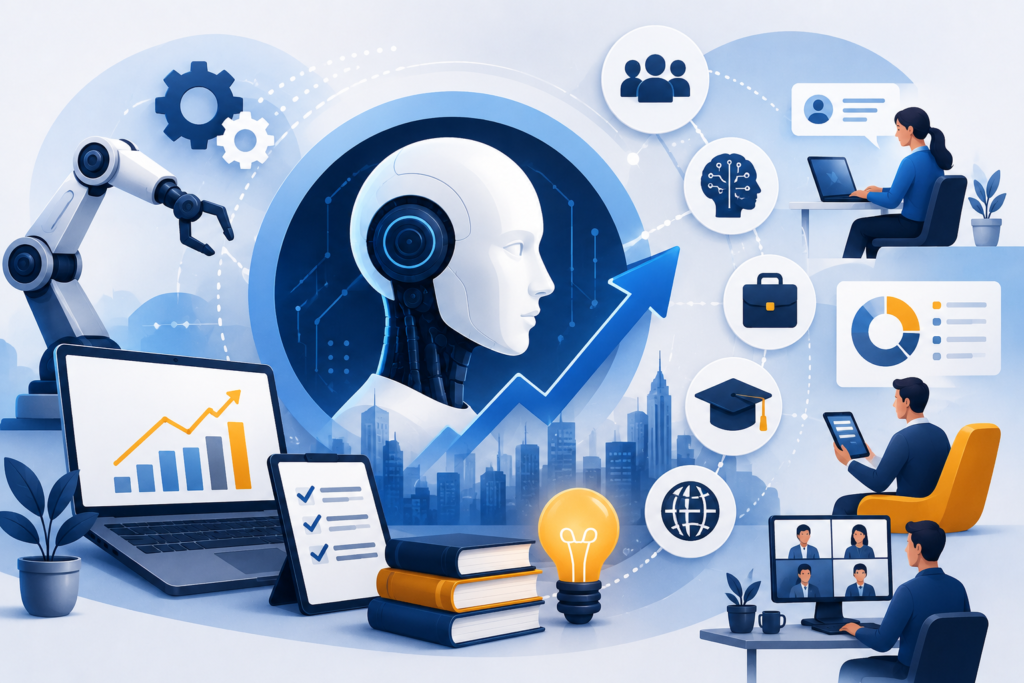
That moment captures where so many workers find themselves right now. AI jobs automation isn’t some distant, theoretical concern anymore. It’s showing up in real meetings, real budget decisions, and real headcount plans, across industries that never expected to be touched by it this soon. Radiologists are watching AI systems flag scans with impressive accuracy. Paralegals are watching AI tools draft contracts in minutes. Junior developers are watching AI write functional code from a two-sentence prompt. And every single one of them is asking some version of the same question: what does this mean for me?
Here’s the honest answer, and it’s more nuanced than either the doom-laden headlines or the breezy reassurances suggest. The future of work is genuinely being reshaped, but not in the simple, linear way most conversations frame it. Some jobs are shrinking. Some are transforming into something almost unrecognizable. And some entirely new categories of work are emerging that didn’t exist five years ago. Understanding the difference between these three patterns is the key to actually navigating what’s coming, rather than just reacting to the scariest headline you read that morning.
This piece walks through what’s genuinely changing in the job market because of AI, which roles face the most real exposure, which ones are proving surprisingly resilient, what the data actually says rather than what gets clicks, and what both workers and employers in the US and UK can do to prepare for a future of work that’s arriving faster than most institutions know how to handle.
Table of Contents
- Introduction: The Meeting Where Everyone Went Quiet
- Why This Moment Feels Different From Past Tech Disruptions
- What AI Jobs Automation Actually Looks Like in Practice
- The Jobs Most Exposed to AI Jobs Automation
- The Jobs AI Struggles to Touch
- New Roles Emerging From the Future of Work
- What the Data Actually Shows
- How the US and UK Are Responding
- Skills That Matter More in the Future of Work
- What Employers Should Be Doing Right Now
- What Workers Can Do to Stay Ahead
- Where This Is Realistically Heading
- Conclusion: Adapt Before You’re Forced To
- FAQ: Common Questions About AI and the Future of Work
Why This Moment Feels Different From Past Tech Disruptions
Every generation has faced a wave of anxiety about technology replacing jobs. The industrial revolution displaced hand weavers. Computers displaced typists and switchboard operators. E-commerce reshaped retail. Each time, new jobs eventually emerged to replace the old ones, and the labor market, painfully but reliably, adjusted.
What makes the current wave of AI jobs automation feel different is the speed and the breadth. Previous waves of automation mostly targeted physical, repetitive tasks, assembly line work, manual data entry, and routine manufacturing. This wave is targeting cognitive work too, the kind of thinking, analyzing, writing, and decision-making tasks that were long considered safely human territory. A tool that can draft a legal brief, summarize a medical chart, or write functional software code is operating in a completely different category than a machine that welds car parts.
The breadth matters just as much as the depth. Previous automation waves tended to concentrate in specific sectors over the course of a decade or more. This one is touching law, healthcare, finance, journalism, software development, Ai Jobs customer service, and creative industries essentially simultaneously, within the span of just a few years. That compressed timeline gives workers, employers, and policymakers far less runway to adjust than they’ve historically had, which is exactly why this particular moment in the future of work feels so unsettling to so many people at once.
What AI Job Automation Actually Looks Like in Practice
It’s worth being precise here, because AI job automation rarely looks like a robot walking in and taking someone’s desk. In practice, it tends to unfold in three overlapping patterns.
The first is task automation, where AIi Jobs handles specific components of a job rather than the entire role. A paralegal might still manage a case, but the document review that used to take days now takes hours, because an AI tool handles the initial pass. This pattern doesn’t necessarily eliminate the job, but it does change what the job actually involves day to day, and it often means fewer people are needed to handle the same overall workload.
The second is augmentation, where AI acts as a genuine productivity multiplier rather than a replacement. A software developer using AI coding assistants can often complete tasks significantly faster, but the tool still requires human judgment to catch errors, understand business context, and make architectural decisions. Here, the job doesn’t disappear, it evolves, and the people who adapt fastest tend to become disproportionately more valuable to their employers.
The third, and the one people fear most, is full role elimination, where an entire position essentially becomes unnecessary because AI can handle the complete function at an acceptable quality level and a fraction of the cost. This pattern is real, but it’s also the least common of the three in practice, at least so far, and it tends to concentrate in roles built almost entirely around a single, narrow, repeatable task with minimal need for judgment, context, or interpersonal interaction.
The Jobs Most Exposed to AI Jobs Automation
Certain categories of work face genuinely higher exposure to AI jobs automation, and it’s worth naming them plainly rather than dancing around the discomfort. Data entry and basic bookkeeping roles are shrinking as AI tools handle categorization, reconciliation, and reporting tasks that used to require dedicated staff. Entry-level content writing and basic copywriting have seen real contraction, particularly for formulaic content like product descriptions and simple summaries, where AI output has become good enough for many businesses to consider human review sufficient.
Customer service represents one of the clearest examples, with AI chatbots & Ai Jobs now handling a substantial share of routine inquiries that used to require a human representative, pushing many companies to reduce first-line support staff while retaining a smaller team for complex, escalated issues. Basic legal document review and contract analysis, once a significant part of junior legal work, has been substantially compressed by AI tools that can flag relevant clauses and inconsistencies in a fraction of the time a human associate would need.
Certain financial analysis and reporting roles are also seeing real pressure, particularly those centered on compiling and summarizing data rather than exercising independent judgment about what that data means for a specific business decision. The common thread across all these examples is clarity: roles built around well-defined, repeatable, rules-based tasks with clear inputs and outputs are the ones facing the most direct exposure, because that’s precisely the kind of work current AI systems handle most reliably.
The Jobs AI Struggles to Touch
On the other side of the ledger, plenty of work remains genuinely resistant to AI jobs automation, and understanding why is just as important as understanding the risk categories. Jobs requiring deep physical dexterity in unpredictable environments, skilled trades like electricians, plumbers, and HVAC technicians, remain largely untouched, because current AI systems, however sophisticated in language and reasoning, still struggle enormously with the physical world’s messiness and variability.
Roles built around genuine relationship and trust, therapists, hospice caregivers, teachers working with young children, remain difficult to automate meaningfully, not because AI can’t generate empathetic-sounding language, but because the actual value in these roles often comes from lived human presence and accountability, not just words on a screen. Complex, ambiguous decision-making roles, senior executives navigating genuinely novel business situations, experienced surgeons handling unusual complications mid-procedure, remain firmly human territory, because these situations demand judgment built from years of accumulated experience across situations that don’t fit any clean, learnable pattern.
Creative work involving genuine artistic vision, rather than formulaic output, has also proven more resilient than early predictions suggested, since audiences continue to place real value on authorship, originality, and the specific human perspective behind a piece of work, something AI-generated content, however technically polished, still struggles to replicate convincingly at scale. The pattern here is consistent: work requiring physical adaptability, deep human trust, high-stakes ambiguous judgment, or genuine creative originality remains considerably more resistant to the current generation of AI tools than the more mechanical, rules-based work discussed earlier.
New Roles Emerging From the Future of Work
It’s easy to focus entirely on what’s disappearing and miss what’s actually being created, but the future of work includes genuinely new categories of employment that simply didn’t exist a few years ago. Prompt engineering and AI workflow design have become legitimate specializations, with professionals dedicated to figuring out how to get the most useful, accurate output from AI systems within a specific business context. Ai Jobs & AI ethics and governance roles have expanded rapidly, as companies increasingly need dedicated staff to audit AI systems for bias, ensure regulatory compliance, and manage the genuine reputational risk of deploying these tools irresponsibly.
AI training data specialists and model evaluators represent another growing category, people whose Ai Jobs is essentially teaching AI systems what good output looks like, correcting errors, and refining performance in specific domains like law, medicine, or finance. Human-AI collaboration coordinators, roles focused specifically on redesigning workflows so human employees and AI tools work together effectively rather than at cross purposes, are emerging inside larger organizations undergoing significant AI adoption.
Even outside of purely AI-focused roles, demand has grown for professionals who can bridge technical AI capability with Ai Jobs practical business application, translating what these systems can genuinely do into solutions that solve real organizational problems. This pattern echoes previous technological shifts closely: the internet didn’t just eliminate jobs, it created entirely new categories like social media management and search engine optimization that nobody could have precisely predicted in advance, and AI job automation appears to be following a similar, if faster-moving, trajectory.
What the Data Actually Shows
It’s worth stepping back from anecdote and looking at what broader research actually indicates, because the picture is more measured than either extreme in the public conversation suggests. Multiple labor economists studying AI job automation have found that the technology tends to affect specific tasks within jobs more than it eliminates entire occupations outright, meaning most workers are more likely to see their day-to-day responsibilities shift than to see their job title disappear entirely.
Research examining historical automation trends consistently shows that while individual roles have been displaced, overall employment levels have generally recovered and, in many cases, expanded over time, though this recovery hasn’t always happened at the same pace, in the same locations, or for the same workers who were initially displaced, which is a genuinely important caveat rather than a reason for blanket optimism. Ai Jobs Surveys of business leaders in both the US and UK show that a majority expect Ai Jobs to change job requirements substantially within their organizations over the next several years, while a smaller but still significant share expect outright headcount reduction as a direct result.
What this data collectively suggests is that the future of work is unfolding less like a single dramatic collapse and more like a prolonged, uneven transition, one that hits certain sectors, regions, and demographics considerably harder than others, and one where the transition costs for individual displaced workers can be very real, even if aggregate employment figures eventually stabilize.
How the US and UK Are Responding
Policy responses on both sides of the Atlantic remain a work in progress, reflecting just how quickly this issue has moved from theoretical to urgent. In the US, there’s no comprehensive federal framework specifically addressing AI job automation, though several states have begun exploring worker retraining initiatives and transparency requirements around AI use in hiring and employment decisions. Labor unions have increasingly made AI-related job protections a central bargaining priority, with several high-profile disputes in entertainment and media explicitly addressing how AI tools can and cannot be used in relation to human labor.
In the UK, the government has emphasized a broader skills and retraining strategy, alongside ongoing consultations about how AI adoption should be monitored and reported within specific industries. The Department for Education and various industry bodies have expanded funding for digital and AI-related skills training, reflecting a recognition that the future of work will require substantial workforce adaptation regardless of exactly how quickly displacement occurs in any given sector.
Both countries share a similar underlying challenge: political and regulatory systems that move relatively slowly are being asked to respond to a technological shift moving considerably faster, which means much of the practical adaptation happening right now is occurring at the level of individual companies and workers, rather than through comprehensive national policy.
Skills That Matter More in the Future of Work(Ai Jobs)
Certain skills are proving disproportionately valuable as AI job automation reshapes specific tasks within nearly every profession. Genuine critical thinking, the ability to evaluate AI-generated output for accuracy, relevance, and appropriateness rather than accepting it uncritically, has become a core professional skill rather than a nice-to-have, since AI tools are only as useful as the human judgment applied to their output.
Comfort with continuous learning matters more than ever, given how quickly the specific tools and workflows within any given profession are changing, meaning the specific software skills someone learns today may need meaningful updating within just a couple of years. Strong communication and interpersonal skills have become more valuable, not less, precisely because they’re among the areas where AI still struggles to fully substitute for genuine human connection and nuanced understanding of context.
Domain expertise combined with AI fluency, rather than either alone, has emerged as a particularly powerful combination, since professionals who deeply understand their field and can effectively direct AI tools within it tend to significantly outperform those with either skill set in isolation. This pattern suggests that the future of work rewards people who can act as skilled orchestrators of AI capability within their area of genuine expertise, rather than either resisting these tools entirely or relying on them uncritically.
What Employers Should Be Doing Right Now
Organizations navigating this transition responsibly tend to share a few common practices worth highlighting. Transparent communication about how and why AI tools are being adopted, rather than vague, anxiety-inducing silence, tends to reduce the kind of workplace uncertainty that damages morale and productivity well before any actual job changes occur. Investing genuinely in retraining and internal mobility, rather than treating displaced workers as simply expendable, both preserves valuable institutional knowledge and builds a stronger, more resilient long-term workforce.
Building clear, documented policies around AI use, including where human review remains mandatory and where full automation is appropriate, helps manage both the practical risk and the ethical dimension of AI jobs automation within an organization. Companies that involve employees directly in redesigning AI-integrated workflows, rather than imposing changes from the top down without consultation, tend to see meaningfully smoother adoption and considerably less internal resistance than those that don’t.
What Workers Can Do to Stay Ahead
For individual workers navigating genuine uncertainty about their own roles, a few practical habits make a real difference. Actively learning how AI tools function within your specific field, rather than avoiding them out of anxiety or resentment, positions you as someone who can direct and evaluate these tools effectively, which tends to be considerably more valuable to employers than either blind enthusiasm or outright resistance. Building skills that combine deep domain expertise with genuine technological fluency creates a stronger, more durable professional position than either specialization alone.
Paying close attention to which tasks within your specific role are becoming automated, and proactively shifting your focus toward the tasks that require judgment, relationship building, or complex problem solving that remain genuinely human, is a practical way to stay ahead of gradual task-level displacement rather than being caught off guard by it. Staying connected to professional networks and industry associations relevant to your field also matters considerably, since these communities are often the first to identify emerging skill demands and genuine job market shifts well before they become obvious to the broader public.
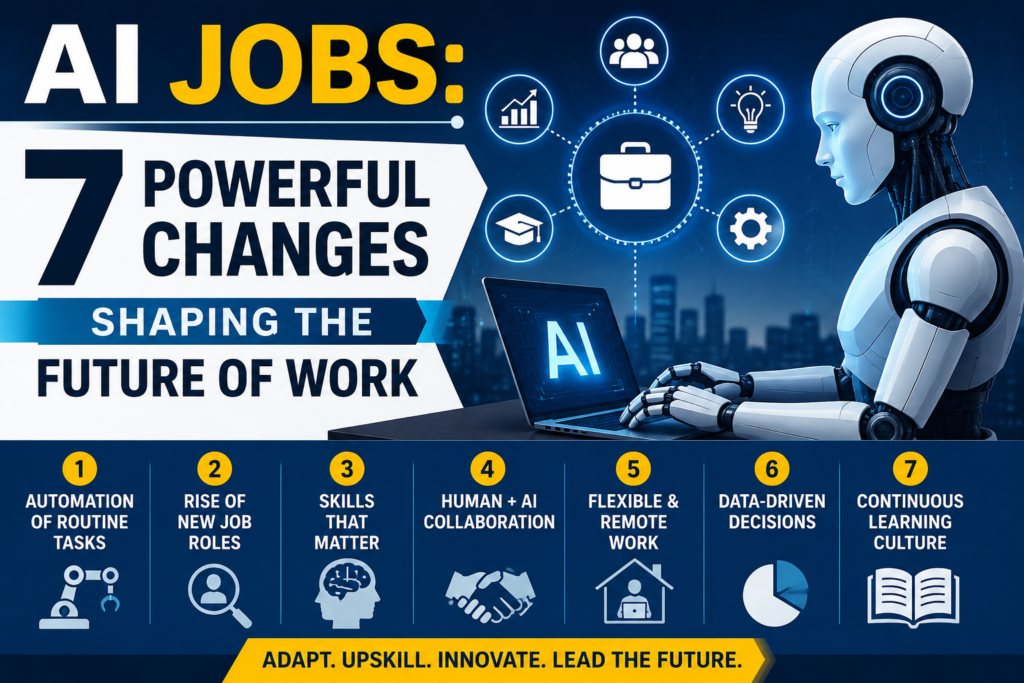
Where This Is Realistically Heading
The most credible projections suggest a future of work defined by uneven, sector-specific transformation rather than a single, sweeping collapse or a uniformly smooth transition. Some sectors, particularly those built around highly repeatable, well-defined cognitive tasks, will likely see continued and substantial contraction in specific roles over the coming years. Others, particularly those requiring physical adaptability, deep human trust, or complex ambiguous judgment, will likely remain considerably more stable, at least for the foreseeable future, even as the tools surrounding those roles continue to evolve.
New categories of employment will almost certainly continue emerging alongside this disruption, though predicting their exact shape with confidence remains genuinely difficult, much as it would have been difficult to predict the rise of social media management roles a decade before social media itself existed. What seems most likely, based on both historical precedent and the specific patterns already visible in AI jobs automation data, is a prolonged period of genuine adjustment, uneven across regions, industries, and demographics, rather than either the utopian or apocalyptic scenarios that tend to dominate public conversation.
Conclusion: Adapt Before You’re Forced To
Here’s the honest truth after everything above: nobody, not economists, not policymakers, not the AI companies themselves, can tell you with certainty exactly how your specific job will look in five years. What we do know, based on the patterns already visible right now, is that the future of work is being shaped by task-level change more than wholesale job elimination, that certain categories of work remain genuinely resilient, and that the people who adapt proactively tend to fare considerably better than those who wait for change to be forced upon them.
AI jobs automation isn’t a distant, theoretical concern anymore. It’s already reshaping meetings, budgets, and career paths across nearly every industry, often quietly, one task at a time, rather than through the dramatic, single moment of disruption most people picture when they imagine losing a job to a machine. The organizations and individuals navigating this transition most successfully aren’t the ones pretending it isn’t happening, nor the ones panicking about an inevitable collapse. They’re the ones treating this moment as what it actually is: a genuine, significant shift that rewards preparation, adaptability, and honest engagement with what’s actually changing, rather than what the loudest headlines claim.
If there’s one action step worth taking from everything above, it’s this: don’t wait for a town hall meeting to force you into thinking seriously about how AI is changing your specific field. Start paying attention now, build the skills that remain genuinely valuable, and treat this transition as something you can actively navigate, rather than something that’s simply happening to you.
FAQ: Common Questions About AI and the Future of Work
1. Will AI job automation eliminate more jobs than it creates? The evidence so far suggests a more nuanced pattern than outright elimination, with AI reshaping specific tasks within many roles more than eliminating entire occupations, though certain narrow, repeatable job categories are genuinely shrinking while entirely new roles are simultaneously emerging.
2. Which jobs are safest from AI job automation? Roles requiring physical dexterity in unpredictable environments, deep human trust and relationship building, complex ambiguous judgment, and genuine creative originality currently remain the most resistant to meaningful automation.
3. Which jobs are most at risk right now? Roles built around well-defined, repeatable, rules-based tasks, such as basic data entry, routine customer service, formulaic content writing, and standard document review, face the clearest and most immediate exposure.
4. Is the future of work going to require everyone to learn to code? Not necessarily. What matters more broadly is developing comfort using AI tools effectively within your specific field, combined with strong critical thinking and communication skills, rather than everyone needing to become a software developer.
5. What are governments in the US and UK doing about AI job automation? Neither country has a comprehensive national framework yet, though both have expanded funding for skills retraining, and various state-level and industry-specific initiatives are exploring transparency requirements and worker protections related to AI adoption.
6. How can I tell if my specific job is at risk? Look closely at whether your day-to-day responsibilities are built primarily around well-defined, repeatable tasks with clear inputs and outputs, versus tasks requiring judgment, relationship building, or complex problem solving, since the former face considerably higher exposure than the latter.
7. Are entirely new jobs really being created because of AI? Yes, genuinely new roles like prompt engineering, AI governance, and AI training data specialization have emerged in just the past few years, echoing how previous technological shifts created job categories that didn’t previously exist.
8. Should I be worried about AI replacing my job entirely? It depends heavily on your specific role and industry, but full role elimination remains less common in practice than task-level transformation, meaning most workers are more likely to see meaningful changes to their responsibilities than to lose their job outright, at least in the near term.
9. What skills should I focus on developing right now? Critical thinking to evaluate AI output, continuous learning habits, strong interpersonal and communication skills, and combining deep domain expertise with genuine AI fluency all currently offer strong protection and growing professional value.
10. How fast is this transition actually happening? Considerably faster than previous waves of automation, given AI’s ability to affect cognitive tasks across law, healthcare, finance, and creative industries essentially simultaneously, rather than concentrating in one sector over a decade or more, though the pace still varies significantly by specific role and industry.
Read About 7 AI Powerful