
There’s a specific kind of exhaustion that comes with running marketing for a small business. You’re the copywriter, the social media manager, the email strategist, and the person who has to figure out why last month’s ad spend didn’t convert, all before lunch. If you’ve ever closed your laptop at 9 PM still wondering how bigger companies seem to do all of this with a fraction of the stress, you’re not imagining things. They usually have bigger teams and bigger budgets. What you might not have realized is that the gap between you and them has gotten a lot smaller over the past few years, and the reason is AI tools for small business marketing.
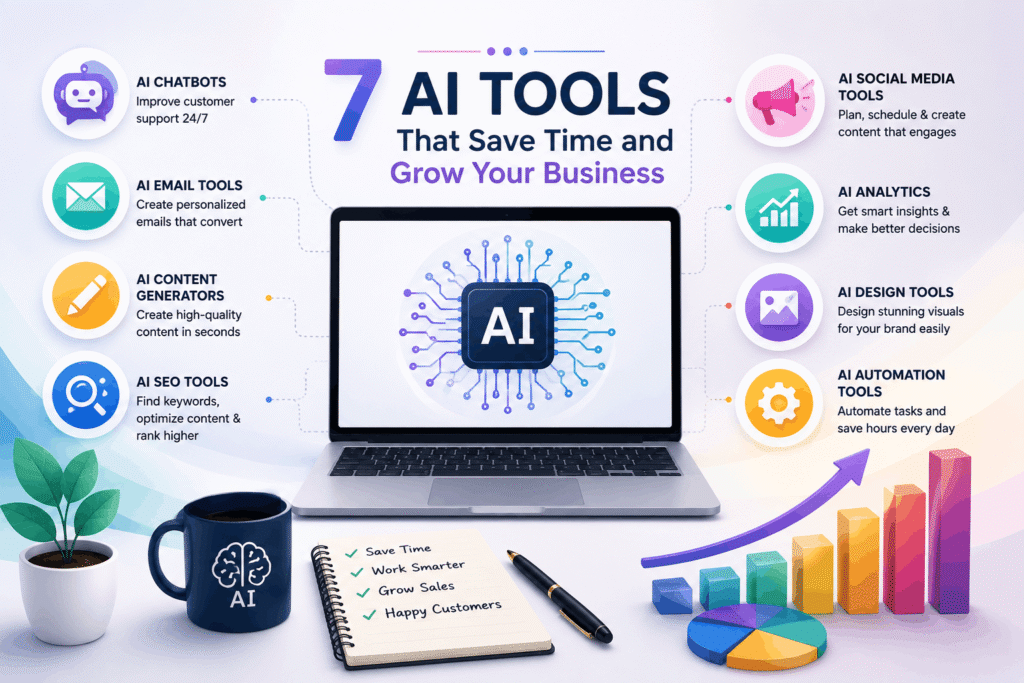
This isn’t another breathless “AI will change everything” piece. It’s a grounded look at what these tools actually do, where they genuinely save time and money, where they fall short, and how to build a system that works for a business your size, not a Fortune 500 marketing department. If you’ve been curious about AI tools for small business marketing but skeptical of the hype, or if you’ve already dipped a toe in and want to go deeper, this guide is for you.
Table of Contents
- Why Small Businesses Can’t Afford to Ignore AI Marketing Anymore
- What Marketing Automation Actually Means for a Small Team
- Content Creation: Where AI Tools Earn Their Keep
- Social Media Management Without Losing Your Evenings
- Email Marketing That Runs While You Sleep
- SEO and Search Visibility on a Small Budget
- Customer Insights and Ad Targeting Made Simple
- Chatbots and Customer Service Automation
- Building a Realistic AI Marketing Stack
- Common Mistakes Small Businesses Make with AI Marketing
- A Realistic Case Study: How a Small Retail Brand Used AI Marketing Tools
- The Human Side of AI Marketing
- Getting Started This Week
- Frequently Asked Questions
Why Small Businesses Can’t Afford to Ignore AI Marketing Anymore
Let’s start with the honest version of this conversation. A few years ago, AI marketing tools felt like something built for enterprise companies with dedicated data teams. That’s no longer true. The current generation of AI tools for small business marketing was built with exactly the opposite audience in mind: solo founders, two-person marketing teams, and shop owners who need to compete against businesses with far deeper pockets.
The shift happened because the underlying technology got dramatically more accessible. What used to require a developer to implement now comes as a simple dashboard with a monthly subscription. What used to take a data analyst days to figure out now gets summarized in a plain-English report generated in seconds. That accessibility is precisely why AI tools for small business marketing have become less of a luxury and more of a baseline expectation.
Here’s the part that matters most for your bottom line: your competitors are already using them. A local competitor doesn’t need a marketing department to run smarter ad campaigns anymore. They need a subscription to the right platform and forty-five minutes to learn how it works. If you’re still doing everything manually while your competition uses AI tools for small business marketing to work faster and smarter, you’re not just working harder, you’re working at a structural disadvantage.
What Marketing Automation Actually Means for a Small Team
Before diving into specific categories, it’s worth clearing up what marketing automation actually is, because the term gets thrown around loosely enough to lose its meaning.
Marketing automation, at its core, means setting up systems that handle repetitive marketing tasks without you manually triggering each one. Someone signs up for your newsletter, and a welcome sequence starts automatically. A customer abandons their cart, and a reminder email goes out three hours later without you lifting a finger. A social post gets scheduled two weeks in advance and publishes itself at the optimal time.
What’s changed is that marketing automation used to be rule-based and rigid: if this happens, then do that. Today’s AI tools for small business marketing add a layer of intelligence on top of that structure. Instead of a fixed rule, the system learns from behavior. It notices which subject lines get opened, which time of day your specific audience engages most, and adjusts on its own. That’s the real difference between old-school automation and the current wave of AI-powered marketing automation: one follows instructions, the other learns and adapts.
For a small business, this distinction is worth understanding because it changes how much oversight you actually need to provide. You’re not just setting rules once and forgetting them. You’re setting a direction and letting the system refine itself over time, which frees up hours you’d otherwise spend tweaking campaigns manually.
Content Creation: Where AI Tools Earn Their Keep
If there’s one category where AI tools for small business marketing have had the most visible impact, it’s content creation. Blog posts, product descriptions, ad copy, social captions, email subject lines. All of it used to require either your own time or a freelancer’s invoice. Now, a huge chunk of that first-draft work can be handled by AI writing tools, with a human editing pass to add your brand’s real voice and catch anything that reads generically.
The practical benefit here isn’t that AI replaces a writer. It’s that it collapses the blank-page problem. Staring at an empty document is often the biggest time sink in content marketing, and AI tools are remarkably good at generating a workable starting point in seconds. You still need to review, fact-check, and personalize what comes out, but going from zero to a rough draft is where most of the friction used to live, and that friction has largely disappeared.
This extends beyond written content too. Image generation tools can produce product mockups or social graphics without a designer on retainer. Video editing tools can auto-caption, auto-cut, and even generate short clips from longer footage. For a small business trying to maintain a consistent content calendar without a full creative team, this category of AI tools for small business marketing is often the single highest-leverage investment available.
A word of caution, though: content created entirely by AI, with zero human editing, tends to read exactly like what it is. Readers and search engines have both gotten better at recognizing generic, unedited AI output, and it can quietly hurt your brand’s credibility. The businesses getting the most value treat AI as a fast first-draft generator, not a finished-product machine.
Social Media Management Without Losing Your Evenings
Ask any small business owner what eats the most unplanned time in their week, and social media is a common answer. Coming up with captions, finding the right posting time, responding to comments, keeping up with trends across three or four platforms simultaneously. It adds up fast.
This is another area where AI tools for small business marketing have made a real dent. Modern social scheduling platforms don’t just let you queue up posts in advance anymore. Many now suggest optimal posting times based on when your specific audience is actually active, generate caption variations you can quickly edit, and flag trending topics relevant to your industry before they peak.
Some tools go further, using AI to analyze which of your past posts performed best and why, then applying those patterns to suggest what to post next. Instead of guessing whether Tuesday or Thursday works better for your audience, the platform tells you based on your actual historical data rather than generic best-practice advice that may not apply to your specific customers.
The time savings here compound quickly. What used to be an hour of daily social media management can often shrink to fifteen or twenty minutes of review and light editing, with the AI handling the repetitive scheduling and first-draft generation work in the background.
Email Marketing That Runs While You Sleep
Email remains one of the highest-return channels available to small businesses, and it’s also one of the categories where AI tools for small business marketing have matured the most. The days of blasting the same email to your entire list and hoping for the best are largely behind us, at least for businesses using modern tools well.
AI-powered email platforms now handle segmentation automatically, grouping your subscribers based on behavior rather than requiring you to manually sort them. Someone who’s browsed your pricing page three times gets a different follow-up than someone who just downloaded a free guide. Send-time optimization means each subscriber might receive your email at a slightly different hour, based on when they’re statistically most likely to open it, rather than everyone getting blasted at 9 AM regardless of their habits.
Subject line testing has also become significantly smarter. Instead of manually running A/B tests and waiting to see results, many platforms now generate multiple subject line variations, test them on a small percentage of your list, and automatically send the winning version to everyone else. That’s the kind of optimization that used to require a dedicated email marketer, now handled quietly in the background by AI tools for small business marketing.
For businesses running on tight margins, this matters enormously, because email marketing tends to deliver a higher return relative to cost than almost any other digital channel, and AI-driven refinement makes that return even stronger without demanding more of your time.
SEO and Search Visibility on a Small Budget
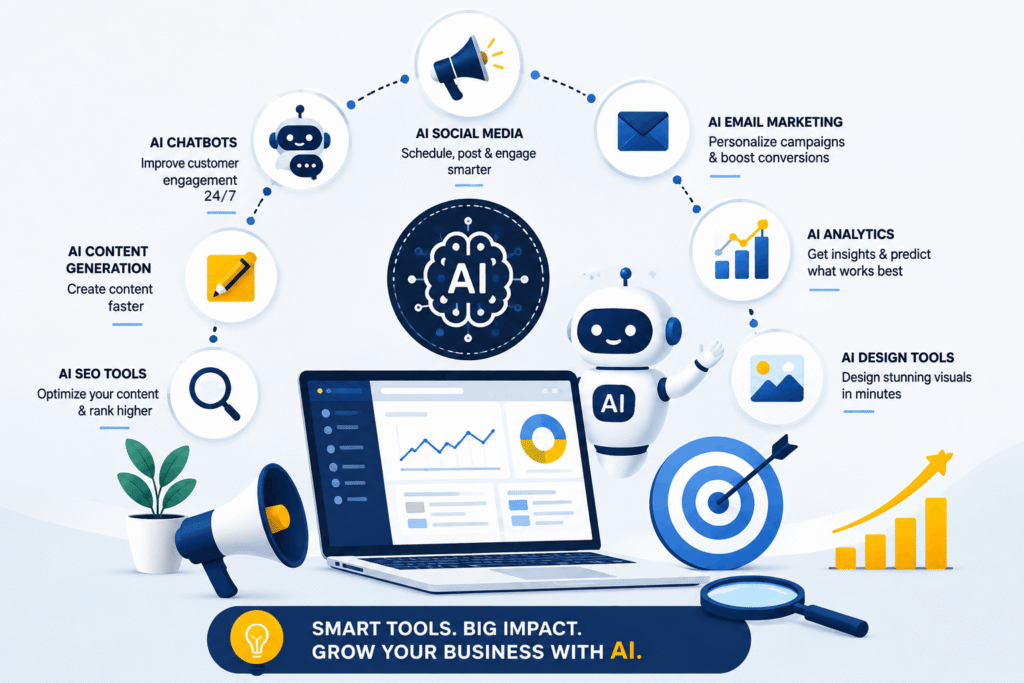
Search engine optimization has historically felt like a specialist’s domain, full of jargon and slow-moving results that make it hard for a small business owner to know if their efforts are working. AI tools for small business marketing have made this category considerably more approachable, without pretending SEO has become instant or effortless.
Keyword research tools now use AI to surface search terms your specific customers are actually using, including long-tail phrases you’d likely never think to target manually. Content optimization tools analyze your draft against top-ranking competitors and suggest specific improvements: headers you’re missing, related topics you haven’t covered, readability issues that might be hurting engagement.
Technical SEO, the kind of behind-the-scenes site health work that used to require a developer, has also gotten more accessible. AI-powered site audit tools can now scan your website, flag broken links, slow-loading pages, and missing metadata, then explain the fix in plain language rather than a wall of technical jargon.
None of this means SEO happens overnight. It’s still a long game built on consistency and genuine value to readers. But AI tools for small business marketing have removed a lot of the guesswork that used to make SEO feel inaccessible to anyone without a dedicated specialist on staff.
Customer Insights and Ad Targeting Made Simple
One of the quieter but more valuable applications of AI tools for small business marketing involves something a lot of business owners underuse: their own customer data. Every purchase, every email open, every website visit generates a data trail, and most small businesses simply don’t have the time or expertise to analyze it manually.
AI-powered analytics platforms now do this work automatically, surfacing patterns you’d likely miss otherwise. Maybe customers who buy Product A almost always come back for Product B within six weeks. Maybe your highest-value customers all discovered you through a specific social platform rather than the one you’ve been investing most of your budget in. These insights used to require a data analyst to uncover. Now, a dashboard can surface them for you in plain language.
This same intelligence extends to advertising. Platforms like Google Ads and Meta Ads have built AI deeply into their targeting systems, using machine learning to find audiences that resemble your best existing customers rather than requiring you to manually define every targeting parameter. This is often called lookalike audience targeting, and it’s one of the more powerful, lower-effort applications of AI tools for small business marketing available today, because it directly improves ad spend efficiency without requiring you to become an advertising expert.
Chatbots and Customer Service Automation
Marketing doesn’t end at the sale. How you handle questions, concerns, and support requests shapes whether a customer becomes a repeat buyer or a one-time transaction. This is another area where AI tools for small business marketing overlap meaningfully with customer experience.
Modern AI chatbots have moved well past the clunky, frustrating scripted bots of a few years ago. Current versions can understand natural language questions, pull answers from your actual product catalog or knowledge base, and hand off to a human when a conversation genuinely needs one. For a small business without the staffing to offer round-the-clock support, a well-configured chatbot means customers get immediate answers to common questions at 11 PM on a Sunday, rather than waiting until Monday morning.
This matters more for marketing than it might initially seem. A prospective customer who gets a fast, helpful answer is far more likely to convert than one who abandons their cart while waiting for a response. In that sense, a good chatbot isn’t just a support tool, it’s a quiet but meaningful part of your conversion funnel.
Building a Realistic AI Marketing Stack
With so many categories and tools available, it’s easy to get overwhelmed trying to adopt everything at once. The businesses that get the most value from AI tools for small business marketing tend to follow a similar pattern: they start narrow, prove value in one area, and expand deliberately rather than all at once.
A reasonable starting stack for most small businesses looks something like this. Pick one AI writing tool to handle first drafts of your blog content, social captions, and email copy. Pick one email marketing platform with built-in AI segmentation and send-time optimization. Pick one social scheduling tool with AI-assisted content suggestions. That’s genuinely enough to start.
Resist the urge to subscribe to ten different platforms in your first month. Overlapping tools create confusion, and most small businesses end up paying for features they never use. It’s far more effective to master three well-chosen AI tools for small business marketing than to dabble in a dozen without fully learning any of them.
As you get comfortable, layer in the more specialized categories: AI-powered SEO tools, advanced analytics dashboards, chatbot platforms. Let your actual bottlenecks guide what you add next, rather than adopting a tool simply because it’s trending.
Common Mistakes Small Businesses Make with AI Marketing
It’s worth being honest about where things go wrong, because the mistakes tend to repeat themselves across businesses of every size.
Treating AI output as finished, not draft. The single most common mistake is publishing AI-generated content without a human editing pass. It shows, and both readers and search engines have gotten better at spotting it.
Ignoring your own brand voice. AI tools default to a fairly generic tone unless you actively train them on your specific voice through examples and instructions. Skipping this step is why so many small business social accounts start to sound interchangeable.
Automating too much, too fast. Handing every customer touchpoint to automation, including ones that genuinely benefit from a human response, can make your business feel impersonal exactly when personal connection would have won a customer over.
Not tracking actual results. It’s tempting to assume a tool is working simply because it’s convenient. Actually comparing performance before and after adoption is the only way to know whether an investment in AI tools for small business marketing is paying off.
Choosing tools based on hype rather than fit. The most talked-about platform isn’t always the best fit for your specific business size, industry, or budget. Take the time to trial before committing to an annual plan.
A Realistic Case Study: How a Small Retail Brand Used AI Marketing Tools
To make this concrete, consider a composite example that reflects a pattern seen across many small retail businesses. A small AI Tools for Small Business Marketingin dependent home goods shop, run by two people, was spending roughly ten hours a week on marketing tasks: writing product descriptions, scheduling social posts, and manually sending the same promotional email to their entire list regardless of purchase history.
Over three months, they adopted a modest AI marketing stack: an AI writing tool for product descriptions and captions, an email platform with automatic segmentation, and a social scheduler with AI-suggested posting times. They didn’t overhaul everything overnight. They started with email, since it had the clearest measurable return, then added the other tools once the first one proved its value.
The results weren’t dramatic overnight transformations, but they were meaningful. Email open rates improved because messages were more relevant to each segment. Weekly marketing time dropped from ten hours to roughly four, freeing up time to focus on product sourcing and in-person customer relationships. Social engagement ticked up modestly, largely because posts were going out at times the audience was actually online rather than whenever the owners had a spare moment.
Nothing about this story involves a dramatic AI-powered overnight success. It’s a realistic picture of what AI tools for small business marketing tend to deliver: steady, compounding efficiency gains that free up time and attention for the parts of the business that genuinely need a human touch.
The Human Side of AI Marketing
It’s worth pausing on something easy to lose sight of in a guide like this: none of these tools replace the reason customers choose a small busines over a larger competitor in the first place. People support small businesses because they want the personal touch, the story, the sense that a real person is behind the brand. AI tools for small business marketing work best when they protect that human element rather than erase it.
The goal isn’t to automate your business into feeling like everyone else’s. It’s to automate the repetitive, time-consuming parts so you have more energy left for the parts only you can do: the personal reply to a loyal customer, the handwritten thank-you note, the genuine story behind why you started your business. AI handles the volume. You still provide the soul.
Getting Started This Week
If all of this feels like a lot, here’s the simplest possible starting point. Pick the single task that eats the most of your time right now, whether that’s writing content, scheduling social posts, or managing email. Choose one AI tool built specifically for that task, and give yourself two weeks to genuinely learn it before judging whether it’s working.
Track a simple before-and-after: time spent, and one relevant performance metric, whether that’s email open rate, social engagement, or hours saved. Small, measured steps beat trying to overhaul your entire marketing approach in a weekend. The businesses seeing the best results from AI tools for small business marketing aren’t the ones that adopted everything at once. They’re the ones that started small, measured honestly, and built from there.
Are AI tools for small business marketing actually affordable for a solo entrepreneur or very small team? Yes, in most cases. Many AI marketing platforms now offer free tiers or low-cost starter plans specifically designed for individuals and very small teams, often ranging from free to around fifty dollars a month for core features. The cost has come down significantly as competition among providers has increased.
FAQ
Do I need any technical skills to use AI marketing automation tools? Generally, no. Most modern platforms are built with drag-and-drop interfaces and plain-language settings specifically so non-technical business owners can use them without hiring a developer or specialist.
Will using AI tools hurt my SEO or make my content look inauthentic? Not if you edit and personalize what the AI produces. Search engines and readers respond negatively to obviously generic, unedited AI content, but a well-edited piece that started as an AI draft performs no differently than one written entirely by hand.
How long does it take to see results from AI-powered marketing automation? Some improvements, like better email open rates from send-time optimization, can show up within days. Others, like SEO gains, take months regardless of whether AI is involved, since search rankings build gradually over time.
Can AI tools completely replace a marketing person or agency for a small business? For very small businesses with straightforward needs, AI tools can handle a significant portion of day-to-day marketing tasks. For businesses with more complex strategy needs, AI tools work best as a force multiplier alongside a human marketer rather than a full replacement.
What’s the biggest risk of relying too heavily on AI marketing tools? Losing your authentic brand voice and over-automating customer interactions that genuinely benefit from a human touch. The tools work best as an efficiency layer, not a replacement for genuine connection with your customers.
Which AI marketing tool should a small business start with first? There’s no single universal answer, but starting with whichever task currently eats the most of your time, whether that’s content writing, email marketing, or social scheduling, tends to deliver the clearest and fastest return.
Small business marketing has never been a level playing field against bigger competitors with bigger budgets, but AI tools for small business marketing have narrowed that gap more than almost any development in the past decade. The businesses pulling ahead right now aren’t necessarily the ones with the most resources. They’re the ones willing to start small, learn one tool well, and let that efficiency compound over time. Pick one task today, find the right tool for it, and give yourself permission to get better at this gradually rather than all at once. That’s how real, lasting marketing systems get built.
Read About AI Tools for Small Business Marketing