
There’s a particular kind of frustration that most of us know intimately. You’ve been on hold for 22 minutes. The hold music always something vaguely jazzy has looped three times. You’ve rehearsed exactly what you’re going to say. Then the call drops.
Now imagine the alternative: you open a chat window at 11:47 PM, type your question about a delayed shipment, and get a clear, accurate answer in under 30 seconds. No hold music. No dropped call. No repeating your account number twice to a half-awake representative.
That’s the world chatbots are building and in 2025, it’s no longer a futuristic vision. It’s Tuesday afternoon for millions of businesses across the US and UK.
But here’s the thing most articles miss: this isn’t just a cost-cutting exercise for companies trying to offshore their support teams. Done right, AI customer service is genuinely better for customers. And done wrong, it’s a one-way ticket to scathing reviews and churn. The difference lies in how businesses approach it.
- The AI Customer Service Problem Nobody Likes Admitting
- What Business Chatbots Actually Do (Beyond Answering FAQs)
- Handling the Tier-1 Avalanche
- Intelligent Triage and Routing AI Customer Service
- Proactive Support
- The AI Layer: What Makes Modern Business Chatbots Different
- Natural Language Understanding
- Context Retention
- Sentiment Analysis
- Continuous Learning business chatbots
- Real Business chatbots Impact: What the Numbers Say
- The Pitfalls That Can Sink a Chatbot Deployment
- The Walled Garden Problem
- Over-Automation of Sensitive Situations
- Poor Training and Stale Knowledge
- The Uncanny Valley of Fake Human Pretense
- Implementing Chatbots the Right Way: A Practical Framework
- The Human Side of the Equation
- What the Best Implementations Look Like in Practice
- Looking Ahead: Where This Is Going
- The Bottom Line
The AI Customer Service Problem Nobody Likes Admitting
Before we talk about solutions, let’s be honest about the problem.
Traditional customer service is expensive, inconsistent, and hard to scale. Ai business selling products in both the US and UK has to wrangle time zones, peak seasons, staffing gaps, and the ever-present reality that no two support agents answer the same question the same way. One customer gets a refund cheerfully approved in three minutes. Another spends forty-five minutes navigating the same policy with a different representative and walks away empty-handed.
That inconsistency erodes trust quietly, steadily, and often invisibly right up until it shows up in your churn rate.Then there’s the volume problem. According to data from Salesforce, 83% of customers expect to interact with someone immediately when they contact a company. Meanwhile, average response times for email support hover around 12 hours across most industries. The gap between expectation and reality is enormous.Something had to give. And AI customer service has stepped into that gap not perfectly, not without friction, but with real and measurable results.
What Business Chatbots Actually Do (Beyond Answering FAQs)
There’s a common misconception that chatbots are basically glorified FAQ pages that they exist to deflect simple questions so human agents can focus on the hard stuff. And while that’s part of it, it’s a pretty undersized view of what modern business chatbots are capable of.
Handling the Tier-1 Avalanche
Yes, chatbots excel at answering repetitive questions: “Where’s my order?” “What’s your return policy?” “Can I change my delivery address?” These queries make up a surprisingly large share of total support volume anywhere from 40% to 80% depending on the industry. Automating them isn’t just convenient; it’s operationally transformative.A mid-sized UK e-commerce brand with 50,000 monthly support contacts, for example, might find that 35,000 of those are asking one of about a dozen questions. Routing those through a well-trained chatbot doesn’t just save money it frees up the human team to focus on complex complaints, escalations, and genuinely sensitive situations that deserve thoughtful attention.
Intelligent Triage and Routing AI Customer Service

This is where it gets more interesting. Modern AI customer service platforms don’t just respond they classify, prioritize, and route. A chatbot integrated with your CRM can look at an incoming message, identify that the customer has been with you for four years, that their last order had a problem, and that this new message carries a tone suggesting frustration and escalate it to a senior agent immediately, with full context attached.That kind of routing used to require a team lead manually scanning a queue. Now it happens in milliseconds.
Proactive Support
Some of the more sophisticated deployments flip the script entirely. Instead of waiting for a customer to reach out with a problem, AI systems monitor order status, account health, or usage patterns and trigger outreach before the customer even realizes there’s an issue.
A SaaS company noticing that a user hasn’t logged in for three weeks might have their chatbot send a personalized check-in. A logistics company detecting a shipping delay can proactively message the customer with an update and a discount code before they ever open a support ticket.This shifts the dynamic from reactive to proactive, which is where the real customer experience improvements live.
The AI Layer: What Makes Modern Business Chatbots Different
Here’s where it’s worth slowing down, because “chatbot” is doing a lot of work as a term. A rules-based decision tree from 2015 and a large language model-powered assistant in 2025 are barely the same category of tool.
Natural Language Understanding
The old chatbots were brittle. They needed you to phrase things exactly right, or they’d fall back to “I didn’t understand that can you rephrase?” Modern AI customer service tools, built on natural language processing, understand intent. A customer typing “yo my package is nowhere” is interpreted the same way as “I’d like to inquire about the status of my recent delivery.” The system extracts the same intent track order regardless of how it’s phrased.This matters enormously. Frustrated customers don’t write formal sentences. They type fast, skip words, and use slang. A system that can’t handle that isn’t serving them.
Context Retention
One of the most aggravating experiences in AI customer Service is having to repeat yourself. You explain your issue to one agent, get transferred, and explain it all over again. AI systems with proper context management hold the entire conversation in memory and in more advanced setups, pull in your full account history so you never have to repeat yourself.
Sentiment Analysis
Leading platforms now analyze not just what a customer is saying, but how they’re saying it. A rising note of frustration or distress in a conversation can trigger an automatic escalation to a human, or a tone shift in the bot’s responses. This isn’t just a nice feature it’s the difference between a chatbot that makes a bad situation worse and one that de-escalates it gracefully.
Continuous Learning business chatbots
Unlike a human agent who has a training day and then learns mostly from experience, AI systems can be retrained at scale. A business chatbot that’s getting a new question frequently say, after a product recall or a policy change can be updated centrally in hours, and every customer immediately gets consistent, accurate information.
Real Business chatbots Impact: What the Numbers Say
It’s easy to be skeptical of vendor-supplied statistics, so let’s focus on patterns that have emerged from industry research and real implementations.
Deflection rates the percentage of contacts handled end-to-end by the bot without human involvement typically range from 40% to 70% in well-implemented deployments. For high-volume businesses, that’s a meaningful shift in operational cost.
First-contact resolution tends to improve when chatbots handle straightforward queries efficiently and escalate complex ones appropriately. When customers get answers faster and don’t get bounced around, their satisfaction scores reflect it.
Availability is perhaps the clearest win. A human support team working business hours leaves 16 hours a day unserved. A chatbot covers every minute. For US businesses with UK customers (or vice versa), that time zone coverage alone can justify the investment.
Agent satisfaction is an underrated benefit. Support agents are often the most burned-out employees in a company fielding the same questions hundreds of times a week while managing genuine complexity. When automation handles the repetitive volume, agents can focus on work that’s actually engaging. Turnover drops. Quality improves.
The Pitfalls That Can Sink a Chatbot Deployment
For every success story, there are cautionary tales. And most of them share common failure modes.
The Walled Garden Problem
Some chatbots are deployed as a moat a barrier designed to prevent customers from reaching a human, rather than a bridge to get them help faster. Customers aren’t fooled. If they try to reach a human agent and keep getting routed back to the bot, they feel trapped. Resentment builds quickly.The principle is simple: the bot’s job is to solve problems, not to avoid human interaction. A clear, accessible escalation path isn’t optional it’s the foundation of trust.
Over-Automation of Sensitive Situations
Not every customer support interaction is about a missing package. Billing disputes, accessibility concerns, healthcare questions, bereavement notifications these situations require human judgment and emotional intelligence that no bot should attempt to simulate. Deploying a chatbot on emotionally sensitive inquiries without robust escalation protocols is genuinely harmful.
Poor Training and Stale Knowledge
A Business chatbot is only as good as what it knows. A bot trained six months ago that hasn’t been updated since a pricing change will confidently give customers wrong information and they’ll trust it because it sounds authoritative. Keeping the knowledge base current isn’t a one-time task; it’s ongoing maintenance.
The Uncanny Valley of Fake Human Pretense
Customers overwhelmingly don’t mind interacting with a bot as long as they know it’s a bot. What they resent is being deceived. A chatbot that pretends to be a human named “Sarah” and tries to pass itself off as a real person creates a sense of betrayal when the customer figures it out. And they almost always do. Be transparent. Give your bot a name that clearly signals what it is.
Implementing Chatbots the Right Way: A Practical Framework
If you’re thinking about deploying AI customer service for your business or improving what you already have — here’s a framework that holds up across industries.
Start with your data, not the technology. Before you pick a platform, audit your current support tickets. What are your top 20 inquiry types? What percentage of contacts are resolved in under two minutes by any agent? That’s your chatbot’s initial scope. Build for what’s actually happening, not for every possible scenario.
Design for graceful escalation. Every conversation path should have a natural handoff point to a human agent. Test it obsessively. The worst customer experience is a bot that can’t answer your question and also can’t get you to someone who can.
Test with real customers before full deployment. Run a beta with a segment of your actual user base. Not your internal team they know too much about your products. Real customers will ask questions in ways you never anticipated, and that’s exactly what you need to learn before going live.
Integrate with your existing systems. A chatbot that operates in isolation from your CRM, order management system, and helpdesk is dramatically less useful than one that can pull real-time data. Integration is often where the real value is unlocked.
Establish a feedback loop. Every unresolved conversation is a lesson. Build a process for regularly reviewing failed or escalated interactions and using them to improve the bot’s training. This isn’t optional — it’s how you close the gap between where the bot starts and where it needs to be.
The Human Side of the Equation
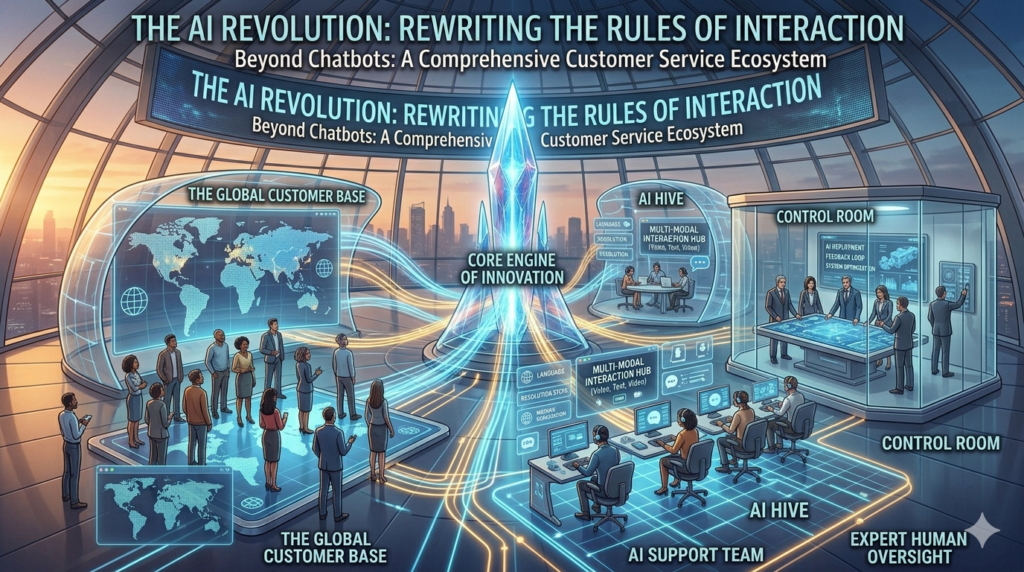
There’s a concern worth addressing directly: what happens to the human support agents when chatbots arrive?
The honest answer is nuanced. Some entry level tier-1 roles will be reduced that’s a reality of automation at scale. But organizations that deploy chatbots thoughtfully tend to redeploy human talent, not eliminate it. Support agents become specialists: handling complex escalations, building customer relationships, managing high-value accounts, and doing the kind of nuanced problem-solving that actually requires human judgment .In both the US and UK, there’s growing regulatory and public scrutiny of how companies deploy AI in customer-facing contexts. Being transparent about when and how bots are used isn’t just ethical it’s increasingly expected, and in some sectors, required. The Financial Conduct Authority in the UK, for instance, has clear expectations around how financial services firms handle automated customer interactions The businesses getting this right aren’t choosing between humans and AI. They’re engineering a collaboration where each handles what it does best.
What the Best Implementations Look Like in Practice
Consider a financial services company serving customers across the US and UK. Before deploying AI customer service, their average handle time was 8 minutes. Tier-1 queries balance inquiries, statement requests, basic product questions were consuming 60% of agent capacity.After deploying a large language model-based chatbot integrated with their core banking platform, tier-1 contacts dropped to around 25% of agent workload. Average handle time for human-handled contacts actually increased not because agents were less efficient, but because they were handling genuinely complex situations that warranted the time. Customer satisfaction scores improved, not despite the automation, but because customers got fast answers on simple questions and thoughtful attention on hard ones.That’s the model. Not replacement. Not deflection. Optimization.
Looking Ahead: Where This Is Going
AI customer service is moving fast. A few trends worth watching:
Voice AI is maturing rapidly. Text-based chatbots are being joined by voice interfaces capable of natural, low-latency conversation essentially AI phone agents that can handle calls with a fluency that makes hold music a relic of the past.
Multimodal support is emerging bots that can process photos, videos, and documents alongside text. A customer submitting a photo of a damaged product will have it analyzed automatically, with a resolution triggered before a human even reviews it. Hyper-personalization will deepen as AI systems get better at using customer history, preferences, and behavioral data to deliver responses that feel genuinely tailored rather than templated. And underlying all of it, the regulatory landscape is evolving. The EU AI Act and emerging UK AI governance frameworks will shape how businesses deploy these tools, with requirements around transparency, explain ability, and human oversight that responsible businesses should get ahead of now.
The Bottom Line
Automating customer support with chatbots isn’t a magic solution, and it isn’t the cold, customer-alienating move that skeptics sometimes fear. In the right hands, it’s a genuine upgrade faster answers for customers, meaningful work for agents, and sustainable operations for businesses.The companies winning with this technology share a few things in common: they know their customers’ actual pain points, they’ve designed their systems around those pain points rather than around cost reduction alone, and they’ve treated escalation to humans as a feature, not a failure.Your customers aren’t asking whether a bot or a human answered their question. They’re asking whether their question got answered quickly, accurately, and without making them feel like a ticket number.Build toward that, and the technology is firmly on your side.
Read About A Brief of History