
In the summer of 1956, a small group of researchers gathered at Dartmouth College with a proposal that sounds almost comically ambitious in hindsight. They believed that within roughly a generation, machines would be able to use language, form abstractions, solve problems reserved for humans, and even improve themselves. Give it about twenty years, they figured, and the hard part would basically be done.Seventy years later, we’re still working on it. And yet, somehow, we’re also further along than most of those researchers could have possibly imagined just not in a straight line, and not on the timeline they predicted.That’s really the story of AI in one paragraph: wild optimism, humbling setbacks, quiet decades of unglamorous progress, and then sudden, almost disorienting leaps forward. If you’ve ever wondered how we went from science fiction robots to a chatbot casually helping you draft a resignation letter, this is that story told without the textbook dryness it usually gets.
Table of Content
- Before the Term Existed The Philosophical Roots
- 1956: The Summer AI Got Its Name
- The First Golden Age and Its Early Promise
- The AI Winters When the Money Disappeared
- The Quiet Comeback of the 1980s and 90s
- The Data and Compute Revolution
- The Deep Learning Breakthrough
- The Generative AI Explosion
- Where We Stand Today
- Lessons the History of AI Teaches Us
- FAQ Section
Artificial Intelligence Term Existed The Philosophical Roots
The idea of artificial intelligence didn’t begin with computers at all it began with a much older question: can something non-human think?Ancient Greek myths told stories of Talos, a giant bronze automaton built to guard the island of Crete. Medieval folklore included tales of mechanical men and animated statues. These weren’t engineering blueprints, obviously, but they reveal something important: humans have been fascinated by the idea of artificial minds for thousands of years, long before we had any real technical means of pursuing it.The more direct intellectual roots of AI trace back to the 1940s, with mathematician Alan Turing, whose work during World War II on code-breaking machines laid essential groundwork for computer science itself. In 1950, Turing published a paper posing a deceptively simple question: instead of asking “can machines think? a question he considered too vague to be useful he proposed a practical test. Artificial Intelligence If a human conversing with a machine through text couldn’t reliably tell whether they were talking to a person or a computer, the machine could reasonably be said to be exhibiting intelligent behavior. This became known as the Turing Test, and remarkably, it’s still referenced in AI conversations today, more than seventy years later.Around the same period, researchers were also getting inspired by biology, publishing early theoretical models of how simplified, artificial neurons might be connected together to process information an idea that, decades later, would become the foundation of modern neural networks.
So by the early 1950s, the ingredients were on the table: a philosophical framework for evaluating machine intelligence, early theories about artificial neurons, and the first real computers capable of running programs. All that was missing was a name for the field itself and a room full of ambitious people willing to claim it.
1956: The Summer AI Got Its Name(Artificial Intelligence)
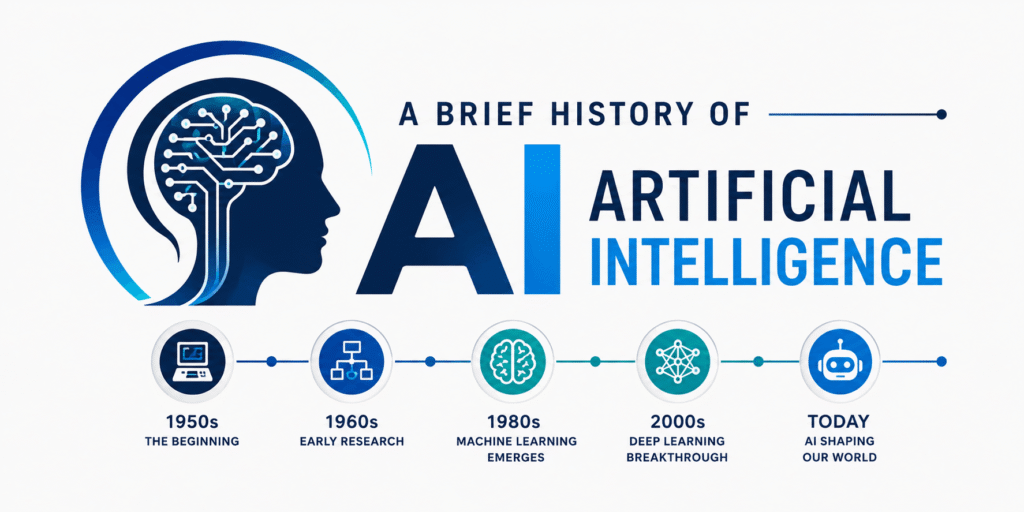
That room was Dartmouth College, and that summer produced the term “artificial intelligence,” coined by computer scientist John McCarthy for a research proposal that brought together some of the most influential minds in early computing including Marvin Minsky, Claude Shannon, and Nathaniel Rochester.
The Dartmouth proposal is worth appreciating for its sheer confidence. It stated that the researchers believed significant progress could be made on machine intelligence if a carefully selected group worked on it together for a summer. A summer. Not a decade a summer.They were wrong about the timeline, but the gathering itself was genuinely historic. It marked the moment AI became a defined, named field of study rather than scattered philosophical musing and isolated engineering experiments. Within a few years, researchers had built programs that could prove basic mathematical theorems, play simple checkers well enough to beat their own creators, and process limited natural language queries. Artificial Intelligence For the era, this felt like undeniable proof that human-level machine intelligence was just around the corner.
The First Golden Age and Its Early Promise
The late 1950s through the mid-1960s are often called AI’s first golden age, and the optimism during this period was genuinely infectious. Government funding, particularly from U.S. defense research agencies, poured into AI labs at institutions like MIT, Stanford, and Carnegie Mellon.Researchers built programs like ELIZA, an early chatbot created in the mid-1960s that simulated a psychotherapist by reflecting users’ statements back as questions. It was a remarkably simple trick, technically speaking mostly pattern matching and templated responses but many users reported feeling genuinely understood by it, some even preferring to confide in it over a human. This surprised its own creator, Joseph Weizenbaum, who later became one of AI’s most vocal early critics, worried about how easily people could be emotionally fooled by fairly shallow programs. That tension impressive seeming output masking a much shallower underlying mechanism is a thread that runs through the entire history of AI, right up to debates about today’s chatbots. Researchers of this era genuinely believed full machine intelligence was close. In 1965,Artificial Intelligence one of the Dartmouth attendees predicted that machines would be capable of doing any work a person could do within roughly twenty years. That prediction, like many from this period, turned out to be significantly premature and the gap between promise and delivery would soon catch up with the entire field.
The AI Winters When the Money Disappeared(Brief History)
By the early 1970s, cracks were showing. The problems AI researchers had chosen to tackle first chess, basic theorem proving, simple language processing turned out to be far easier than tasks that seemed almost trivial to humans, like recognizing objects in a cluttered room or understanding a sentence with any real ambiguity. This mismatch became known as Morava’s paradox: things that are hard for humans, like advanced math, turned out to be relatively easy for early computers, while things effortless for humans, like basic sensory perception, turned out to be brutally difficult to replicate. In 1973, a critical government-commissioned report in the UK, known as the Light hill Report, delivered a harsh assessment of AI research, concluding that the field had largely failed to deliver on its grand promises and that continued heavy funding wasn’t justified. This report Brief History triggered major funding cuts across British AI research and had ripple effects in the United States as well. Combined with similar disillusionment from American funding agencies, the result was what researchers now call the first AI winter a period roughly spanning the mid-1970s where funding, interest, and hiring in AI research collapsed .There was a brief resurgence in the 1980s, driven by a technology called expert systems programs designed to capture the specialized knowledge of human experts in a specific domain, like medical diagnosis or geological analysis, using large sets of hand-coded rules. Companies invested heavily, and for a while it looked like AI might finally deliver commercial value at scale. But expert systems proved expensive to build, brittle to maintain, and hard to update as knowledge changed. By the late 1980s, this enthusiasm collapsed too, triggering a second, deeper AI winter that lasted into the early 1990s, during which even using the phrase Artificial intelligence” in a funding proposal could hurt your chances of getting approved.
The Quiet Comeback of the 1980s and 90s Artificial Intelligence
Here’s the part of the story that often gets skipped in popular retellings: even during the AI winters, meaningful research never actually stopped. It just got quieter, less funded, and less publicly visible.
Researchers kept refining neural network theory, including a critical algorithm called backpropagation the method that allows a neural network to learn from its mistakes by adjusting internal connections layer by layer. Though the underlying concept had existed in some form since the 1970s, it was popularized more widely in a landmark 1986 paper, giving researchers a genuinely practical way to train deeper networks. It wouldn’t become truly powerful for another two decades, simply because the computing power and data needed to make it shine didn’t exist yet but the theoretical foundation was quietly being laid.
The 1990s also brought a notable public moment for AI Artificial Intelligence: in 1997, IBM’s chess-playing system, Deep Blue, defeated reigning world champion Garry Kasparov in a six-game match the first time a computer had beaten a sitting world chess champion under standard tournament conditions. It wasn’t “intelligent” in any general sense; it was a highly specialized system built to search through possible chess moves with brute computational force. But symbolically, it mattered enormously, reintroducing the public to the idea that machines could outperform humans at tasks once considered a pinnacle of human intellect.
The Data and Compute Revolution
The real turning point for modern AI wasn’t a single breakthrough insight it was three long-building trends finally converging in the 2000s and early 2010s.
More data than ever before. The explosive growth of the internet meant that, for the first time, researchers had access to genuinely massive datasets billions of images, articles, and search queries the raw fuel that machine learning models desperately need to learn meaningful patterns.
Dramatically more computing power. Graphics processing units, or GPUs originally designed for rendering video game graphics turned out to be extraordinarily well-suited to the kind of parallel mathematical calculations neural networks require. Researchers began repurposing gaming hardware for AI training, unlocking speed improvements that would have been unthinkable a decade earlier.
Refined algorithms. Decades of theoretical work on neural networks, much of it developed quietly during the AI winters, was finally ready to be applied at meaningful scale, now that the data and hardware to support it actually existed.
These three forces data, compute, and algorithms didn’t arrive in isolation. They fed each other. More compute allowed researchers to test more ambitious algorithms. More data made those algorithms genuinely useful rather than theoretical curiosities. It was this convergence, not any single eureka moment, that set the stage for the modern AI boom.
The Deep Learning Breakthrough
If there’s one single moment widely credited with kicking off the current era of AI, it’s 2012. That year, a deep learning model called Alexines, built by researchers including Geoffrey Hinton who would later be dubbed one of the “godfathers of AI” competed in a prominent annual image recognition competition. It dramatically outperformed every previous approach, cutting the error rate nearly in half compared to the next-best system, which had relied on older, hand-engineered techniques rather than deep learning.
This result sent a shockwave through the research community. It wasn’t a marginal improvement it was a definitive demonstration that neural networks, given enough data and computing power, could outperform decades of alternative approaches on a genuinely hard problem. Within just a few years, deep learning had become the dominant approach across nearly every major subfield of AI research, from computer vision to speech recognition to natural language processing.
The following decade brought a rapid succession of milestones. In 2016, Google DeepMind’s AlphaGo defeated world champion Go player Lee Sedol a landmark moment because Go was long considered far too complex, with more possible board positions than atoms in the observable universe, for a computer to master through brute-force calculation alone; it required something closer to genuine strategic intuition, which the system developed through extensive self-play and reinforcement learning. In 2017, a research paper introduced the transformer architecture, a new neural network design particularly good at understanding relationships between words across long passages of text. That architecture, quietly published in an academic paper, would go on to become the foundation of nearly every major language model that followed.
The Generative AI Explosion
For most of AI’s history, the technology operated largely behind the scenes classifying images, filtering spam, recommending products genuinely useful, but mostly invisible to the average person. That changed dramatically starting around 2022, with the arrival of accessible generative AI tools.
Image generators capable of creating original artwork from a simple text description captured public attention first, followed shortly by the release of conversational AI tools built on large language models, capable of holding fluid, coherent conversations, writing essays, debugging code, and answering questions across nearly any topic. Within just months, tens of millions of people were interacting directly with sophisticated AI systems for the first time in their lives not through a hidden algorithm quietly shaping a news feed, but through a direct, conversational interface anyone could use without technical training.
This shift mattered enormously, not because the underlying technology was entirely new transformers and large scale neural networks had been developing for years but because it was the first time the general public could directly experience AI’s capabilities firsthand, rather than reading about them in a research paper or news article. It’s the difference between electricity existing in a power plant for decades versus suddenly appearing as a light switch in your kitchen. The underlying science had been building for a long time. The moment it became personally, Artificial Intelligence tangibly usable is what changed the cultural conversation almost overnight.
Where We Stand Today
As of the mid-2020s, AI has moved from a specialized research field into something closer to everyday infrastructure. Major technology companies across the US and UK are racing to build increasingly capable language models, integrate AI into everyday software, and compete for the enormous computing resources these systems require. Governments on both sides of the Atlantic are actively working on AI regulation, trying to balance innovation with growing concerns about bias, misinformation, job displacement, and safety.We’re also, honestly, in a period where hype and genuine capability are hard to disentangle from the outside. Some claims about AI’s near-term future fully autonomous general intelligence within a handful of years, for instance remain genuinely contested even among leading researchers. Others, like AI’s growing role in medical diagnosis, scientific research, and everyday productivity tools, are already measurably real and continuing to expand Artificial Intelligence.
Lessons the History of AI Teaches Us
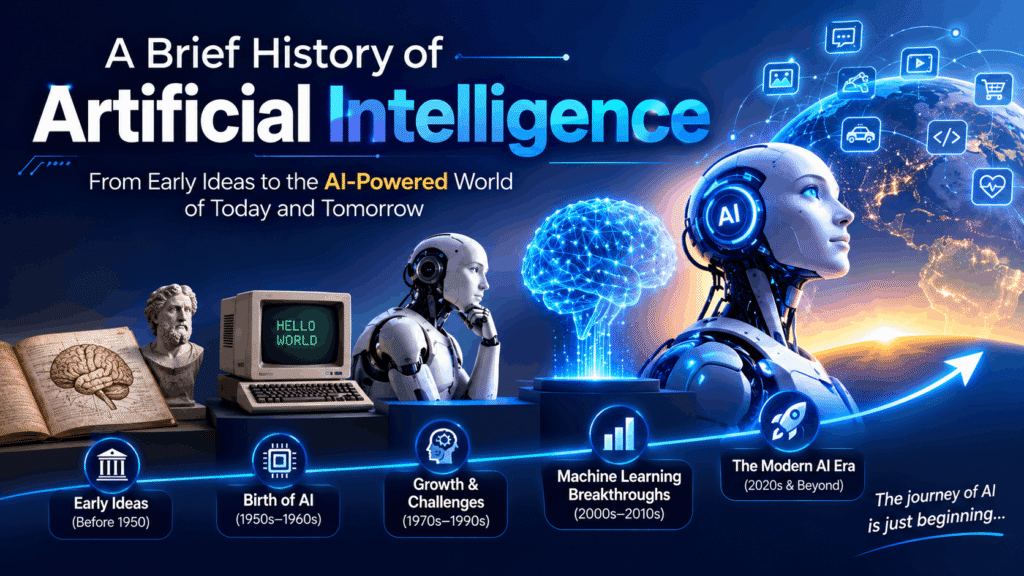
Looking back at seven decades of AI history, a few patterns show up again and again, and they’re worth carrying with you as you evaluate today’s headlines.
Progress in AI has never been linear. It moves in bursts, followed by long, quiet stretches of unglamorous refinement. The current period of rapid progress is remarkable, but history suggests we should expect it to eventually plateau or shift in unexpected directions, rather than continuing in a perfectly straight line upward forever.
Hype has consistently outpaced reality, and reality has consistently outpaced abandonment. Nearly every generation of AI researchers has overestimated how quickly human-level capability would arrive. But nearly every generation has also underestimated how useful and permanent the intermediate technology would become, even short of that lofty goal.
The biggest leaps often come from unglamorous, cross-disciplinary convergence, not sudden genius. The deep learning revolution wasn’t one person’s brilliant idea appearing out of nowhere it was decades-old theory finally meeting modern data and repurposed gaming hardware. Genuine breakthroughs are usually built on quiet, patient groundwork that goes unnoticed for years before it suddenly doesn’t.
Public perception often lags dramatically behind technical reality. AI felt “sudden” to most people around 2022 and 2023, but the underlying techniques had been maturing for the better part of a decade already. The technology rarely arrives overnight our collective awareness of it does.
FAQ Section
When was artificial intelligence invented? There’s no single invention date, but the field was formally named and established at the Dartmouth Conference in the summer of 1956, which is widely considered the official birth of AI as an academic discipline.
What caused the AI winters? The AI winters were periods of sharply reduced funding and interest, primarily caused by a persistent gap between the ambitious promises researchers made and the actual capabilities the technology could deliver at the time, combined with limited computing power and data availability.
Who is considered the father of AI? John McCarthy is generally credited with coining the term “artificial intelligence” and organizing the Dartmouth Conference, though the field owes foundational debts to several other figures, including Alan Turing for his early theoretical work and Geoffrey Hinton, often called a “godfather of AI,” for his pioneering contributions to deep learning decades later.
What was the first real AI breakthrough people noticed? Public awareness moments have occurred in waves early chatbot ELIZA in the 1960s, IBM’s Deep Blue defeating a world chess champion in 1997, and most recently, the widespread public release of generative AI chatbots starting around 2022, which is arguably the moment AI became a mainstream, everyday topic rather than a specialist one.
Why did AI suddenly improve so much in the last decade? Three trends converged: massive growth in available data thanks to the internet, dramatically cheaper and more powerful computing hardware (particularly GPUs originally built for gaming), and refined algorithms, especially deep learning techniques, that had been developed theoretically for years but only became practical once enough data and computing power existed to support them.
Is today’s AI progress going to keep accelerating indefinitely? Nobody can say for certain. Historically, AI progress has moved in bursts followed by plateaus, and while today’s pace is genuinely remarkable, credible researchers hold a wide range of views on how long the current momentum will continue, and no one has been reliably accurate at predicting AI’s timeline throughout the field’s history.
Read about neural Networks