
A sales director I once spoke with told me about the deal that got away, not because the prospect wasn’t interested, but because nobody on her team noticed they were interested until it was too late. The lead had visited the pricing page four times in a single week, downloaded two technical whitepapers, and had a decision-maker title that matched their ideal customer profile almost perfectly.
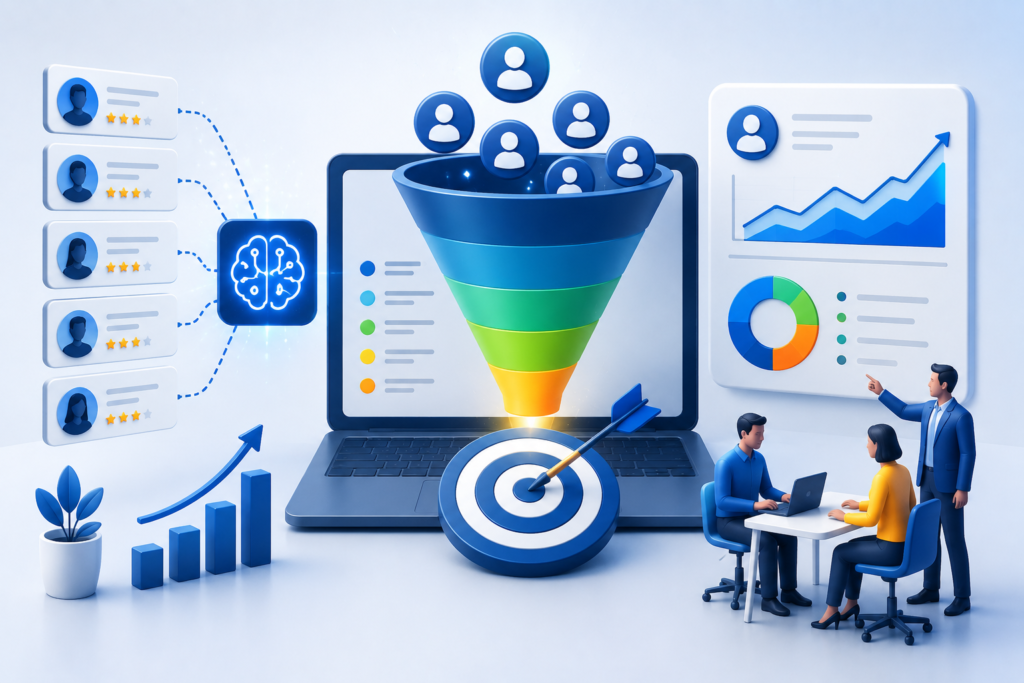
And yet that lead sat untouched in a general inbox for three weeks, buried under dozens of other inquiries that looked identical on the surface, because nothing in their system distinguished a genuinely hot prospect from someone who’d casually clicked a LinkedIn ad out of idle curiosity. By the time a rep finally reached out, the prospect had already signed with a competitor who happened to call two days after that first pricing page visit.
That story plays out constantly in B2B sales, and it’s rarely a story about lazy or incompetent salespeople. It’s a story about volume outpacing judgment. When you’re generating hundreds or thousands of leads a month across multiple channels, sorting genuine buying intent from casual curiosity by feel simply isn’t a task human attention can reliably handle at scale, no matter how experienced or diligent your team is.
This is exactly the gap AI lead scoring was built to close. Rather than relying on a sales rep’s gut instinct or a rigid, manually assigned point system that goes stale the moment your market shifts, AI-driven lead scoring analyzes genuine behavioral and firmographic patterns to identify which leads are actually worth a rep’s limited time and attention, right now, before the window closes.
Paired with broader B2B sales automation built into modern CRM platforms, it’s reshaping how sales teams in the US and UK prioritize their pipeline, and the businesses getting this right are converting noticeably more of their leads into actual revenue, while spending less time chasing prospects who were never going to buy.
This piece walks through exactly how AI lead scoring works, why traditional scoring methods keep falling short, what genuinely smart CRM software looks like in practice, and how sales teams are using these tools to stop losing deals to something as avoidable as a lead sitting unnoticed in a shared inbox.
Table of Contents
- Why Traditional Lead Scoring Keeps Letting Good Leads Slip Away
- What AI Lead Scoring Actually Does Differently
- The Real Cost of Poor Lead Prioritization
- How AI Lead Scoring Models Actually Work
- Behavioral Signals That Matter Most
- Firmographic and Demographic Data in the Scoring Equation
- B2B Sales Automation Beyond Just Scoring
- Real-World Applications Across Different B2B Sectors
- Integrating AI Lead Scoring Into Your Existing CRM
- Common Mistakes Sales Teams Make With AI Scoring
- How to Measure Whether Your Lead Scoring Is Actually Working
- Where AI Lead Scoring and Sales Automation Are Headed
- Conclusion: Let Your Best Reps Spend Time Where It Actually Counts
- FAQ: Common Questions About AI Lead Scoring and Sales Automation
Why Traditional Lead Scoring Keeps Letting Good Leads Slip Away
Most B2B sales teams didn’t start with sophisticated scoring systems, and for a while, they genuinely didn’t need one. A small pipeline and a handful of experienced reps who know their market well can prioritize leads reasonably effectively just by feel. The trouble starts once lead volume grows past what any individual rep can reasonably evaluate one by one, which happens far sooner than most growing companies expect.
Traditional lead scoring, the manually assigned point system many CRM platforms have offered for years, assigns fixed values to specific actions, ten points for downloading a whitepaper, twenty for requesting a demo, and so on, then totals everything up into a single score. The problem is that these systems are static. They’re built once, based on assumptions about what buying intent looks like at a specific moment, and they rarely get revisited often enough to stay accurate as your market, product, and buyer behavior evolve. A scoring model built around your product two years ago may bear little resemblance to what actually predicts conversion today, and most teams simply don’t have the bandwidth to continuously audit and rebuild these rules by hand.
There’s also a fundamental blind spot built into manual scoring: it can only account for the specific signals someone thought to include when building the model. It can’t discover patterns nobody anticipated, like a specific combination of behaviors that turns out to correlate strongly with conversion in ways that wouldn’t be obvious from looking at any single action in isolation. This is precisely the gap AI lead scoring is designed to close, not by replacing sales judgment, but by handling pattern recognition at a scale and depth that manual rule-building simply can’t match.
What AI Lead Scoring Actually Does Differently
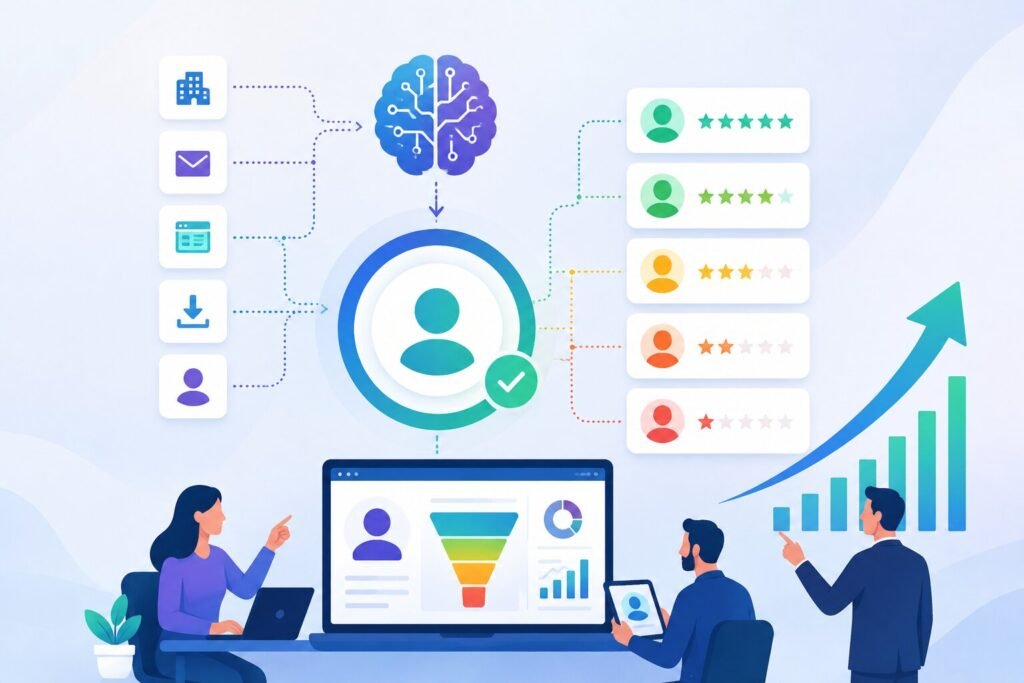
At its core, AI lead scoring uses machine learning models trained on your actual historical data, which leads converted, which didn’t, and what behavioral and firmographic patterns distinguished the two groups, to generate a dynamic, continuously updating score for every lead in your pipeline. Rather than relying on a fixed set of point values someone assigned based on assumptions, the model learns directly from your own conversion history what genuinely predicts a sale, which means it often surfaces patterns human intuition would never have thought to weight so heavily.
What sets genuine AI lead scoring apart from basic automation is this adaptive quality. As new leads convert or fall through, the model incorporates those outcomes and refines its predictions accordingly, meaning the scoring logic actually improves over time rather than slowly drifting out of date the way static point systems inevitably do. It also typically evaluates a considerably broader range of signals simultaneously than a human-built rule set realistically could, combining website behavior, email engagement, firmographic fit, timing patterns, and even signals like how quickly a lead responded to initial outreach, weighing all of it together into a single, continuously refreshed prioritization score.
This distinction matters enormously in daily sales operations. A rep working from a stale, static score might spend an hour chasing a lead that looked promising eighteen months ago under an outdated model, while a genuinely hot prospect sits unscored and unnoticed simply because their specific combination of behaviors wasn’t part of the original point system. AI lead scoring closes that gap by continuously re-evaluating what buying intent actually looks like based on what’s genuinely happening in your pipeline right now.
The Real Cost of Poor Lead Prioritization
It’s worth being specific about what poor lead prioritization actually costs a B2B sales organization, because the damage extends well beyond the individual deals that slip through. Every hour a rep spends chasing a low-intent lead is an hour not spent on a genuinely promising prospect, and in B2B sales, where response speed often correlates directly with conversion likelihood, that misallocated time compounds quickly across an entire team and pipeline.
Response time itself deserves particular attention here, since research on B2B buying behavior has consistently shown that leads contacted within the first hour of expressing interest convert at dramatically higher rates than those contacted even a few hours later, let alone days. Without reliable prioritization, hot leads often sit in a general queue alongside dozens of lower-intent inquiries, losing exactly the response speed advantage that matters most, simply because nothing in the system flagged them as urgent.
There’s a morale and retention cost too, one that’s easy to overlook. Sales reps who spend significant time chasing leads that were never realistically going to convert tend to burn out faster and hit quota less consistently, which affects both individual performance reviews and broader team retention over time. And from a pure revenue forecasting standpoint, sales leadership working from an unreliable sense of which deals in the pipeline are genuinely likely to close ends up making resourcing and hiring decisions based on inflated or inaccurate expectations, a problem that tends to surface painfully at the end of a quarter when the numbers don’t materialize the way the pipeline suggested they would.
How AI Lead Scoring Models Actually Work
Understanding the mechanics behind AI lead scoring helps demystify what can otherwise feel like a black box producing numbers you’re simply expected to trust. Most models are trained using historical conversion data as the foundation, feeding the system a substantial set of past leads along with the outcome for each one, whether they converted, how long the sales cycle took, and what specific actions and characteristics preceded that outcome.
From there, the model identifies which combinations of signals most reliably predicted conversion in your specific historical data, weighting those factors accordingly rather than treating every action as equally important the way a manual point system typically does. This is where AI lead scoring genuinely earns its value over traditional methods, since it can identify non-obvious correlations, perhaps leads from a specific industry who engage with a particular piece of content convert at unusually high rates, a pattern a human building rules by hand would be unlikely to notice or think to weight heavily.
Once trained, the model scores new incoming leads by comparing their behavior and characteristics against the patterns it’s learned, generating a continuously updated score that shifts as the lead takes additional actions or as more time passes without further engagement. Most genuinely effective systems also incorporate a feedback loop, where sales reps can flag when a highly scored lead turns out to be a poor fit, or when a lower-scored lead unexpectedly converts, feeding that information back into the model to keep its predictions calibrated against real-world outcomes rather than drifting away from reality over time.
Behavioral Signals That Matter Most
Behavioral data tends to carry considerable predictive weight in AI lead scoring models, and understanding which signals typically matter most helps sales and marketing teams design their digital presence with scoring accuracy in mind. Website behavior remains one of the strongest indicators, particularly repeat visits to high-intent pages like pricing, product comparison, or case study content, which tend to correlate strongly with genuine evaluation activity rather than casual browsing.
Content engagement patterns matter considerably too, though not all content signals equally. Downloading a broad, top-of-funnel educational resource typically indicates considerably less buying intent than requesting a product demo, engaging with a detailed technical specification sheet, or attending a live product webinar, and effective AI lead scoring models learn to weight these differently based on your actual historical conversion patterns rather than treating all content downloads as equivalent.
Email engagement, including open rates, click-through behavior, and particularly reply behavior, provides another meaningful signal layer, especially when a lead’s engagement pattern shows escalating interest over a compressed timeframe rather than sporadic, inconsistent activity spread across many months. Timing signals deserve specific mention too, since the velocity of engagement, several high-intent actions clustered within a short window, often predicts conversion considerably more reliably than the same actions spread thinly across a much longer period, a nuance that static point systems typically miss entirely since they simply total up actions regardless of when they occurred relative to each other.
Firmographic and Demographic Data in the Scoring Equation
Behavioral signals tell you how engaged a lead is, but firmographic and demographic data tell you whether that engaged lead actually fits your ideal customer profile in the first place, and genuinely effective AI lead scoring weighs both dimensions together rather than relying on either alone. Company size, industry, geographic location, and technology stack, where that information is available, all factor into whether a highly engaged lead represents a genuinely strong-fit opportunity or simply an enthusiastic prospect who was never going to be a realistic customer regardless of how much content they consumed.
Job title and seniority carry particular weight in B2B contexts specifically, since a highly engaged individual contributor without genuine purchasing authority represents a fundamentally different opportunity than an equally engaged decision-maker, even though their behavioral signals might look identical on the surface. Sophisticated AI lead scoring models learn to weight these firmographic factors based on your actual historical conversion data rather than generic industry assumptions, since what constitutes an ideal customer profile varies considerably between businesses even within the same broad sector.
Combining behavioral and firmographic scoring into a unified model, rather than treating them as entirely separate evaluation criteria, produces considerably more actionable prioritization in practice. A lead with strong behavioral engagement but poor firmographic fit might warrant a lighter-touch nurture sequence rather than immediate high-priority sales outreach, while a lead with strong firmographic fit but currently modest engagement might benefit from a slightly more proactive touch to gauge genuine interest, distinctions that a single, undifferentiated score would completely fail to capture.
B2B Sales Automation Beyond Just Scoring
AI lead scoring represents just one piece of the broader B2B sales automation landscape reshaping how modern sales teams operate, and understanding how it connects to adjacent automation capabilities reveals considerably more value than scoring alone provides. Automated lead routing, directing high-scoring leads immediately to the appropriate rep based on territory, industry specialization, or current capacity, ensures that improved prioritization actually translates into faster response times rather than simply producing a more accurate score that still sits unactioned in a queue.
Automated follow-up sequencing, triggering personalized outreach based on a lead’s specific score and behavior pattern rather than a generic, one-size-fits-all sequence, allows sales teams to maintain consistent engagement across a much larger pipeline than manual outreach could realistically sustain. Predictive deal scoring extends similar principles further down the funnel, analyzing active opportunities already in progress to flag deals at genuine risk of stalling or falling through, giving sales managers visibility into pipeline health that goes considerably beyond simple stage-based tracking.
Conversation intelligence tools, analyzing sales call recordings and transcripts to identify successful patterns and coaching opportunities, represent another meaningful extension of B2B sales automation, helping teams understand not just which leads are worth pursuing, but which specific conversational approaches actually drive those prioritized leads toward conversion once a rep does engage with them.
Real-World Applications Across Different B2B Sectors
AI lead scoring plays out somewhat differently depending on the specific B2B sector applying it, and walking through a few concrete examples illustrates the practical range involved. A software-as-a-service company with a self-service trial model benefits enormously from behavioral scoring that tracks in-product usage patterns alongside marketing engagement, since actual product adoption during a trial period often predicts conversion considerably more reliably than pre-trial marketing engagement alone.
A professional services firm with longer, relationship-driven sales cycles benefits from scoring models weighted more heavily toward firmographic fit and engagement consistency over time, rather than prioritizing rapid behavioral velocity the way a transactional SaaS product might, since genuine buying intent in these sectors often develops more gradually across a series of consistent, lower-intensity touchpoints.
A manufacturing or industrial equipment supplier, where purchase decisions frequently involve multiple stakeholders across procurement, engineering, and finance, benefits from AI lead scoring that can identify and weight multi-contact engagement patterns within a single target account, recognizing that meaningful buying intent often shows up as coordinated activity across several individuals rather than a single highly engaged contact.
A financial services or fintech provider operating under specific regulatory constraints benefits from scoring models that incorporate compliance-relevant firmographic filtering alongside standard behavioral and fit signals, ensuring high-priority leads genuinely meet the qualification criteria the business is legally or contractually required to enforce, rather than simply representing the most behaviorally engaged prospects regardless of underlying eligibility.
Integrating AI Lead Scoring Into Your Existing CRM
Adopting AI lead scoring doesn’t necessarily require replacing your existing CRM platform entirely, and businesses that assume it does often overestimate the disruption involved unnecessarily. Many established CRM platforms have built native AI scoring capabilities directly into their existing product, meaning implementation often involves configuring and training an existing feature rather than integrating an entirely separate third-party system from scratch.
For businesses using CRM platforms without robust native AI scoring, dedicated third-party lead scoring tools designed to integrate directly with popular CRM systems offer a genuinely practical middle path, syncing scored leads back into the existing platform your sales team already knows how to use daily, rather than forcing a disruptive switch to unfamiliar software during the transition.
Data quality and historical volume matter considerably during implementation, since AI lead scoring models need a genuinely substantial set of historical conversion data to train against effectively, meaning businesses with limited historical records or highly inconsistent data entry practices often need to invest in cleanup and standardization before implementation delivers genuinely reliable results.
Change management deserves real attention too, since sales reps accustomed to prioritizing leads based on personal instinct sometimes resist trusting an unfamiliar scoring system, particularly during the early calibration period before the model has demonstrated consistent accuracy against real outcomes. Involving experienced reps directly in reviewing and validating early scoring results, rather than simply imposing the new system top-down, tends to produce considerably smoother adoption and genuinely better long-term buy-in across the team.
Common Mistakes Sales Teams Make With AI Scoring
A handful of recurring mistakes tend to undermine otherwise promising AI lead scoring implementations. Treating the score as an absolute, infallible ranking rather than a genuinely useful prioritization signal is probably the most common, since even well-trained models can misjudge unusual leads that don’t closely resemble the historical patterns they were trained on, meaning experienced sales judgment should still meaningfully inform final prioritization decisions rather than being entirely overridden by an automated number.
Failing to feed outcome data back into the model consistently is another frequent misstep, since AI lead scoring depends on an ongoing feedback loop to stay accurate, and teams that don’t consistently log which leads actually converted, and which high-scoring leads turned out to be poor fits, gradually undermine the model’s ability to keep learning and improving over time.
Applying a single, undifferentiated scoring model across genuinely distinct product lines or customer segments represents another common error, since buying intent signals that predict conversion for one product or segment often don’t translate cleanly to a meaningfully different one, and forcing a single unified model across genuinely different buyer contexts tends to produce considerably less accurate results than segmenting the scoring approach appropriately.
Underestimating the necessary calibration period is a subtler but genuinely costly mistake too, since teams expecting immediate, highly accurate scoring from day one often lose confidence in the system during its early learning phase, abandoning it prematurely before it’s had sufficient time and data to actually reach its genuine potential accuracy.
How to Measure Whether Your Lead Scoring Is Actually Working
Establishing clear metrics before and after implementation allows you to genuinely evaluate whether AI lead scoring is delivering real value rather than simply assuming it’s working because the underlying technology sounds sophisticated. Lead-to-opportunity conversion rate, specifically comparing conversion rates for high-scored leads against lower-scored ones, provides the most direct signal of whether the model is genuinely distinguishing meaningful buying intent, since a well-functioning scoring system should show a clear, consistent gap in conversion rates between its priority tiers.
Average response time to high-priority leads matters just as much as scoring accuracy itself, since improved prioritization only delivers value if it actually translates into faster, more focused outreach rather than simply producing a more accurate number that sits unactioned. Sales cycle length for scored versus unscored historical cohorts offers another meaningful comparison point, since effective prioritization often shortens overall sales cycles by ensuring reps focus their energy on genuinely ready buyers rather than spending extended time nurturing prospects who were never realistically close to a decision.
Rep-reported score accuracy, gathered through periodic, structured feedback rather than assumed from the outside, rounds out a genuinely comprehensive evaluation, since the people actually working these leads daily often notice patterns and misclassifications that pure conversion metrics alone might not immediately surface, particularly during the model’s earlier calibration period before enough outcome data has accumulated to fully validate its accuracy through the numbers alone.
Where AI Lead Scoring and Sales Automation Are Headed
Looking ahead, a few clear trends are shaping how AI lead scoring and broader B2B sales automation continue developing. Increasing integration of intent data from beyond a company’s own website and marketing channels, tracking research and engagement signals happening across the broader internet before a prospect ever directly interacts with your brand, is making lead scoring considerably more predictive by catching genuine buying intent earlier in a prospect’s evaluation journey, well before they’ve submitted a form or requested a demo.
Greater sophistication in account-based scoring, evaluating buying intent at the level of an entire target account rather than treating each individual contact as a fully independent lead, reflects growing recognition that B2B purchasing decisions, particularly for larger deals, genuinely involve multiple stakeholders whose combined engagement pattern matters more than any single contact’s score in isolation.
And continued expansion of natural language capabilities within CRM platforms, allowing sales reps to query pipeline insights and scoring rationale in plain conversational language rather than navigating complex dashboards and filters, is gradually making these genuinely powerful tools considerably more accessible to reps who aren’t naturally inclined toward data analysis, extending the practical benefit of AI lead scoring to a much broader range of sales professionals than the analytically inclined early adopters who tend to embrace these tools first.
Let Your Best Reps Spend Time Where It Actually Counts
Here’s what that sales director eventually did after losing that deal to a competitor’s faster response: she implemented genuine AI lead scoring, invested real time cleaning up years of inconsistent historical CRM data, and gave her team a full quarter to calibrate and build trust in the new system before expecting it to run flawlessly. Within two quarters, her team’s lead-to-opportunity conversion rate improved meaningfully, and her reps reported something just as valuable, they finally felt like they were spending their limited selling time on prospects genuinely worth pursuing, rather than guessing which of the dozens of leads sitting in front of them each morning actually deserved a call.
That’s really the core promise of AI lead scoring and broader B2B sales automation. Not replacing the judgment and relationship-building skill that genuinely great salespeople bring to their work, but making sure that skill gets pointed at the right opportunities in the first place, before a hot lead has the chance to quietly go cold sitting unnoticed in a shared inbox. The sales organizations pulling ahead right now aren’t necessarily the ones with the biggest teams or the largest lead volume. They’re increasingly the ones that respond fastest to the leads that actually matter, and that speed, built on genuinely accurate prioritization rather than lucky guesswork, compounds into real competitive advantage over time.
If you take one action step from everything above, let it be this: pull up your CRM right now and look at how your current highest-value closed deals were actually scored at the moment they first entered your pipeline. If your existing system would have deprioritized them, that gap is exactly where AI lead scoring starts delivering genuine value, and it’s worth starting there rather than waiting for the next great lead to slip away unnoticed.
FAQ: Common Questions About AI Lead Scoring and Sales Automation
1. What exactly is AI lead scoring? AI lead scoring uses machine learning models trained on your historical conversion data to automatically evaluate and rank incoming leads based on how likely they are to convert, continuously updating as new outcomes and behaviors provide fresh data for the model to learn from.
2. How is AI lead scoring different from traditional point-based scoring? Traditional scoring assigns fixed point values to specific actions based on manual assumptions and rarely gets updated. AI lead scoring learns directly from your actual historical conversion patterns and continuously adapts as new data comes in, rather than relying on a static rule set that gradually becomes outdated.
3. How much historical data do I need before implementing AI lead scoring? Most effective implementations require a genuinely substantial set of historical leads with known outcomes, generally at least several hundred converted and non-converted leads, though the exact threshold varies depending on your specific sales cycle length and data consistency.
4. Can AI lead scoring work with my existing CRM platform? Often yes, since many established CRM platforms now include native AI scoring features, and businesses using platforms without this capability can typically integrate dedicated third-party scoring tools that sync directly with their existing system.
5. Does AI lead scoring replace the need for sales judgment entirely? No, it’s meant to inform and prioritize sales judgment rather than replace it entirely, since even well-trained models can misjudge unusual leads that don’t closely resemble historical patterns, meaning experienced rep intuition still plays a meaningful role in final decisions.
6. What behavioral signals matter most for accurate lead scoring? Repeat visits to high-intent pages like pricing, engagement with detailed technical or product-specific content, escalating email engagement within a compressed timeframe, and the overall velocity of engagement tend to carry particularly strong predictive weight.
7. How long does it take for an AI lead scoring model to become accurate? Most models genuinely improve over the first several months as they accumulate more of your specific business’s outcome data, meaning the initial implementation period should be treated as a calibration phase rather than expecting immediate, fully optimized accuracy from day one.
8. What’s the biggest mistake sales teams make when adopting AI lead scoring? Treating the score as an absolute, infallible ranking rather than a useful prioritization signal, and failing to consistently feed real conversion outcomes back into the model, are among the most common mistakes that undermine long-term accuracy and trust in the system.
9. Does B2B sales automation extend beyond just scoring leads? Yes, it typically includes automated lead routing, personalized follow-up sequencing based on score and behavior, predictive deal scoring for active opportunities, and conversation intelligence tools analyzing sales calls for coaching and pattern insights.
10. How do I know if my AI lead scoring implementation is actually working? Track the conversion rate gap between high-scored and low-scored leads, average response time to priority leads, sales cycle length compared to historical cohorts, and gather periodic rep feedback on score accuracy, rather than relying on any single metric alone.
Reas About 7 AI Tools for small