
A few years ago, a friend of mine sharp, experienced, ten years in marketing applied for a job through an online portal. She never heard back. Not a rejection email, not a “thanks but no thanks.” Just silence. Months later, she found out the company used an automated screening tool to filter resumes before a human ever looked at them. Her resume had been auto-rejected because of a keyword mismatch and an employment gap the system didn’t know how to interpret. She was maternity leave. The algorithm didn’t care.
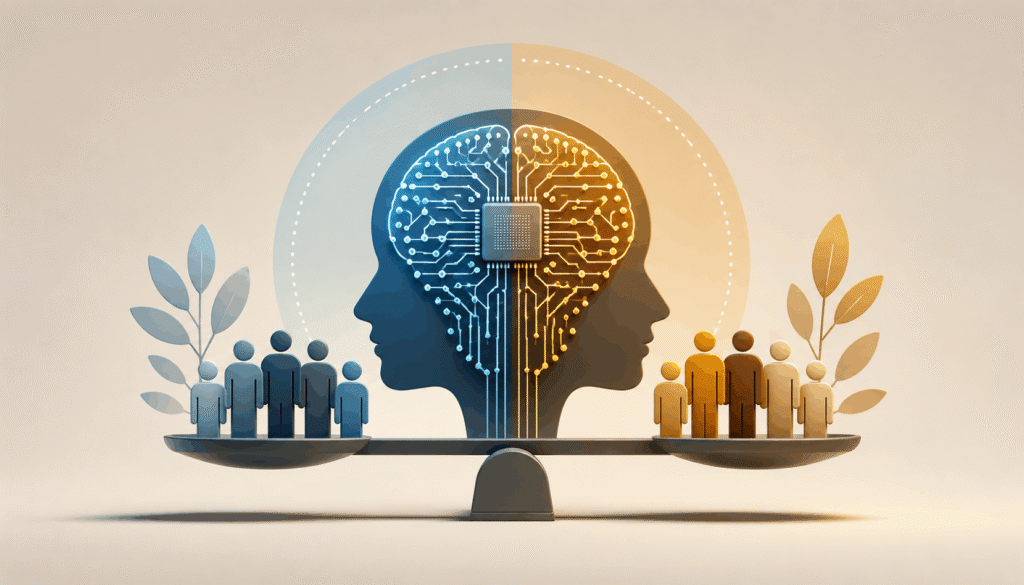
That’s Ai Bias and Fairness in action. Not a robot uprising, not some dystopian sci-fi plot just quiet, invisible decision-making that shapes who gets hired, who gets a loan, who gets flagged by police, and who gets approved for a mortgage. And most of the time, nobody even notices it’s happening until the damage is done.
We like to believe that machines are objective. No emotions, no prejudice, no bad mood on a Monday morning. But here’s the uncomfortable truth: Ai Bias and Fairness systems are built by humans, trained on human-generated data, and deployed in a world shaped by human history including all its inequalities. So when we talk about AI bias, we’re really talking about a mirror. A mirror that reflects our own blind spots back at us, except at scale, and often without accountability.
This article is going to walk through what Ai Bias and Fairness actually is, where it comes from, why it’s so hard to fix, and what ethical AI really requires not the marketing version, but the real one. Whether you’re a business leader deploying AI tools, a developer building them, or just someone who wants to understand how these systems affect your daily life, this is for you.
Table of Contents
- Introduction: The Algorithm That Judged Me Before I Applied
- What Is AI Bias, Really?
- Where Ai Bias and Fairness Actually Comes From
- Real-World Cases That Should Worry Us
- Why Fairness Isn’t as Simple as “Just Fix the Data”
- The Cost of Ignoring Ai Bias and Fairness
- What Ethical AI Actually Looks Like
- How Companies Can Build Fairer Systems
- What Regulators in the US and UK Are Doing
- What You Can Do as a User, Employee, or Citizen
- The Future of Fair AI
- Conclusion: Fairness Isn’t a Feature, It’s a Responsibility
- FAQ: Common Questions About AI Bias
What Is AI Bias and Fairness?
Let’s clear something up first. AI bias isn’t a bug that shows up once in a while and gets patched in the next software update. It’s a structural issue baked into how machine learning systems learn.
At its core, AI bias happens when an algorithm produces results that are systematically prejudiced due to flawed assumptions in the machine learning process. This could mean favoring one demographic group over another, misclassifying certain populations more often, or making decisions that reinforce existing social inequalities.
Here’s the thing people often miss: AI doesn’t “think.” It pattern-matches. It looks at historical data, finds correlations, and repeats them. If your historical data reflects decades of unequal hiring practices, biased lending decisions, or skewed policing patterns, guess what your AI model learns? It learns to replicate exactly that just faster, and at a much larger scale.
There are a few recognized categories worth understanding:
- Historical bias bias that already existed in the world before the algorithm was built, and simply gets absorbed into the training data.
- Representation bias when certain groups are underrepresented or overrepresented in the dataset used to train the model.
- Measurement bias when the data collected doesn’t accurately capture what it’s supposed to measure for all groups equally.
- Aggregation bias when one model is applied to diverse populations without accounting for meaningful differences between them.
- Evaluation bias when the benchmarks used to test a system’s performance don’t reflect the real-world population it will serve.
Each of these forms of AI bias can operate independently or stack on top of one another, which is exactly why fairness in AI is such a layered, complicated problem. It’s rarely one broken line of code. It’s usually a chain of small, reasonable-seeming decisions that add up to something deeply un
Where AI Bias Actually Comes From
People often assume AI bias comes from malicious intent some engineer deliberately coding discrimination into a system. In reality, it’s almost always more mundane, and honestly, more unsettling because of that.
1. Biased Training Data
Machine learning models are only as good as the data they’re trained on. If a facial recognition system is trained mostly on images of light-skinned faces, it will perform worse on darker-skinned faces. This isn’t speculation it’s been documented repeatedly in independent research. The data doesn’t need to be “wrong” to cause Ai Bias and Fairness it just needs to be unrepresentative.
2. Historical Inequality Baked Into the Data
If a bank’s loan approval data reflects decades of redlining or discriminatory lending, an algorithm trained on that data will learn those patterns as “normal” and continue them, even without anyone explicitly telling it to consider race or zip code. The AI bias isn’t invented by the algorithm it’s inherited.
3. Poor Problem Framing
Sometimes the issue isn’t the data at all it’s how the problem was defined in the first place. A now-famous example: a healthcare algorithm used “cost of past care” as a proxy for “how sick a patient is.” Sounds reasonable, right? Except historically, less money was spent on Black patients for the same level of illness due to unequal access to care. So the algorithm concluded Black patients were healthier than they actually were, and gave them lower-priority scores for extra care. That’s Ai Bias and Fairnesshiding in a seemingly neutral proxy variable.
4. Lack of Diverse Teams
When the people building and testing AI systems come from similar backgrounds, they’re more likely to miss blind spots that affect groups they don’t belong to. This isn’t about blame it’s about the simple reality that diverse perspectives catch problems that homogenous teams tend to overlook.
5. Feedback Loops
Some AI systems create their own biased data over time. Predictive policing tools, for example, send more officers to neighborhoods flagged as “high crime.” More officers means more recorded incidents. More recorded incidents “confirms” the algorithm’s prediction, even if the actual crime rate elsewhere was just as high but under-policed. This is a feedback loop, and it’s one of the sneakiest forms of Ai Bias and Fairness because it looks like validation when it’s actually a self-fulfilling prophecy.
Real-World Cases That Should Worry Us
Theory is useful, but nothing drives the point home like real examples. Here are a few cases of AI bias that made headlines and should make anyone deploying AI pause before hitting “launch.”
Hiring AI Algorithms That Penalized Women
A major tech company built an internal resume-screening tool trained on ten years of hiring data. Because the tech industry has historically hired more men, the model learned to associate male-coded language and experiences with success and began downgrading resumes that included the word “women’s,” as in “women’s chess club captain.” The company eventually scrapped the tool. But the underlying lesson stuck: training Ai Bias and Fairness on historical data means training it on historical inequality, unless someone actively intervenes.
Facial Recognition and Racial Disparities
Multiple independent studies, including research from MIT Media Lab, found that commercial facial recognition systems had significantly higher error rates for darker-skinned women compared to lighter-skinned men in some cases, error rates were dozens of times higher. When these systems are used by law enforcement, that gap isn’t just a technical inconvenience. It has real consequences, including wrongful arrests.
Healthcare Algorithms and Underestimated Risk
As mentioned earlier, a widely used healthcare risk-prediction algorithm significantly underestimated the health needs of Black patients because it used healthcare spending as a proxy for illness severity. Researchers estimated this AI bias affected the care prioritization of millions of patients before it was identified and corrected.
Credit Scoring and Loan Decisions
Financial institutions increasingly rely on machine learning to assess creditworthiness. Investigations in both the US and UK have found that algorithmic lending models sometimes charge higher interest rates or reject applicants from historically marginalized communities, even when controlling for income and credit history largely because the models pick up on proxy variables correlated with race or ethnicity, like zip code.
Predictive Policing
Tools designed to forecast where crime is likely to occur have been criticized for reinforcing over-policing in already heavily surveilled communities, creating the feedback loop we talked about earlier. Several US cities have quietly discontinued predictive policing programs after independent audits raised fairness concerns.
These aren’t hypothetical scenarios. They’re documented, studied, and in several cases, led to lawsuits, policy changes, or the outright discontinuation of the tools involved. If there’s one takeaway from this section, it’s this: Ai Bias and Fairness isn’t a future risk. It’s already shaping real decisions, right now, in systems many of us interact with without even realizing it.
Why Fairness Isn’t as Simple as “Just Fix the Data”
Here’s where things get genuinely tricky, and where a lot of well-meaning conversations about AI bias oversimplify the problem.
You’d think the fix is obvious: collect better data, remove the biased variables, and the algorithm becomes fair. Unfortunately, “fairness” isn’t one single, universally agreed-upon concept. It’s actually several competing mathematical definitions, and here’s the kicker research has shown that you often cannot satisfy all of them at the same time.
- Demographic parity says different groups should receive positive outcomes (like loan approvals) at the same rate.
- Equalized odds says the model should have similar true positive and false positive rates across groups.
- Predictive parity says that among people predicted to be a certain outcome, the accuracy should be equal across groups.
Sounds reasonable, right? The problem is that unless the underlying base rates between groups are already identical (which they almost never are in the real world, due to you guessed it historical inequality), you mathematically cannot satisfy all three fairness definitions simultaneously. Improving one often worsens another.
This isn’t a hypothetical technicality. It’s a proven mathematical result, and it means every organization deploying AI has to make a values-based decision about which type of fairness matters most for their specific use case. There is no neutral, apolitical setting on the dial. Choosing to prioritize one fairness metric over another is itself an ethical choice, whether the people making it acknowledge that or not.
This is exactly why Ai Bias and Fairness “ethical AI” can’t just mean “remove bias from the dataset” and call it a day. It requires ongoing judgment, transparency about trade-offs, and honest conversations about who bears the cost when a system inevitably gets something wrong.
The Cost of Ignoring AI Bias
Some organizations treat fairness testing as a nice-to-have, something to address “later” once the product ships. That’s a costly mistake, and not just morally.
Legal risk. Regulators on both sides of the Atlantic are increasingly treating discriminatory AI outcomes the same way they’d treat discriminatory human decisions. A hiring algorithm that disproportionately screens out older applicants or women can trigger the same legal exposure as a human hiring manager doing it deliberately.
Reputational damage. Public trust erodes fast when a company’s AI system is caught discriminating. Headlines about biased algorithms spread quickly, and rebuilding consumer trust afterward is expensive and slow.
Bad business decisions. Beyond ethics, biased models are often just less accurate. A hiring tool that overlooks qualified candidates because of a flawed pattern isn’t just unfair — it’s actively hurting the company’s ability to find good talent.
Real human harm. This is the one that matters most. Behind every statistic about AI bias is a person who didn’t get the loan, the job interview, the medical attention, or the fair trial they deserved. Numbers can make this feel abstract, but the consequences are deeply personal.
Ignoring AI bias doesn’t make it go away. It just means the problem grows quietly until it becomes impossible to ignore — usually in the form of a lawsuit, an investigative news story, or a public relations crisis.
What Ethical AI Actually Looks Like
The phrase “ethical AI” gets thrown around a lot, often as a marketing buzzword rather than a real practice. So let’s define it properly.
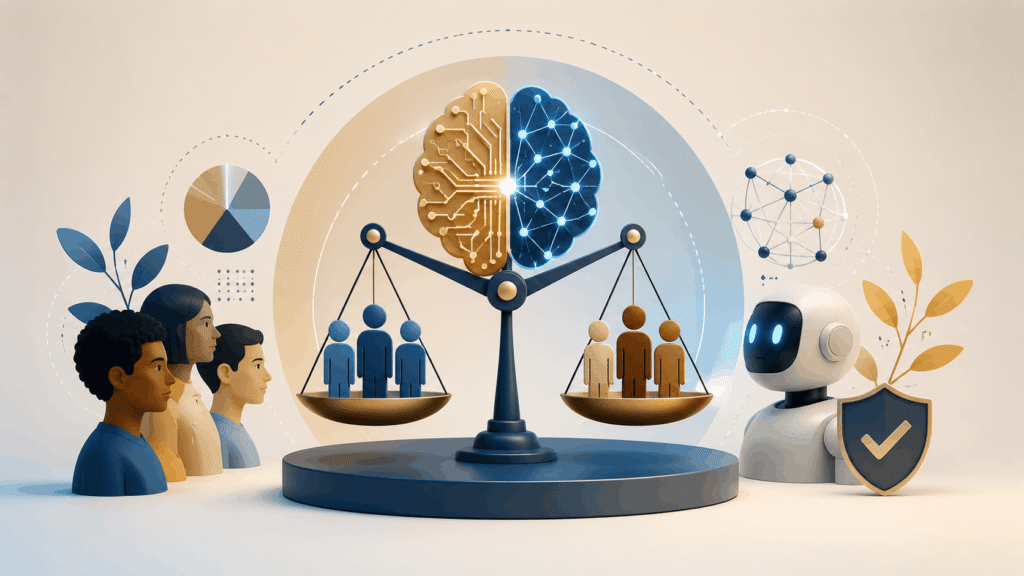
Ethical AI is not a checklist you complete once. It’s an ongoing discipline built around a few core principles:
Transparency. People affected by an AI decision should be able to understand, at least at a high level, how that decision was made. Black-box systems that even their own creators can’t fully explain make accountability nearly impossible.
Accountability. Someone — a person, not just “the AI algorithm” needs to be responsible when an AI system causes harm. Diffusing responsibility across a vague technical process is a way of avoiding accountability, not achieving fairness.
Human oversight. Fully automated decision-making without a human review process, especially in high-stakes areas like hiring, lending, healthcare, or criminal justice, is a recipe for compounding AI bias at scale.
Continuous auditing. Fairness isn’t a one-time certification. Models drift over time as the world changes, and what was fair at launch might not stay fair a year later. Regular bias audits should be built into the AI lifecycle, not treated as an afterthought.
Inclusive design. Bringing diverse voices across race, gender, age, disability, and socioeconomic background into the design and testing process catches blind spots earlier and more cheaply than discovering them after deployment.
Ethical AI, done properly, isn’t about perfection. No system will ever be 100% bias-free, because the humans and data behind it aren’t perfect either. It’s about building processes that actively look for AI bias, correct it when found, and stay honest about the limitations that remain.
How Companies Can Build Fairer Systems
If you’re a business leader, product manager, or developer reading this and wondering “okay, but what do we actually do,” here’s a practical roadmap.
Audit Your Training Data Before You Build
Before a single line of model code gets written, examine your dataset for representation gaps. Who’s missing? Who’s overrepresented? What historical patterns might already be embedded in this data? This step alone catches a huge percentage of AI bias before it ever becomes a production problem.
Define Fairness for Your Specific Context
Since no single mathematical fairness definition works universally, decide as a team, with input from legal, ethics, and affected stakeholders which type of fairness matters most for this particular use case. Document that decision. Revisit it regularly.
Test Across Subgroups, Not Just in Aggregate
A model can look accurate overall while performing terribly for a specific subgroup. Always break down performance metrics by race, gender, age, and other relevant categories, not just in the overall average.
Build in Human Review for High-Stakes Decisions
Automated systems can assist decisions, but for things like hiring, lending, healthcare, and criminal justice, a human should have the final say, along with the ability to override the algorithm when something seems off.
Use Bias Detection Tools
Open-source tools like IBM’s Ai Bias and Fairness 360, Google’s What-If Tool, and Microsoft’s Ai Bias and Fairness exist specifically to help teams measure and mitigate AI bias throughout the development process. There’s no excuse for not using them.
Create Feedback Channels for Affected Users
People impacted by an algorithmic decision should have a clear, accessible way to flag concerns or appeal outcomes. This closes the loop and often surfaces problems the internal team never anticipated.
Keep Auditing After Launch
Bias isn’t a launch-day problem — it’s a lifecycle problem. Schedule regular audits, especially after major data updates or shifts in the population the model serves.
None of this is exotic or unreasonable. It’s simply treating fairness with the same seriousness organizations already treat security, performance, and cost. The tools exist. The frameworks exist. What’s often missing is the organizational will to prioritize it before something goes wrong.
What Regulators in the US and UK Are Doing
Both the United States and the United Kingdom have been ramping up scrutiny of algorithmic decision-making, though their approaches differ.
In the US, there’s no single comprehensive federal AI law yet, but multiple agencies have signaled that existing anti-discrimination laws apply to algorithmic decisions just as they apply to human ones. The Equal Employment Opportunity Commission has issued guidance on AI-driven hiring tools, and several states including Illinois, Colorado, and New York City have passed local laws requiring bias audits for automated employment decision tools. Financial regulators have similarly warned lenders that Ai Bias and Fairness credit models must comply with fair lending laws, regardless of how the discriminatory outcome was produced.
In the UK, the Information Commissioner’s Office and the Equality and Human Rights Commission have both published guidance on algorithmic fairness, and the UK government has taken a more principles-based, sector-specific regulatory approach rather than one sweeping law. The Online Safety Act and ongoing AI governance frameworks continue to evolve, with growing emphasis on transparency and accountability for high-risk AI systems.
Meanwhile, the EU’s AI Act which affects any company doing business with EU citizens, including many US and UK firms classifies certain AI applications (like those used in hiring, credit scoring, and law enforcement) as “high-risk,” requiring stricter bias testing, documentation, and human oversight.
The direction of travel is clear across all these jurisdictions: regulators are no longer willing to accept “the algorithm did it” as an excuse. Organizations deploying AI are expected to understand, monitor, and be accountable for the fairness of their systems, full stop.
What You Can Do as a User, Employee, or Citizen
You don’t need to be a data scientist to push back against AI bias in your own life.
If you’re a job seeker: Ask companies directly whether they use automated screening tools, and whether those tools have been audited for bias. It’s a fair question, and a growing number of jurisdictions now legally require disclosure.
If you’re a consumer: If you’re denied a loan, insurance coverage, or another service by an automated decision, you often have the right to ask for an explanation, and in some regions, the right to request human review. Use it.
If you’re an employee inside a company building AI products: Speak up early if you notice representation gaps in training data or if fairness testing is being treated as optional. It’s far cheaper and far less damaging to catch AI bias before launch than after.
If you’re simply a member of the public: Support policies and organizations pushing for algorithmic transparency and accountability. Public pressure has historically been one of the most effective forces in getting companies to take AI bias seriously.
None of us are powerless here, even if it sometimes feels that way when a decision has already been made by a system you can’t see inside of.
The Future of Fair AI
There’s reason for cautious optimism. Bias detection tools are getting more sophisticated. Regulatory pressure is increasing. Public awareness is higher than it’s ever been, partly because of high-profile failures that made headlines and forced a reckoning.
But there’s also reason for caution. As AI systems get more complex particularly large generative models trained on enormous, messy datasets scraped from across the internet the sources of potential AI bias multiply, not shrink. It’s genuinely harder to audit a model with billions of parameters than a simple decision tree from a decade ago.
The organizations that will come out ahead aren’t the ones that pretend their Ai Bias and Fairness AI is perfectly neutral. They’re the ones that build a culture of ongoing scrutiny, treat fairness as a continuous practice rather than a one-time checkbox, and stay honest with users about the limitations of the systems they deploy. Ethical AI isn’t a destination you arrive at and then stop thinking about. It’s a discipline, much like security or quality control, that requires constant maintenance.
Conclusion: Fairness Isn’t a Feature, It’s a Responsibility
Here’s the honest truth: AI isn’t going anywhere. It’s already deciding who gets interviewed, who gets approved, who gets flagged, and who gets overlooked. The question isn’t whether we should use these systems that ship has sailed. The real question is whether we’re willing to hold them, and ourselves, accountable for getting it right.
Ai Bias and Fairness isn’t an abstract, far-off problem. It’s showing up right now, in resume screeners, in credit models, in healthcare algorithms, in policing tools. And the uncomfortable part is that it often doesn’t look like discrimination at all. It looks like efficiency. It looks like data. It looks neutral, right up until you look closely enough to see whose interests it was quietly built around.
Building genuinely ethical AI means doing the unglamorous work: auditing datasets, testing across subgroups, keeping humans in the loop, and being willing to slow down a launch when something doesn’t sit right. It means accepting that perfect fairness is mathematically impossible, but meaningful, measurable improvement absolutely isn’t.
If you take one thing from this article, let it be this: the next time an algorithm makes a decision that affects you or someone you’re responsible for ask questions. Ask how it works. Ask what data trained it. Ask who’s accountable if it gets something wrong. That single habit, multiplied across enough people, is what pushes Ai Bias and Fairness from an invisible problem into one that organizations can no longer afford to ignore.
FAQ: Common Questions About AI Bias
1. What exactly is AI bias? AI bias refers to systematic and unfair discrimination that occurs when an algorithm produces results that disadvantage certain groups of people, usually due to flawed training data, poor problem framing, or unrepresentative testing.
2. Can AI bias be completely eliminated? Not entirely. Because fairness has multiple, sometimes conflicting mathematical definitions, and because training data reflects an imperfect world, some level of trade-off is inevitable. The goal is continuous reduction and monitoring, not a mythical zero-bias state.
3. Is AI bias intentional? Almost never. Most cases of Ai Bias and Fairness stem from unrepresentative data, historical inequality embedded in past records, or flawed proxy variables, rather than deliberate discrimination by developers.
4. How can companies detect AI bias before launching a product? By auditing training data for representation gaps, testing model performance across demographic subgroups (not just in aggregate), and using established fairness-testing tools before deployment, not after.
5. What industries are most affected by AI bias? Hiring, lending and financial services, healthcare, insurance, criminal justice, and law enforcement are among the highest-risk sectors, largely because decisions in these areas carry serious, life-altering consequences.
6. Are there laws against AI bias in the US and UK? There’s no single comprehensive federal AI law in either country yet, but existing anti-discrimination laws are increasingly being applied to algorithmic decisions, and specific regulations (like state-level AI hiring audit laws in the US and sector guidance in the UK) are expanding rapidly.
7. What’s the difference between AI bias and ethical AI? AI Algorithms describes a problem unfair or discriminatory outcomes produced by an algorithm. Ethical AI describes a set of practices and principles transparency, accountability, human oversight, and continuous auditing designed to prevent and correct that bias.
8. How does AI bias affect everyday consumers? It can influence whether you’re approved for a loan, shown certain job listings, flagged by a fraud detection system, prioritized for medical care, or even how you’re treated by law enforcement algorithms, often without your knowledge that an automated system was involved at all.
9. What can an individual do if they suspect they were affected by AI bias? Request an explanation of the automated decision, ask whether human review is available, and in many jurisdictions, you have a legal right to appeal or contest a fully automated decision that significantly affects you.
10. Will future AI systems be less biased than today’s? Potentially, as detection tools, regulations, and public awareness improve. But as models grow larger and more complex, new and harder-to-detect forms of AI bias are also likely to emerge, meaning ongoing vigilance will always be necessary.
Read About 10 AI Marketing Tools For Small Business